AI Didn’t Kill Computer Science. It Made It More Valuable.
In 2026, one of the most common questions among students and software engineers is:
Should I spend my time mastering Data Structures and Algorithms, or should I focus entirely on AI?
The question appears reasonable.
After all, AI can now generate code, debug applications, explain concepts, build websites, write tests, and even create complete software projects. New developers see AI systems producing thousands of lines of code in seconds and naturally wonder whether learning algorithms still matter.
Many conclude that DSA belongs to the past while AI belongs to the future.
That conclusion is becoming one of the costliest career mistakes in modern software engineering.
The reality is that the DSA versus AI debate is built on a false assumption.
It assumes that computer science fundamentals and AI engineering are competing skills.
They are not.
In fact, the rise of AI is making strong engineering fundamentals more valuable than ever.
The engineers building the next generation of intelligent products are not choosing between DSA and AI. They are combining algorithmic thinking, system design, cloud infrastructure, distributed computing, and AI capabilities into a single skill set.
The future does not belong to developers who only know algorithms.
It also does not belong to developers who only know prompts.
It belongs to engineers who understand how intelligence is built, scaled, optimized, and deployed.
And that requires both.
The Great Skill Shift: How Software Engineering Changed
To understand what developers should learn in 2026, we first need to understand how software engineering itself has evolved.
2010–2020: The Era of Code Production
For more than a decade, software engineering careers were largely defined by one skill:
Writing code.
The best engineers could:
- Build applications faster
- Solve algorithmic problems
- Understand computer science fundamentals
- Deliver features efficiently
Companies hired engineers primarily to convert business requirements into software.
The bottleneck was code production.
If a company needed a feature, humans had to write every line.
Naturally, interview processes emphasized DSA because algorithmic thinking was one of the strongest predictors of programming ability.
2020–2025: The Era of System Design
As software systems became larger and more distributed, another challenge emerged.
Writing code was no longer the hardest problem.
Designing scalable systems became the challenge.
Questions shifted from:
Can you write code?
to
Can you build systems that serve millions of users?
This is why system design interviews became increasingly important.
Engineers needed to understand:
- Distributed systems
- Databases
- Load balancing
- Caching
- Message queues
- Fault tolerance
The industry realized that software success depended not only on algorithms but also on architecture.
2026–2030: The Era of Intelligence Orchestration
Today, we are entering a new phase.
Developers are no longer simply writing software.
They are orchestrating intelligence.
Modern products increasingly include:
- AI copilots
- Conversational interfaces
- Autonomous agents
- Semantic search
- Recommendation engines
- Retrieval systems
- AI-assisted workflows
The engineer’s role is changing.
The most valuable professionals are becoming architects of intelligence rather than producers of code.
Ironically, this transformation is increasing the importance of computer science fundamentals.
Because once AI becomes part of a production system, the problem quickly becomes an engineering problem again.
The Biggest Misunderstanding About AI
Many developers see ChatGPT generating code and assume:
“Algorithms don’t matter anymore.”
This is similar to saying:
“Calculators made mathematics obsolete.”
Calculators did not eliminate mathematics.
They eliminated manual arithmetic.
Likewise, AI is not eliminating engineering.
It is eliminating portions of implementation work.
The underlying problems still exist.
In many cases, they become more important.
Consider a simple AI chatbot.
Most people imagine the architecture looks like this:
User → LLM → Response
In reality, production systems look more like this:

Notice something interesting.
The actual language model is only one component.
Everything else is software engineering.
Everything else depends on computer science fundamentals.
AI Secretly Runs on DSA
This is the part many developers never realize.
AI systems are built on top of algorithms.
The smarter AI becomes, the more important efficient algorithms become.
Let’s examine several examples.
Example 1: Vector Databases
Modern AI applications use vector databases to retrieve information.
When you ask an enterprise chatbot a question, the system typically performs a similarity search among millions of embeddings.
A naive approach would compare your query against every document.
Complexity: O(n)
At a large scale, this becomes expensive.
Instead, modern vector databases use sophisticated indexing structures such as:
- HNSW graphs
- KD trees
- Approximate nearest neighbor search
- Hierarchical graph traversal
These are fundamentally DSA problems.
The AI experience users see depends heavily on algorithmic efficiency underneath.
The intelligence is visible.
The algorithms are invisible.
But both are essential.
Why Elite Engineers Still Study DSA
There is a reason senior engineers at leading technology companies continue studying algorithms even in the AI era.
Algorithms teach something more important than coding.
They teach structured thinking.
When interviewers ask algorithmic questions, they are rarely evaluating whether someone remembers a specific solution.
They are evaluating:
- Problem decomposition
- Logical reasoning
- Optimization mindset
- Tradeoff analysis
- Communication skills
These skills transfer directly into:
- AI engineering
- System design
- Cloud architecture
- Distributed systems
DSA is not valuable because interviews ask it.
Interviews ask it because it develops valuable thinking patterns.
That distinction matters.
Why AI Engineers Need System Design More Than Ever
A surprising trend is emerging across the industry.
As AI models become more powerful, the bottleneck is increasingly shifting away from the model itself and toward the systems surrounding it.
Five years ago, building an AI product meant finding the best model.
Today, multiple organizations can access state-of-the-art models through APIs or open-source alternatives.
The competitive advantage no longer comes solely from the model.
It comes from the engineering around the model.
Consider two teams using the exact same LLM.
Team A creates a slow, expensive, unreliable chatbot.
Team B creates a fast, context-aware, highly reliable assistant.
Same model.
Different engineering.
The difference usually comes from:
- Retrieval architecture
- Data pipelines
- Context management
- Caching strategies
- Latency optimization
- System scalability
This is why system design is becoming one of the most valuable skills in the AI era.
The future AI engineer is not merely someone who understands transformers.
The future AI engineer understands how to build systems around transformers.
The New Software Engineering Stack
For years, developers followed a relatively predictable learning path.
Today, a new layer has emerged.

The critical observation is this:
AI sits on top of traditional engineering.
It does not replace it.
Developers who skip the foundational layers often struggle when building production AI systems.
They can create demos.
They struggle to create products.
And the industry increasingly rewards product builders rather than demo creators.
The 1000-Hour Learning Allocation Framework
One of the most practical questions developers ask is:
If I have the next 1000 hours to invest, where should I spend them?
The answer depends on your target career.
Path 1: FAANG Software Engineer
Recommended Allocation
- DSA: 35%
- System Design: 25%
- Backend Development: 20%
- AI Skills: 20%
Reason:
Large technology companies still heavily evaluate algorithmic thinking and scalable architecture.
AI knowledge helps, but strong fundamentals remain the differentiator.
Path 2: Startup Engineer
Recommended Allocation
- Backend Development: 30%
- AI Engineering: 30%
- System Design: 20%
- DSA: 20%
Reason:
Startups care more about shipping products than solving obscure algorithmic puzzles.
Engineers who can quickly integrate AI into products provide immediate value.
Path 3: AI Engineer
Recommended Allocation
- AI Engineering: 40%
- Backend Systems: 25%
- System Design: 20%
- DSA: 15%
Reason:
Most AI engineering work involves building systems around models rather than creating new models from scratch.
Path 4: Research Engineer
Recommended Allocation
- Machine Learning Theory: 35%
- Mathematics: 25%
- Systems Engineering: 20%
- DSA: 20%
Reason:
Research engineers need a deeper understanding of optimization, training infrastructure, and model architecture.
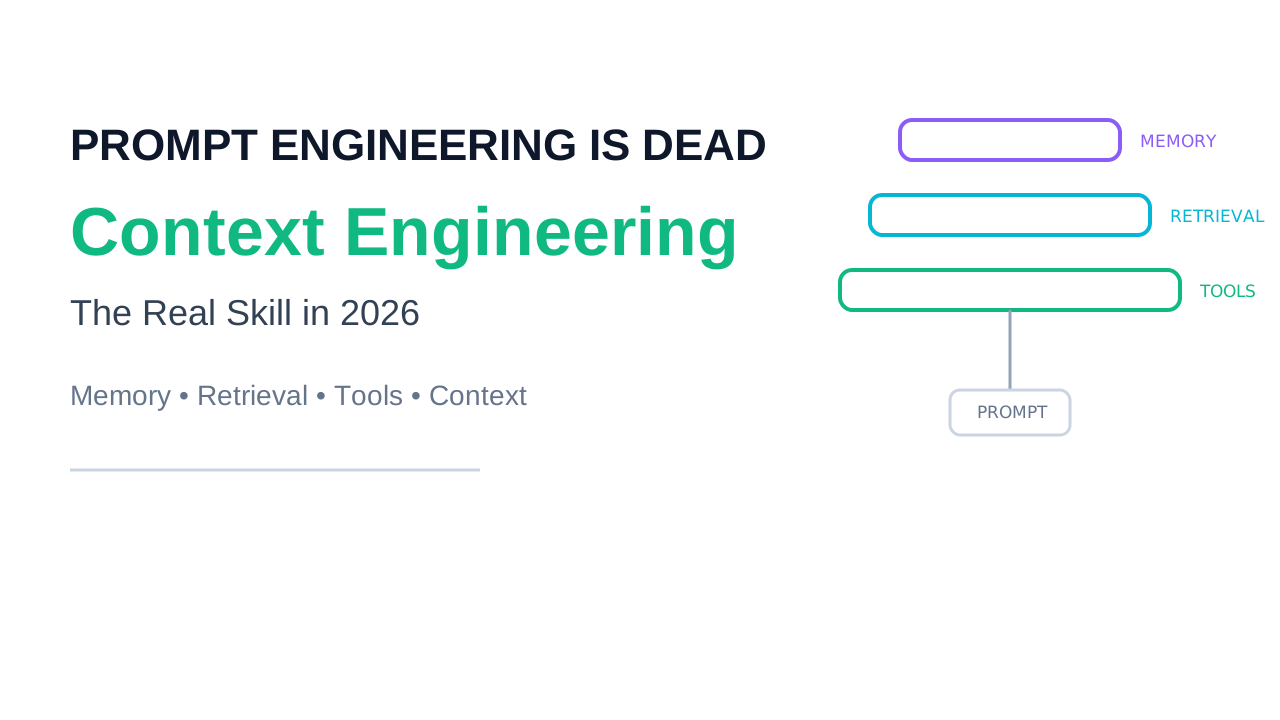
Why Prompt Engineering Alone Is Not a Career
Few topics have generated as much confusion as prompt engineering.
For a period, many people believed prompt engineering would become one of the most valuable careers in technology.
The reality is more complicated.
Prompt engineering is important.
But prompt engineering by itself is becoming increasingly automated.
Modern models are getting better at understanding vague instructions.
Frameworks are becoming better at automatic prompt optimization.
AI agents can increasingly refine prompts without human intervention.
This does not mean prompting is useless.
It means prompting is becoming a component skill rather than a standalone profession.
Think about SQL.
Knowing SQL is valuable.
Building an entire career around writing basic SQL queries is difficult.
Prompting is moving in a similar direction.
The real value lies in combining prompting with:
- Product thinking
- Software engineering
- Domain expertise
- System architecture
Engineers who understand all four become extremely valuable.
What Elite Engineers Are Doing Differently
One of the biggest differences between average developers and elite engineers is where they focus their attention.
Average developers often chase tools.
Elite engineers focus on principles.
Average developer:
- Learns the newest framework
- Learns the newest AI tool
- Learns the newest trend
Elite engineer:
- Learns abstraction
- Learns optimization
- Learns architecture
- Learns systems thinking
This distinction becomes increasingly important during technological shifts.
Tools change.
Principles survive.
Ten years from now:
Today’s AI tools may disappear.
The ability to reason about systems will remain valuable.
The ability to optimize performance will remain valuable.
The ability to solve complex problems will remain valuable.
That is why strong engineers age well in the industry.
Their knowledge compounds rather than expires.
The Rise of the AI-Native Engineer
The software engineer of 2030 will look very different from the software engineer of 2020.
The traditional engineer focused on writing code.
The AI-native engineer focuses on orchestrating outcomes.
Instead of asking:
How do I write this feature?
They ask:
How do I combine models, tools, workflows, and infrastructure to solve this problem?
This shift changes the definition of engineering itself.
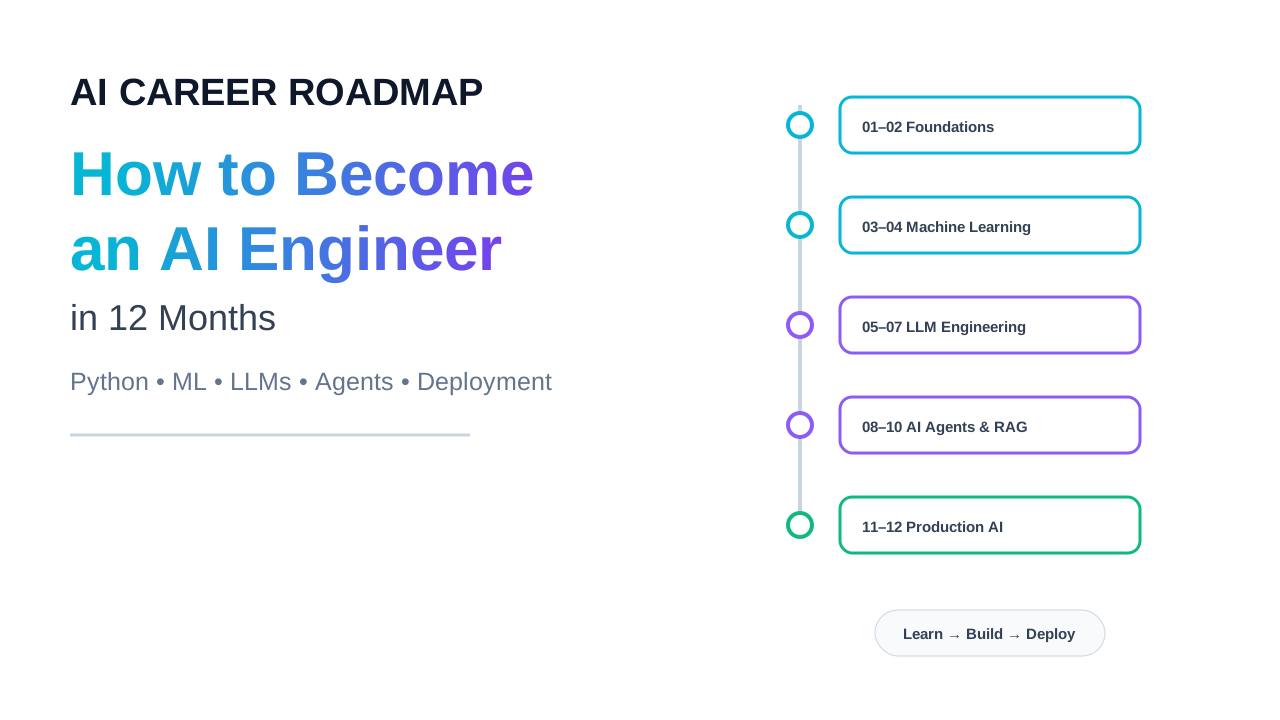
The most valuable professionals will understand three layers simultaneously:
Layer 1: Foundations
- Algorithms
- Data structures
- Operating systems
- Networking
- Databases
Layer 2: Architecture
- Distributed systems
- Cloud infrastructure
- APIs
- Scalability
- Reliability
Layer 3: Intelligence
- LLMs
- RAG
- AI agents
- Vector databases
- Model evaluation
The future belongs to engineers who can operate across all three layers.
Skills That Will Become Commodities by 2030
Every technological revolution makes some skills less valuable.
The AI revolution is no different.
Several areas are likely to become increasingly automated.
Basic CRUD Development
Creating simple applications is becoming dramatically easier.
AI can already generate large portions of boilerplate code.
This does not eliminate developers.
It raises expectations.
Developers will spend less time creating forms and more time designing systems.
Basic Frontend Development
Simple UI implementation is becoming increasingly assisted by AI.
The value is shifting toward:
- Product design
- User experience
- System integration
Rather than pixel-level implementation.
Basic Code Generation
Writing code line-by-line is becoming less important.
Understanding what should be built is becoming more important.
This is a subtle but critical shift.
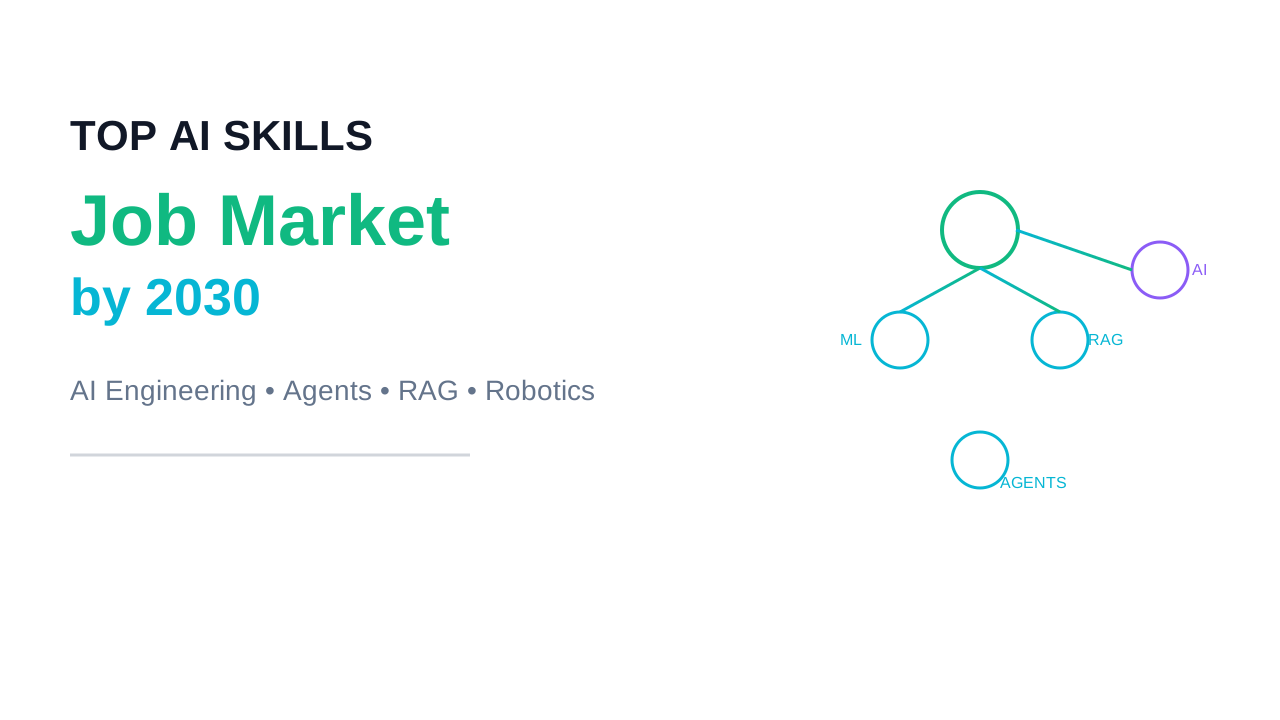
Skills That Will Become More Valuable by 2030
While some tasks become automated, others become significantly more valuable.
Systems Thinking
Organizations increasingly need people who understand how components interact.
AI generates code.
It does not automatically create great architectures.
Optimization
As AI workloads grow, optimization becomes a competitive advantage.
Reducing latency by 100 milliseconds at scale can save millions of dollars.
Distributed Computing
Modern AI applications operate across:
- GPUs
- Databases
- APIs
- Message queues
- Storage systems
Distributed systems expertise will remain highly valuable.
Retrieval Engineering
Many AI failures originate from poor retrieval rather than poor models.
Engineers who understand search, ranking, indexing, and retrieval will become increasingly important.
AI Evaluation
Building AI systems is becoming easier.
Evaluating them correctly remains difficult.
The future will require engineers who can measure:
- Accuracy
- Hallucination rates
- Latency
- Cost efficiency
- Reliability

The Career Advice Most Developers Need to Hear
Many developers are asking the wrong question.
Instead of asking:
Should I learn DSA or AI?
Ask:
What type of engineer do I want to become?
Because different goals require different investments.
If your goal is to pass interviews, DSA deserves significant attention.
If your goal is building AI products, AI engineering deserves significant attention.
If your goal is long-term career resilience, you need both.
Technology trends come and go.
Fundamental thinking skills remain.
The developers who thrive across decades are rarely the ones who chase every trend.
They are the ones who combine timeless principles with emerging technologies.
Final Verdict: The DSA vs AI Debate Is a False Choice
The debate itself is flawed.
It assumes that developers must choose between computer science and artificial intelligence.
The industry is moving in the opposite direction.
Modern AI systems increasingly require:
- Algorithms
- Databases
- Distributed systems
- Search infrastructure
- Optimization techniques
- Software architecture
In other words, they require computer science.
At the same time, modern software products increasingly require:
- LLM integration
- AI workflows
- Intelligent automation
- Semantic search
- Agentic capabilities
In other words, they require AI.
The highest-paid and most impactful engineers of the next decade will not be DSA specialists.
They will not be prompt specialists.
They will be hybrid engineers.
Engineers who can design scalable systems, understand algorithms, leverage AI, evaluate trade-offs, and solve business problems.
The future does not belong to people who choose between DSA and AI.
The future belongs to those who master both and understand how they amplify each other.
That is the real lesson of software engineering in 2026.
And it will likely remain true well into the 2030s.