How Autocomplete Works: The Trie Data Structure Behind Search Suggestions
Phase 1: The Problem — Why a Hash Map Isn’t Enough
Ask most self-taught engineers how they’d implement autocomplete and you’ll get a reasonable-sounding wrong answer almost every time: “store all the search terms in a list, and when the user types something, filter the list for anything that starts with what they typed.” It’s not a crazy instinct — a hash map or a simple list gives you O(1) exact lookups, which feels like the right tool. But autocomplete isn’t an exact-lookup problem. It’s a prefix problem, and that distinction is exactly where the naive approach quietly falls apart.
Here’s the concrete failure. Suppose you have ten million search terms stored in a list, and a user types “engi”. Finding every term that starts with “engi” using a plain list or hash map means scanning through some meaningful fraction of those ten million entries, comparing each one’s first four characters — because a hash map’s entire value proposition is O(1) lookup for an exact key, and it offers you nothing structural to exploit when the question is “give me everything that shares this prefix.” At ten million entries, even a fast scan is far too slow to run on every single keystroke, and autocomplete has to run on every single keystroke, with a response time so fast it feels instantaneous — typically under 50-100 milliseconds end to end, including network round-trip, or the feature feels laggy and broken rather than helpful.
This performance requirement is the whole reason this topic is worth understanding deeply. It’s not just “how do I filter a list of strings” — it’s “how do I organize a huge set of strings so that prefix queries are essentially free, no matter how large the underlying dataset grows.” That reframing is the entire motivation for the data structure this article is about: a trie (pronounced “try,” from retrieval), sometimes called a prefix tree.
The historical context matters here too. Tries predate modern search engines by decades — they were originally developed for tasks like efficient dictionary lookups and IP routing table lookups, where “does this string/address share a prefix with something I know about” is the fundamental operation, not an afterthought. Autocomplete is, in a very real sense, one of the more visible modern applications of a genuinely old idea, repurposed because the underlying problem — fast prefix matching over a huge set of strings — never went away, it just found a new, extremely high-visibility home in every search bar on the internet.
Phase 2: The Mental Model — A Tree Where the Path Is the Word
The cleanest way to build intuition for a trie is to stop thinking of it as storing words and start thinking of it as storing paths through letters.
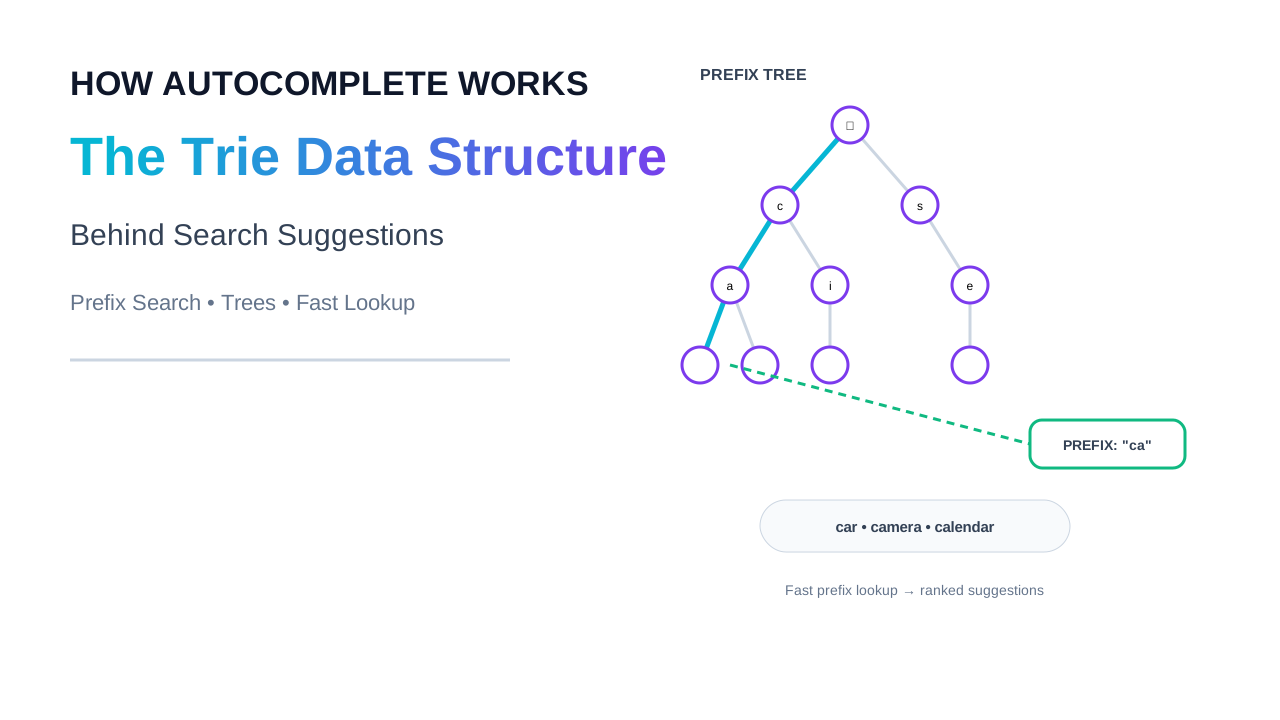
In a trie, each node represents a single character, and a path from the root down through a sequence of nodes spells out a prefix — and if a node along that path is specially marked as “end of word,” the path from the root to that node spells out a complete, stored word. Critically, multiple words that share a common beginning share the same nodes for that shared portion. The words “engine,” “engineer,” and “engineering” don’t get stored as three separate strings sitting side by side — they share the exact same path of nodes for “e-n-g-i-n-e,” and then the tree branches only at the point where the words actually start to differ.
This sharing is the entire reason the data structure is powerful, and it’s worth sitting with why. It means the cost of looking up a prefix has nothing to do with how many words share that prefix, and almost nothing to do with how many total words are in the entire dictionary — it only depends on the length of the prefix itself. Looking up “engi” takes exactly four steps down the tree — one per character — regardless of whether “engi” is the prefix of three words or three million. Compare that to the list-scanning approach from Phase 1, where the cost scales with the size of the entire dataset, and the appeal becomes obvious: a trie turns “search through everything” into “walk a fixed number of steps equal to what the user already typed.”
A useful physical analogy is a hotel with numbered hallways branching off numbered hallways — to find room 4-2-7, you don’t search every room in the hotel; you walk down hallway 4, then take the second branch off that hallway, then find room 7 on that branch. The “search” is really just following a predetermined path, and that path length depends only on the room number’s own length, not on how many other rooms exist in the entire hotel. A trie gives you exactly that property for strings: the “path” is the prefix itself, and walking it is all you ever need to do to find everything that shares it.
Once a prefix has been walked to its corresponding node, every complete word “stored below” that node in the tree — every path continuing downward from it that eventually hits an “end of word” marker — is, by construction, a word that starts with that prefix. This is the second half of the trick: the walk down finds where the prefix lives in the structure, and then a small traversal of the subtree below that point collects every valid completion, without ever having to look at a single word elsewhere in the tree that doesn’t share the prefix.
Phase 3: Internal Working Deep Dive — From Keystroke to Suggestion List
3.1 Building the Trie
Each node in a trie typically holds two things: a collection of child nodes, one per possible next character (commonly implemented as a small map or fixed-size array keyed by character), and a flag marking whether a complete word ends at this node.
Inserting a word like “cat” starts at the root and walks character by character: check if a child node for ‘c’ exists off the root — if not, create one — then move into it; check if a child for ‘a’ exists off that node — if not, create it — move into it; same for ‘t’; and finally mark that final node as “end of word.” Inserting “car” afterward reuses the exact same ‘c’ and ‘a’ nodes already created for “cat” — because they’re genuinely the same prefix — and only creates a new branch at the point where the words diverge, adding a new child ‘r’ off the shared ‘a’ node.
This incremental sharing is why memory usage in a trie, while higher per-node than a flat list (each node needs pointers to potential children), scales far better than storing every word as an independent string once the dataset has significant prefix overlap — and real-world search term datasets have enormous prefix overlap, since common words and common query beginnings repeat constantly across millions of distinct full queries.
3.2 Answering a Prefix Query
When a user types “ca” into a search box, the system walks the trie exactly two steps: follow the ‘c’ child from the root, then the ‘a’ child from there. If at any point along this walk a required character has no corresponding child node, the answer is immediate and definitive — no word in the entire dataset starts with this prefix, full stop, with no need to check anything else.
If the walk succeeds and lands on a valid node, that node represents the “ca” prefix, and now a traversal (typically depth-first) explores everything below it, collecting every “end of word” marker it finds along the way, reconstructing each complete word by remembering the path of characters taken to reach it. This subtree traversal is where “cat,” “car,” “cats,” and “carpet” (if all four were inserted) would all be discovered, purely as a byproduct of walking downward from the node the initial two-step prefix walk landed on.
3.3 The Ranking Problem — Why “Every Match” Isn’t the Answer
Here’s where a naive trie implementation, correct as far as it goes, produces a genuinely bad product. A popular prefix like “how to” might have millions of stored completions in a real search engine’s dataset — collecting literally all of them and dumping them on the user is useless; nobody wants to scroll a million-item dropdown. Production autocomplete systems need to return only the top handful — typically five to ten — ranked by relevance, not just existence.
This is solved by storing more than a boolean “end of word” flag at each node — real systems attach a popularity or frequency score (how often this exact query has actually been searched, often combined with recency, since query popularity shifts over time) and use that score to prioritize which completions to surface. A common and important optimization here is to precompute and cache the top-k completions at every node, rather than recomputing a fresh top-k ranking on every single keystroke by traversing the entire subtree from scratch. Since the trie’s structure doesn’t change on every query — only occasionally, as new search data comes in — it’s far cheaper to do this ranking work once, ahead of time, during a periodic rebuild or update pass, and simply read the precomputed top-k list instantly at query time. This shifts expensive computation out of the hot path (every keystroke, needing sub-100ms response) and into a cold path (periodic background updates, where taking a few seconds or minutes is completely fine).
3.4 The Typo Problem — Why Exact Prefix Matching Isn’t Enough Either
A pure trie handles exact prefixes beautifully and handles typos not at all. A user typing “enigneer” (a transposed ‘i’ and ‘g’) gets nothing useful from a strict trie walk, because the very first mismatched character (position 3: ‘i’ where ‘g’ was inserted) causes the walk to fail immediately, even though a human would recognize the obvious intent instantly.
Real systems handle this with a layered approach rather than abandoning the trie. One common technique is maintaining a small edit-distance tolerance during the trie walk — rather than requiring an exact character match at each step, allow the walk to also explore paths that represent one character being substituted, inserted, or deleted, up to a small budget (typically one or two total edits), effectively exploring a bounded set of “nearby” trie paths in addition to the exact one. This is meaningfully more expensive than an exact walk, which is precisely why it’s usually only invoked as a fallback — first attempt the fast, exact prefix walk from 3.2, and only fall back to the more expensive fuzzy walk if the exact walk returns too few results to be useful, which keeps the common case (correctly-typed prefixes) as fast as the basic trie design allows while still gracefully handling the less common case of typos.
3.5 Personalization — The Same Prefix, Different Answers for Different People
The final layer of sophistication in real systems is that “ca” typed by a chef and “ca” typed by a software engineer arguably shouldn’t return identical top suggestions. Production autocomplete typically blends the global, precomputed top-k completions from 3.3 with a lightweight personalization signal — the user’s own recent search history, or broader behavioral signals tied to their account — re-ranking or injecting personalized candidates into the otherwise-generic result set. This has to be done carefully and cheaply, because personalization lookups add latency on top of an already tight time budget, so it’s typically implemented as a fast, separate lookup (the user’s own recent queries matching the prefix, which is a tiny, per-user dataset) merged with the precomputed global results, rather than personalizing the entire ranking computation from scratch on every keystroke.
Phase 4: Engineering Implementation — A Trie With Ranked Completions
The following reflects the real shape of the design decisions from Phase 3, with the reasoning made explicit.
class TrieNode:
    def __init__(self):
        self.children = {}
        self.is_end_of_word = False
        # Precomputed top completions below this node, kept sorted
        # by score — this is what avoids re-scanning the whole
        # subtree on every keystroke (see 3.3).
        self.top_completions = []  # list of (word, score), max length k


class Trie:
    def __init__(self, top_k=5):
        self.root = TrieNode()
        self.top_k = top_k

    def insert(self, word, score):
        node = self.root
        # Update precomputed rankings at every node along the
        # insertion path, not just the final node — every prefix
        # of this word needs to know this completion exists.
        self._update_top_completions(node, word, score)

        for char in word:
            if char not in node.children:
                node.children[char] = TrieNode()
            node = node.children[char]
            self._update_top_completions(node, word, score)

        node.is_end_of_word = True

    def _update_top_completions(self, node, word, score):
        # Keep only the top_k highest-scored completions per node.
        # This bounds memory per node and makes lookup O(1) instead
        # of O(completions below this node).
        node.top_completions.append((word, score))
        node.top_completions.sort(key=lambda x: -x[1])
        node.top_completions = node.top_completions[:self.top_k]

    def get_suggestions(self, prefix):
        node = self.root
        for char in prefix:
            if char not in node.children:
                # No word in the dataset starts with this prefix —
                # fail fast rather than searching further.
                return []
            node = node.children[char]

        # No subtree traversal needed at query time — the ranking
        # work already happened during insert/rebuild.
        return [word for word, score in node.top_completions]
The most common production mistake with this design isn’t in the trie logic itself — it’s updating top_completions synchronously on every single write in a high-traffic system, which turns every incoming search-log event into an expensive re-sort operation cascading up every prefix-length node of that word. Real systems instead batch these updates: log raw query events continuously, and periodically (every few minutes, not every event) rebuild or incrementally update the precomputed rankings in a background process, accepting that the “trending right now” signal has a small, deliberate lag rather than paying a heavy synchronous cost on the write path for every single search.
Phase 5: Real-World Systems — How This Plays Out at Scale
Google Search’s autocomplete operates at a scale where a single logical trie, even a well-optimized one, cannot live on one machine — the underlying suggestion data is sharded across many servers, and a query typically needs to be routed to and merged from multiple shards, which introduces a genuinely hard distributed-systems problem on top of the trie itself: how do you get sub-100ms responses when the answer might require fanning a query out to several machines and merging their partial results before the user sees anything? The answer generally involves aggressive caching of extremely common prefixes (so the most frequent queries never need to touch the sharded backend at all) and careful engineering to keep the number of backend round-trips per keystroke to an absolute minimum.
Amazon’s product search autocomplete is a useful contrast because the ranking signal is fundamentally different from general web search — rather than ranking by raw query popularity alone, it has to weight heavily toward commercial intent and conversion likelihood, since a suggestion that’s popular to type but rarely leads to a purchase is less valuable to surface than one that reliably leads somewhere revenue-generating. This is a direct, practical illustration of Phase 3.3’s point that the scoring function attached to each trie node isn’t a fixed, universal thing — it’s a business-specific design decision layered on top of the same underlying structure.
IDEs like VS Code and JetBrains products use trie-like structures for a very different but structurally identical problem: code autocomplete, where the “dictionary” being searched is the set of valid identifiers, function names, and keywords in scope at the cursor’s current position. The core mechanics — prefix walk, then collect and rank completions below that point — are the same ideas from Phase 3, but the ranking signal shifts again, this time weighting toward relevance based on type context, how recently a symbol was used, and how often it appears in the surrounding code, rather than global popularity.
Command-line shells (bash, zsh) and their tab-completion are perhaps the most stripped-down real-world trie application — usually operating over a much smaller dataset (file names in the current directory, or installed command names) where the sheer performance advantage of a trie over a naive scan matters less at that scale, but the underlying algorithmic shape — walk the typed prefix, then explore and present what’s below that point in the structure — is identical to every other example in this section, which is a good illustration of how the same data structure shows up at wildly different scales without changing its fundamental logic.
Phase 6: AI-Era Relevance — Tries, Tokenization, and the Limits of Prefix Matching
It’s worth being honest about something before connecting this to AI: modern semantic search and LLM-powered “search suggestions” increasingly use embedding-based retrieval (the same conceptual approach covered in retrieval-augmented generation systems) rather than pure prefix matching, precisely because embeddings can suggest conceptually related queries a user hasn’t started typing the right prefix for at all — a trie fundamentally cannot suggest “vegetarian dinner ideas” in response to someone typing “meatless,” because there’s no shared character prefix to walk, no matter how semantically close the two phrases are.
That said, tries remain directly relevant to AI systems in a few concrete, underappreciated ways. Tokenizers themselves are frequently implemented using trie-like structures. When a tokenizer needs to greedily match the longest known subword or token against an incoming stream of text — a core operation in byte-pair encoding and similar schemes used by virtually every modern language model — that longest-match problem is structurally identical to the prefix-walk problem this entire article has been describing, just applied to a vocabulary of tokens instead of a vocabulary of search queries. Efficient tokenization at the throughput modern LLM serving infrastructure requires genuinely benefits from exactly the same prefix-tree thinking covered in Phase 3.
Constrained decoding — a technique increasingly used to force a language model’s output to conform to a specific grammar or schema, such as guaranteeing valid JSON output — also leans on trie-like structures under the hood. At each generation step, the system needs to quickly determine which of the model’s possible next tokens would keep the output on a path toward a valid, grammar-conforming string; representing the space of valid continuations as a trie-like structure makes that “which next steps are still legal” check fast enough to run at every single token generated, which is essential given how many tokens a typical response involves.
And practically, hybrid systems are increasingly common rather than a strict either/or between tries and embeddings: a production search bar might use a trie for genuinely fast, cheap, exact-prefix matching as the first-pass candidate source (Phase 3.2), then blend in a smaller number of semantically-retrieved suggestions from an embedding-based system for cases where the trie alone would come up empty or where a genuinely different phrasing is a better suggestion than a literal continuation — combining the raw speed advantage of exact prefix structures with the conceptual flexibility that only a semantic system can provide.
Phase 7: Advantages, Limitations, and Honest Trade-offs
Advantage — query time is essentially independent of dataset size. A trie’s prefix lookup cost scales with the length of the typed prefix, not the number of stored words — this is the property that makes autocomplete viable at all at internet scale, and it’s worth being precise about why: a hash-map-based or naive-scan approach would see lookup cost grow with the dataset, which is exactly the wrong direction for a feature that needs to stay fast as the underlying dataset (search history, product catalog, code symbols) only ever grows over time.
Limitation — memory overhead per stored word is genuinely higher than a flat list, especially for datasets with little shared prefix structure. If most words in a dataset share very few common prefixes (imagine a set of essentially-random unique identifiers rather than natural-language phrases), a trie provides little of the sharing advantage described in Phase 3.1 while still paying the per-node pointer overhead — meaning a trie is the right choice specifically because of the prefix-overlap-heavy nature of real search-query and language data, not as a universally superior string-storage structure.
Trade-off — the precomputed top-k ranking approach from Phase 3.3 trades freshness for speed, deliberately. A newly viral query won’t appear in a node’s precomputed top completions until the next rebuild cycle runs, meaning there’s an inherent, accepted lag between “this query started trending” and “this query shows up in autocomplete for others.” Systems handling genuinely time-sensitive trending content (breaking news search, for instance) have to explicitly engineer a separate, faster-updating path for detecting and surfacing sudden spikes, layered on top of the steadier precomputed baseline, rather than trying to make the whole system update in real time.
Limitation — pure tries have no native understanding of meaning, only characters, which is precisely the gap Phase 6 discussed: a trie will never suggest a synonym, a related concept, or a semantically close alternative unless that alternative happens to share a literal character prefix with what was typed. This isn’t a bug to be fixed within the trie itself — it’s a fundamental boundary of what prefix-matching can do, which is exactly why production systems increasingly treat tries as one fast, cheap layer in a larger hybrid retrieval pipeline rather than the entire solution.
Phase 8: Career Impact — Why This Keeps Showing Up in Interviews
Tries are a perennial data-structures interview topic, and it’s worth understanding precisely why interviewers reach for it so often: it’s one of the cleanest examples of a data structure whose entire design is a direct, traceable response to a specific performance requirement (fast prefix queries at scale), rather than a generic “know this structure” memorization exercise. A strong candidate doesn’t just implement insert and search correctly — they can explain, unprompted, why a hash map falls short for prefix queries specifically, why precomputing top-k completions per node matters once ranking enters the picture, and how the design would need to change under real production constraints like sharding, personalization, or fuzzy matching. That’s the actual signal these questions are trying to surface, and it maps directly onto the phase structure of this entire article.
Beyond interviews, trie-adjacent thinking shows up constantly in systems work that has nothing to do with search bars: IP routing tables (matching an incoming packet’s address against the longest matching prefix in a routing table is structurally the same problem), spell-checkers and predictive text on mobile keyboards, DNS resolution, and, as covered in Phase 6, tokenization and constrained decoding inside modern AI infrastructure. Recognizing “this is fundamentally a prefix-matching problem” is a transferable skill that shows up in far more places than the phrase “autocomplete” would suggest.
What to learn next, if this area is interesting: implement a trie with fuzzy (edit-distance-tolerant) search from scratch, since it forces you to actually reason about the branching-and-backtracking logic described in Phase 3.4 rather than just the clean exact-match case; and separately, look at how a real tokenizer (such as a byte-pair encoding implementation) handles longest-match token lookup, since it’s a direct, practical instance of exactly the structure covered here, hiding inside infrastructure most engineers never think to connect back to “that autocomplete data structure.”
Phase 9: Final Thought — A Tree Shaped Like the Question You’re Asking
The deepest idea in this entire article isn’t really about tries specifically — it’s about a general engineering instinct: when a problem has a structural shape (here, “many strings that share prefixes, queried by prefix”), the right data structure is one whose own shape mirrors that structure directly, rather than one that’s merely convenient or familiar. A hash map is a perfectly good structure — for exact-match lookups. It’s the wrong tool here not because it’s a bad data structure in general, but because its shape doesn’t match the shape of the actual question being asked millions of times a second in a search bar: not “does this exact string exist,” but “what comes next.”
That’s ultimately what a trie is: a tree literally shaped like the space of possible prefixes, so that answering a prefix question becomes nothing more than walking a path that was already, in effect, drawn in advance. It’s a small, elegant piece of engineering sitting behind one of the most-used features on the internet — and understanding it well is a genuinely good rehearsal for a habit worth carrying into every other system you build: before reaching for the data structure you already know, ask what shape the question itself actually has, and let that shape suggest the answer.