The Floor Has Been Raised, Not Removed
There’s a particular kind of career anxiety spreading through engineering right now — the feeling that the thing you spent years learning is being automated away from underneath you, and that if you don’t pivot fast and pivot right, you’ll wake up professionally irrelevant. It’s not entirely irrational. Code generation tools are genuinely writing a substantial portion of production code at leading tech companies. Models are passing advanced reasoning benchmarks. The pace of capability increase is genuinely unprecedented.
But here’s the thing, the anxiety tends to skip over: every time a technological revolution raises the floor for what machines can do, it simultaneously raises the ceiling for what expert humans are valued to do. The spreadsheet didn’t eliminate accountants; it eliminated arithmetic-only accountants and created enormous demand for accountants who could model businesses. The compiler didn’t eliminate programmers; it eliminated assembly-only programmers and created a vast demand for engineers who could think in abstractions. AI coding tools are already following the same pattern: they’re eliminating copy-paste-from-Stack-Overflow programmers and creating urgent demand for engineers who can design systems, evaluate outputs, build infrastructure, manage reliability, and handle the genuinely hard problems that AI cannot yet approach on its own.
The question is not “will there be engineering jobs in 2030?” There will be more of them, at higher compensation, than there are today. The question is which skills will be on the high-demand, well-compensated side of that divide versus the automated, commoditized side — and that question deserves a more honest, more specific, and more deeply technical answer than the usual LinkedIn listicle provides.
This article gives you that answer. Not a surface-level list of buzzwords, but a serious examination of six skill domains — AI Engineering, MLOps, Agentic AI, AI Security, Data Engineering, and Context Engineering — with an honest account of why each one exists, what mastery actually looks like, where the demand is coming from, and how each one is changing under the weight of the AI revolution itself.
Phase 1: The Problem — Why the Skills Map Is Being Redrawn Right Now
The Great Skill Bifurcation
Something structurally important is happening to the value distribution of software engineering skills, and it’s worth naming precisely before looking at individual disciplines.
AI tools are compressing the value of task execution — the ability to translate a clearly defined requirement into working code — toward zero, because machines can now do task execution reasonably well given a clear enough spec. But they are simultaneously amplifying the value of judgment at the boundaries: deciding what to build, evaluating whether AI-generated output is correct, debugging failures in complex AI-infused systems, designing architectures that remain reliable and secure when AI components are embedded in them, and managing the infrastructure that keeps AI systems running in production at scale.
This creates a bifurcation: skills primarily about task execution (writing boilerplate, implementing well-known algorithms, translating specs into code) are depreciating. Skills primarily about judgment, infrastructure, reliability, and system design are appreciating rapidly, because AI amplifies the output of engineers who have those skills without coming close to replacing them.
The six skill domains in this article all sit firmly on the appreciating side of that divide. They are not primarily about task execution. They’re about judgment, system design, reliability engineering, security, and the infrastructure that makes AI products possible. This is not coincidental — it’s the selection criterion that makes them worth building.
The Demand Data Tells a Clear Story
Job postings for AI-related engineering roles have grown faster than any other engineering category in the last two years. But the roles growing fastest aren’t “AI chatbot developer” or “prompt engineer” — they’re roles with titles like AI Infrastructure Engineer, ML Platform Engineer, AI Security Engineer, Agent Systems Engineer, and Data Platform Engineer. These are infrastructure and systems roles, not product feature roles. They are being created by organizations that have gotten past the “we should build something with AI” stage and arrived at “how do we make this reliable, secure, observable, and maintainable at scale.” That operational maturity phase is where the real, durable engineering demand concentrates — and that’s where this article spends its time.
Why the Skills in This Article Compound Over Time
One more framing point before the depth: not all skills compound equally. Some skills are primarily current — valuable because of the current state of tooling, gradually replaced as tooling improves. Some skills are primarily durable — grounded in mathematical, systems, or engineering principles that remain relevant across generations of tooling change.
The skills in this article were selected because they compound: each year of genuine expertise in these domains makes you more valuable, not less, as AI advances. An MLOps engineer who deeply understands distributed training, model versioning, and deployment reliability will find that AI advances create more surface area for their expertise to apply, not less. An AI Security engineer who understands adversarial robustness, prompt injection, and model supply chain risk will find that every new AI capability creates new attack surface for their skills to address. Compound skills are the right investment horizon for a 2030 target — and compounding only works if you start now.
Phase 2: The Mental Model — How to Think About Skill Value in the AI Era
The Three-Layer Skill Hierarchy
Before evaluating any individual skill, it helps to have a classification framework for thinking about how skill value responds to AI advancement. Skills in the AI era fall into three layers.
Layer 1: Tool skills. Using existing AI products effectively — knowing the right prompts, knowing which model to use for which task, and navigating the interfaces of current AI products. These have real but temporary and shallow value. They depreciate as tooling improves (today’s clever prompt is tomorrow’s built-in feature), and they don’t compound because there’s no deep underlying principle to build on.
Layer 2: Application skills. Building applications that use AI — integrating LLM APIs, building RAG pipelines, wiring together agent frameworks. These are genuinely valuable and in high demand right now. They have moderate durability: the specific frameworks change frequently, but the engineering judgment about how to design reliable AI-infused systems transfers across framework generations. A solid Layer 2 skill base is a strong place to be in 2026.
Layer 3: Infrastructure skills. Building and operating the systems that make AI possible and reliable at scale — the training infrastructure, the deployment platforms, the observability systems, the security frameworks, the data pipelines. These are the highest durability skills, the most underserved by current education, and the most resistant to AI automation, because they require the kind of deep systems-level judgment and operational expertise that AI cannot replicate. They are also, correspondingly, the highest compensated.
The six skills in this article span Layer 2 and Layer 3. Layer 1 skills are not in this article because they don’t warrant a 2030 investment thesis.
The Principle of AI Gravity
Here’s a useful mental model for predicting which adjacent skills will appreciate as AI advances: skills that become more necessary because of AI advances, rather than more replaceable, are the high-value plays. Think of it as AI gravity — as AI capabilities expand, certain skills get pulled into higher demand by that expansion rather than pushed out of it.
AI Security is a perfect example. Every new AI capability creates a new attack surface. The more capable and widely deployed AI systems become, the more consequential a security failure is, and the more specialized expertise is needed to identify and mitigate those failures. AI advances don’t reduce the need for AI Security expertise; they generate more of it. This is positive AI gravity — the skill gets heavier, more valuable, and harder to substitute as AI advances.
Contrast this with basic data annotation work, which has strongly negative AI gravity: as AI advances, the quality of AI-generated annotations improves, automated active learning reduces annotation requirements, and the human labor of hand-labeling examples becomes less necessary. This doesn’t mean annotators disappear immediately, but it does mean the skill doesn’t compound.
Use AI gravity as a filter for any skill you’re considering investing in: does AI advance make this skill more necessary, less necessary, or orthogonal? The skills in this article all have strongly positive AI gravity.
Phase 3: The Deep Dive — Six Skills That Will Define the AI-Era Engineer
Skill 1: AI Engineering — The Discipline the Industry Invented to Describe Itself
“AI Engineer” is a job title that barely existed in 2022 and is now one of the most in-demand roles in the industry. What does it actually require, beyond the ability to call an API?
At its core, AI Engineering is the practice of building reliable, production-grade software systems that incorporate large language models, multimodal models, and AI agents as components — not just one-off scripts or demos, but systems with real users, real consequences, and real reliability requirements. This requires a specific combination of capabilities that software engineering, data science, and traditional machine learning engineering each provide partially, but none provides completely.
The genuine AI Engineer needs to understand the failure modes of AI components in a way that distinguishes this from general software engineering. A database query either returns results or throws an exception; its behavior is deterministic. An LLM call returns something on a probabilistic distribution — it might be excellent, it might be subtly wrong, it might confidently hallucinate. An AI engineer must design systems that are reliable despite the non-determinism of their AI components: using evals to measure output quality, building fallback paths for low-confidence outputs, structuring prompts and context for consistency, monitoring output quality as a production metric, and iterating on system design based on empirical quality data rather than intuition.
The AI Engineer also needs to understand the economics of AI systems in a way that product engineers don’t typically need to: token cost per response, latency trade-offs between model size and quality, caching strategies for reducing inference costs, tiered model selection (using a cheaper model for simple classification steps and a more capable model only for the complex reasoning steps). These aren’t details — at production scale, a poorly optimized inference pipeline is the difference between a profitable product and a cost sink.
The specific technical knowledge required includes: RAG pipeline design (covered in depth in our RAG article), prompt and context engineering (covered in our context engineering article), evaluation methodology for LLM outputs, LLM API integration patterns, basic understanding of fine-tuning and when it’s appropriate versus RAG, and agent/tool-use architecture. These are all Layer 2 skills on the path toward the deeper infrastructure expertise that separates senior AI engineers from junior ones.
The 2030 trajectory. AI Engineering as a distinct role will consolidate rather than disappear by 2030. As AI becomes embedded in more products, the demand for engineers who can build, maintain, and improve those embedded systems will grow — and the bar for what “maintaining” means (monitoring quality drift, managing model upgrades, running evals, debugging reasoning failures) will rise.
Skill 2: MLOps — The Reliability Engineering of AI Systems
MLOps — Machine Learning Operations — is often dismissed by engineers coming from traditional software backgrounds as “DevOps with extra steps.” It is not. It is a genuinely distinct engineering discipline addressing a class of reliability and reproducibility challenges that traditional software deployment practices were simply not designed to handle.
A deployed ML model is not like a deployed software service in one crucial respect: its behavior can degrade without any code change. A software service behaves differently when you change the code; it behaves the same when the data changes. An ML model can start performing worse the moment the real-world data it receives begins to drift away from the distribution it was trained on — and this drift is continuous, invisible without monitoring, and not recoverable by rolling back a deployment. This property, called data drift or concept drift, is what makes ML operations fundamentally different from software operations. There is no git revert for a degrading model; there is only a monitoring alert, a retraining pipeline, and a new deployment, if you built those systems. If you didn’t, you would find out about the degradation from customer complaints.
What an MLOps engineer actually builds and maintains: experiment tracking systems (so that the experiments that produced a given deployed model are fully reproducible), feature stores (so that the features used for training and the features computed at inference time are guaranteed to be identical — training/serving skew is one of the most common sources of model degradation, and it’s entirely preventable with proper feature management), model registries (versioned repositories of trained model artifacts with associated metadata — lineage, performance benchmarks, compliance documentation), CI/CD pipelines for model retraining and evaluation, and monitoring systems that track model performance metrics (accuracy, drift, latency, cost) in production with alerts for degradation.
The AI infrastructure layer has shifted dramatically toward serving LLMs rather than training small custom models. Modern MLOps increasingly includes: managing LLM deployment infrastructure (GPU cluster orchestration, quantization, and serving optimization), managing prompt version control as rigorously as code, running automated LLM evaluation pipelines as part of a CI process, and tracking cost and latency per model per endpoint as first-class production metrics. The tools have evolved — Weights & Biases, MLflow, Vertex AI, SageMaker, Ray Serve, vLLM — but the underlying engineering principles (reproducibility, observability, continuous evaluation, versioned artifacts) remain constant. That constant is what makes MLOps a high-durability skill.
The 2030 trajectory. Every organization that ships AI products needs MLOps infrastructure. Most currently have it poorly or not at all. By 2030, the organizations that haven’t built proper ML infrastructure will have experienced enough silent model degradation incidents to fix that, and the ones that built it well will be expanding it. The demand for MLOps engineers with genuine infrastructure depth will continue growing.
Skill 3: Agentic AI Engineering — The New Frontier of Reliable Autonomy
Agentic AI Engineering is the discipline of building AI systems that plan, take actions, use tools, and complete multi-step tasks with varying degrees of human oversight. It’s the fastest-evolving skill domain on this list, and the one where a practitioner who builds deep expertise now will have a genuine two-year head start on most of the industry, because genuine production expertise in agentic systems is still rare.
The core challenge of agentic AI is not making agents capable — the underlying models are already remarkably capable. The challenge is making agents reliable at tasks where reliability actually matters: an agent that completes a task correctly 85% of the time is impressive for a demo and catastrophic for a production workflow involving money, data, or external communications. Engineering the remaining 15% of reliability — through state management, error recovery, human-in-the-loop approval gates, tool design, and output validation — is the actual engineering work that distinguishes a production agent from a demo.
The technical foundation for agentic AI engineering includes: deep understanding of agent state management and checkpointing (covered in our LangGraph deep dive), tool design and MCP integration (covered in our MCP article), multi-agent orchestration patterns (covered in our multi-agent systems article), evaluation methodology for agentic systems (different from single-turn LLM evals), human-in-the-loop workflow design, and reliability patterns for long-running agent tasks (idempotency, retry design, graceful degradation when a tool fails).
The reason this skill has strongly positive AI gravity is that more capable models create more use cases for agents to be deployed in, not fewer. A better model reduces the per-step error rate, but deploying agents to harder tasks reintroduces the reliability engineering challenge at a higher level. The engineering discipline of building reliable agent systems scales with capability — it doesn’t diminish.
The 2030 trajectory. By 2030, agentic AI will be embedded in the standard workflow of most knowledge workers in some form, and the engineering demand to build and maintain those systems will be enormous. Companies that have early internal expertise in agentic system design will be at a significant competitive advantage, and the engineers who built that expertise will be well-compensated to spread it.
Skill 4: AI Security — The Attack Surface That Grows With Every Capability
AI Security is the skill domain with the clearest positive AI gravity of any on this list. Every new AI capability is simultaneously a new attack vector, a new compliance surface, and a new trust problem. The engineering discipline required to address these threats is specialized, underserved by current talent supply, and growing in demand precisely because AI is advancing.
Traditional application security has a well-established threat model: attackers try to inject malicious input to gain unauthorized access or corrupt data. AI systems introduce threat categories that don’t exist in traditional software and that classical security tooling is not equipped to detect or prevent:
Prompt injection is the AI-era equivalent of SQL injection: an attacker embeds instructions in user input (or in data retrieved by an agent) that hijack the model’s behavior, overriding the system prompt’s intent and causing the model to take unauthorized actions, reveal confidential information from its context, or abandon its behavioral constraints. Unlike SQL injection, which has a clear syntactic structure that parsers can identify, prompt injection looks like natural language — it’s semantically a manipulation, not syntactically a malformed input, which makes automated detection fundamentally harder.
Model supply chain attacks are a newer and more insidious vector: models pretrained on adversarially poisoned data, or fine-tuned with backdoors that trigger specific behavior under specific conditions. An organization that downloads a public model checkpoint and deploys it without auditing may be deploying a model with a hidden backdoor that activates on a specific trigger phrase — functionally equivalent to deploying a supply chain-compromised dependency in traditional software, except the mechanism is inside the model’s weights and completely invisible to standard code analysis.
Data exfiltration via AI components exploits agents’ tool-using capability: a malicious instruction embedded in a document retrieved by an agent can instruct the agent to send the contents of the context (which may contain sensitive organizational data) to an external URL via a tool call. This is called “indirect prompt injection,” and it requires architectural mitigations — strict output filtering, network egress controls on agent execution environments, sandboxing tool calls — that go well beyond traditional input validation.
Compliance and regulatory complexity is a fourth dimension: GDPR, CCPA, the EU AI Act (fully in force from 2026), and sector-specific regulations for AI in healthcare (FDA oversight), finance (SEC/FINRA guidance), and legal all create compliance requirements specifically for AI systems that require specialized knowledge to navigate and implement correctly. Organizations deploying AI without dedicated AI compliance and security expertise are accumulating regulatory and reputational risk that is not hypothetical.
An AI Security engineer needs to understand model behavior deeply enough to design effective mitigations (not just apply generic security frameworks that weren’t designed for AI systems), hold a current understanding of an adversarial landscape that evolves faster than traditional security threat landscapes, and be able to communicate risk clearly to non-technical stakeholders who may not grasp why traditional security controls are insufficient.
The 2030 trajectory. This is the highest-certainty demand growth on the entire list. The AI Act and equivalent regulatory frameworks in other jurisdictions are creating compliance requirements that will generate non-discretionary demand for AI Security expertise. Simultaneously, the damage from major AI security incidents — of which there will be many, given current industry posture — will create risk-driven demand from organizations that have been burned. If you’re looking for the skill domain where demand will be structurally high regardless of AI capability progress, this is it.
Skill 5: Data Engineering — The Unglamorous Foundation That Everything Runs On
Data Engineering is the least AI-specific skill on this list and, for that reason, is sometimes overlooked by engineers who want to position themselves as cutting-edge. That’s a strategic error, because the data engineering layer is what every single other skill on this list depends on, and the demand for engineers who can build and maintain high-quality data infrastructure has only accelerated with AI adoption.
The core of what a data engineer builds: pipelines that move data from sources (operational databases, event streams, third-party APIs, IoT devices) through transformation and cleaning steps to destinations (data warehouses, feature stores, training datasets, operational databases) reliably, at scale, with observability into failures and data quality. This is the infrastructure layer that feeds ML training pipelines, that populates the vector databases that RAG systems retrieve from, that builds the feature stores that MLOps systems depend on for training/serving consistency, and that provides the evaluation datasets that AI quality assessment requires.
What AI has changed about data engineering is the variety of data sources and the real-time requirements of AI applications. An AI assistant that retrieves current information, or an agent that monitors and responds to real-time events, requires data pipelines that are not the once-a-day batch ETL jobs of the data warehouse era — they require low-latency streaming pipelines that keep retrieval stores current with source data. The shift from batch to streaming data engineering, and the specific requirements of feeding AI systems (vector indexing pipelines, embedding refresh pipelines, training data versioning), has created demand for data engineers who understand both traditional pipeline design and the specific needs of AI infrastructure.
The technical foundation includes a deep understanding of data pipeline frameworks (Apache Spark, Airflow/Prefect/Dagster for orchestration, dbt for transformation), streaming systems (Kafka, Flink), cloud data platforms (BigQuery, Snowflake, Databricks), and increasingly the AI-specific layer: vector database pipeline design, embedding pipeline management, and feature store architecture. The convergence of traditional data engineering and AI infrastructure means that data engineers who understand both layers are significantly more valuable than specialists in either alone.
The 2030 trajectory. “AI runs on data” is one of those statements that’s so obviously true it sounds trivial — but its engineering implication is that every organization running AI at scale needs data engineers who can build and maintain the infrastructure that feeds those systems. No model is better than the data it runs on, and no agent is more current than the pipelines keeping its retrieval stores fresh. Data engineering is AI infrastructure, full stop.
Skill 6: Context Engineering — The New Interface Design for AI Systems
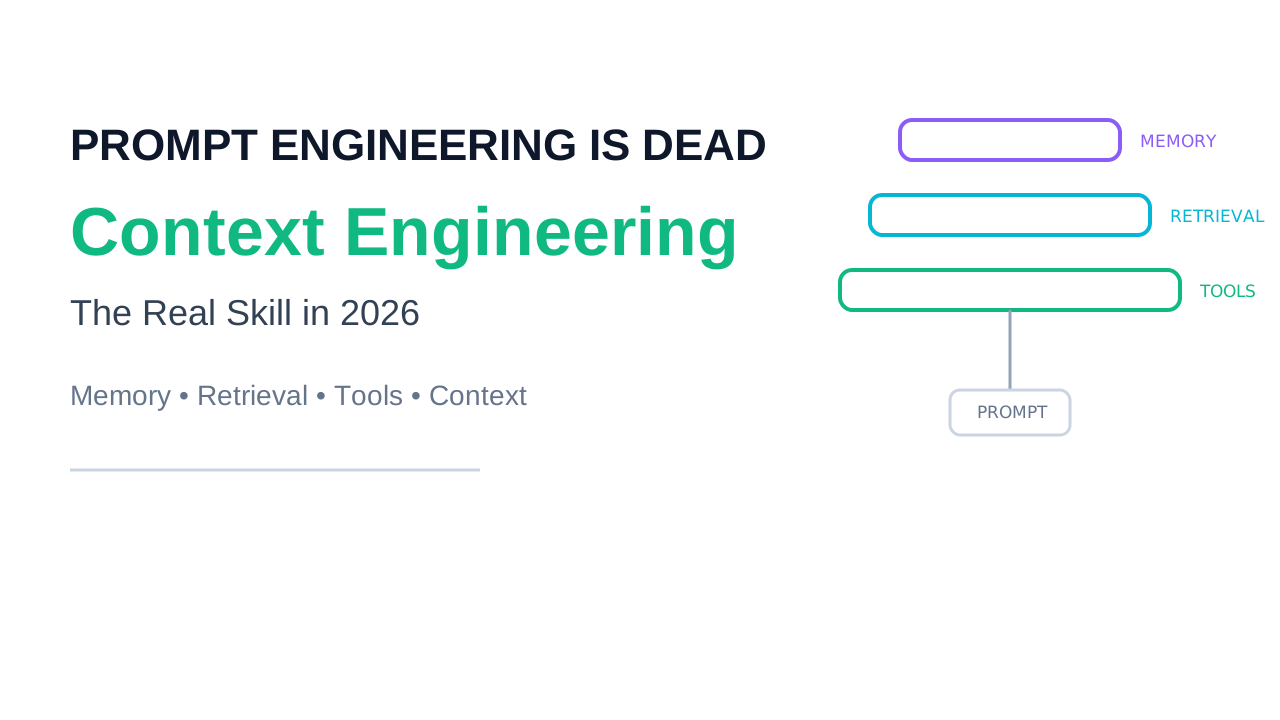
Context engineering — the discipline of designing what goes into an AI model’s context window, how it’s structured, and how it evolves through an interaction — was covered in detail in our dedicated article. Its position in this skills-for-2030 discussion deserves specific framing: it is the Layer 2 skill with the fastest appreciation trajectory, the most underserved by current education, and the clearest separating line between AI systems that work reliably in production and AI systems that only work in demos.
Here’s why it’s a compound skill rather than a temporary one: the principles of context engineering — put critical instructions where models attend most strongly, retrieve precisely rather than abundantly, normalize tool results before injection, manage history budget deliberately, design memory curation for long-running interactions — are grounded in structural properties of how attention-based models process information. These properties are not going away; they’re a function of the architecture. As models improve, the specific optimal context strategies will evolve, but the underlying discipline of designing information architecture for AI model inputs will remain a distinct and valuable engineering competency.
The job market is already creating roles with this kind of work as a primary responsibility — not always labeled “context engineering,” but showing up as AI Platform Engineer, AI Systems Engineer, LLM Infrastructure Engineer, and similar titles where the core work is designing the information architecture that AI systems operate within. By 2030, this discipline will have a standard curriculum, standard tooling, and a recognized career path with senior roles — engineers who build expertise now will have years of production experience by the time that recognition solidifies.
Phase 4: Implementation — How to Actually Build These Skills
The Two Failure Modes of Skill Building
Most engineers fail to build genuinely great skills in one of two ways: surface exploration (reading documentation, watching tutorials, understanding concepts at the level of being able to talk about them without being able to actually build anything nontrivial) or premature specialization (going deep on a specific tool or framework rather than the underlying principles that transcend tooling generations). Both leave you vulnerable to the next technology shift.
The antidote to surface exploration is building real systems with real constraints — not toy examples, but systems where you experience actual failure modes. The antidote to premature specialization is grounding your tooling knowledge in the underlying systems and mathematical principles: understanding why HNSW approximate nearest-neighbor search works before committing its API surface to memory, understanding why training/serving skew degrades models before memorizing which button to click in your feature store interface.
Here’s a skill-by-skill path designed to build genuine depth:
AI Engineering: Build a RAG system without a high-level framework first — raw vector math, direct embedding API calls, your own chunking and retrieval pipeline. Then build an agent with LangGraph that uses at least three tools, includes a human-in-the-loop approval step, and runs against a checkpointed PostgreSQL backend. The experience of debugging these systems from first principles is the education — the working system itself matters less than what you learn breaking and fixing it.
MLOps: Set up a complete ML experiment tracking system with MLflow or Weights & Biases, train a model, track the run, register the model artifact, build a retraining pipeline triggered by drift detection, and deploy two versions with traffic splitting. The point isn’t the model — it’s experiencing the full lifecycle end-to-end so that infrastructure decisions stop being abstract. For LLM-specific MLOps, run an automated evaluation pipeline that measures hallucination rate on a golden test set before every prompt template change, treating prompt changes with the same rigor as code changes.
Agentic AI: Build an agent that completes a genuinely multi-step task — something that requires at least five tool calls, can fail at any step, and needs to handle failure gracefully. Then break it on purpose: crash it mid-execution and verify it resumes correctly, feed it malformed tool responses and verify it doesn’t loop infinitely, and instrument it to log every state transition so you can replay the execution history after the fact. The debugging experience builds the intuition that makes you a genuinely useful agentic systems engineer.
AI Security: Study the OWASP Top 10 for LLMs (updated annually and freely available) and attempt to exploit each vulnerability in a controlled environment you build yourself — set up a local model, attempt prompt injection attacks against various system prompt designs, and test different mitigation strategies. The defender who has tried to attack their own systems understands threat vectors at a fundamentally different level than the defender who has only read about them.
Data Engineering: Build a streaming data pipeline that keeps a vector store continuously synchronized with a source database, handling schema changes gracefully, monitoring for data quality issues, and alerting on lag. The streaming-to-AI-retrieval problem is exactly the production scenario that organizations are struggling with right now, and hands-on experience with it is rare enough to be immediately differentiating.
Context Engineering: Build an instrumented context assembly pipeline that logs, for every inference call, the exact token count of each context layer, the retrieval precision score of the knowledge layer, and the final model output quality. Run experiments changing one variable at a time — the ordering of retrieved chunks, the amount of conversation history, the level of tool result normalization — and measure the effect on output quality. Developing the ability to trace output quality back to context assembly decisions is the core diagnostic skill that separates good context engineers from practitioners who are guessing.
Phase 5: Real-World Demand — What Companies Are Actually Hiring For
The Infrastructure Layers Are Where the Budgets Are Going
An underreported pattern in AI hiring is that the largest, fastest-growing demand isn’t for product-facing AI feature builders — it’s for infrastructure engineers who build the platforms that product teams build on. Amazon, Google, Microsoft, and every major tech company are racing to build internal AI platforms (model serving infrastructure, fine-tuning pipelines, evaluation systems, RAG retrieval platforms) that allow their product teams to ship AI features without each team reinventing the infrastructure from scratch. The teams building those internal platforms are staffed with MLOps, data, and AI infrastructure engineers, and those teams are hiring at a pace that isn’t visible in the consumer-facing AI announcements.
The Vertical Specialization Opportunity
Outside the hyperscalers, the most interesting hiring demand is in industries that are deploying AI to high-stakes, heavily regulated domains and discovering that general AI engineering skills aren’t sufficient: healthcare AI (FDA-regulated AI as a medical device, privacy-preserving ML, clinical decision support reliability), financial services AI (regulatory compliance with SEC/FINRA/MAS guidance, model explainability requirements, fair lending compliance), and legal AI (workflow automation for law firms, compliance-grade document analysis). These verticals need engineers who combine the AI skills covered in this article with domain knowledge and regulatory awareness — a combination rare enough to command significant compensation premiums.
The Contractor and Consulting Market Is Exploding
One career path that’s underappreciated in technical circles: independent AI engineering consulting. The supply of engineers who can walk into an organization, audit their AI systems for reliability and security issues, design a proper MLOps infrastructure, and implement context engineering improvements is tiny relative to the demand, because most organizations know they have AI quality problems and don’t have internal people capable of diagnosing them systematically. Engineers who develop genuine depth in two or three of the skill domains in this article and can credibly diagnose production AI systems command high consulting rates and have a pipeline of demand that a full-time role at one company simply can’t provide.
Phase 6: AI Era Relevance — How AI Advances Affect Each Skill Domain
The Positive Feedback Loop
There’s a positive feedback loop worth naming explicitly: as AI systems become more capable and more widely deployed, they generate more need for the skills required to build them reliably and secure them against misuse. More capable models mean more ambitious production deployments, which means more complex agentic workflows needing reliability engineering, more sensitive data flowing through AI pipelines requiring security expertise, more sophisticated retrieval requirements demanding better data infrastructure, and more complex context assembly problems for context engineers to solve. AI advancement is not the enemy of these skill domains — it’s the demand generator.
The One Risk: Accelerating Tool Abstraction
The honest counter-argument is that AI tooling is improving fast, and some of the complexity that currently requires expert human judgment is being abstracted away. Retrieval quality evaluation is getting better tooling. Security scanning for prompt injection is getting more automated. MLOps workflows are getting more automated with platforms like Google Vertex AI and AWS SageMaker. This abstraction is real and ongoing.
The right response is not to avoid these skill domains but to stay at the leading edge of them, specifically in the areas that tooling hasn’t yet abstracted. Security judgment against novel attack vectors. Architectural decisions about multi-agent system design. Data quality evaluation for novel data types. Context assembly strategies for complex agentic workflows. These are the areas where expert human judgment runs ahead of automated tooling by years — and maintaining that lead is exactly what it means to compound a skill.
Phase 7: Honest Evaluation — Durability Scores for Each Skill Domain
Rather than pretend every skill on this list is equally durable and equally urgent, here’s an honest assessment:
AI Security has the highest durability of any skill here. The attack surface grows with AI capabilities; regulatory requirements are being codified into law; the damage from failures is high enough that organizations cannot afford to underfund it. This skill will be in shortage for the foreseeable future.
MLOps has high durability at the infrastructure design and principles level, moderate durability at the specific tooling level (tooling changes fast). The engineer who understands why training/serving skew degrades models, not just which button prevents it in today’s feature store, is durable. The engineer who only knows the buttons is not.
Agentic AI Engineering has high current premium and very high 2030 potential, but it’s the skill with the highest evolution rate — what a senior agentic AI engineer does in 2030 will look different from what they do today. The investment pays off, but it requires commitment to continuous learning rather than one-time skill acquisition.
Data Engineering has the highest stability — the underlying principles (pipeline reliability, data quality, streaming vs. batch trade-offs) have been stable for years and will remain stable. The tooling changes; the principles don’t. It’s the safest long-term investment with a reliable demand floor.
AI Engineering is the broadest category, which makes it the most important entry point but the hardest to maintain at a premium level without delving into at least one specialization. “I build AI applications” is increasingly table stakes; “I build reliable, production-grade AI systems with rigorous evaluation and optimization” is the premium.
Context Engineering has the highest current alpha — because most practitioners don’t know this discipline exists by name, genuine expertise in it stands out immediately in interviews and in production outcomes. It will become more standard knowledge as the discipline matures; the advantage of building it now is the compounding head start.
Phase 8: Career Map — Roles, Salaries, and What to Build First
The Roles That Will Define the Next Five Years
The job market is converging on several role categories that will be the primary employers of engineers with these skills by 2030. AI Platform Engineer — building the internal infrastructure that lets product teams ship AI features without reinventing infrastructure each time. ML Infrastructure Engineer — owning the training, evaluation, and deployment pipeline for ML and LLM systems. AI Security Engineer — dedicated AI-specific security role, still rare and commanding significant premiums. Agent Systems Engineer — designing and maintaining agentic workflows, increasingly distinct from general AI engineering as agent complexity grows. AI Data Engineer — the data engineering specialist who understands both traditional pipeline design and the specific requirements of AI systems.
What to Prioritize If You’re Starting Now
If you’re choosing where to focus energy in the next twelve months with a 2030 horizon in mind, the highest expected-value move is to build a strong generalist AI Engineering foundation (RAG, agents, evals, basic MLOps) and then develop depth in whichever of the three highest-durability specializations matches your existing background: Data Engineering if you have a backend/infrastructure background, AI Security if you have any security background, MLOps if you have any DevOps or platform engineering background. Your prior experience is a multiplier on new domain knowledge — the fastest path to premium expertise is combining deep domain knowledge you already have with the new AI-specific layer on top of it.
Interview Preparation
AI engineering interviews at leading companies in 2026 have converged on a few high-signal question patterns. System design questions for AI systems (“design a production RAG system with access control and low latency”), debugging scenarios for AI reliability (“your agent is looping indefinitely — walk me through your diagnosis”), evaluation methodology questions (“how do you measure whether your RAG system’s retrieval quality has degraded in production”), and security scenario questions (“walk me through the prompt injection risks in this agent architecture and how you’d mitigate them”). These questions all require genuine depth — they are designed to distinguish engineers who have experienced these problems from engineers who have read about them.
Conclusion: The Skill That Underlies All of Them
After thousands of words on six specific skill domains, it’s worth stepping back to name the one meta-skill that underlies all of them and that is, ultimately, the most durable career asset an engineer can have in this era.
The engineers who will thrive through 2030 and beyond are not the ones who learned the right tools at the right time — because tools will keep changing. They’re the engineers who developed the ability to learn new things quickly, reason from first principles when documentation runs out, diagnose systems from their observable behavior rather than their documentation, and make good engineering judgments under uncertainty. AI advances faster than any curriculum, and the engineers who can keep pace with it are the ones who have developed learning itself as a craft, not just the outputs of prior learning as a credential.
The six skills in this article are the right places to direct that learning capacity right now. They’re the domains where the demand is real, the compensation is high, the problems are genuinely hard, and the trajectory is clearly upward. But the underlying reason to invest in them isn’t just that the job market says to — it’s that these are the places where engineering judgment still decisively outperforms AI, where the work is genuinely interesting, and where the problems you’ll solve will matter to the people and organizations depending on the systems you build.
Build things that are hard. Understand why they break. Develop the discipline to make them reliable. That combination — more than any specific skill, more than any specific certification, more than any specific tool — is what makes an engineer valuable in any era. The AI era just happens to make it especially urgent.