PHASE 1 — THE PROBLEM: THE CRASHING WAVES OF SEQUENCE MODELING
For decades, the holy grail of Natural Language Processing (NLP) was to build a system that could read, comprehend, and generate human language with human-like fluidity. Yet, for just as long, computer science hit a structural wall.
To understand why modern Large Language Models (LLMs) like ChatGPT exist, we must first look at the architectural wreckage of the architectures that preceded them: Recurrent Neural Networks (RNNs), Long Short-Term Memory (LSTM) networks, and Gated Recurrent Units (GRUs).
The Sequential Bottleneck
Human language is intrinsically sequential when spoken or written, but its underlying meaning is deeply hierarchical and contextual. Older NLP paradigms treated language like a conveyor belt. An RNN processes text word by word, tracking an internal hidden state vector $h_t$ that updates at each time step $t$ according to the current word $x_t$ and the previous hidden state $h_{t-1}$:
$$h_t = \tanh(W_{hh}h_{t-1} + W_{xh}x_t + b_h)$$
This sequential dependency introduced two catastrophic flaws that stalled the scaling of artificial intelligence for years:
- The Vanishing and Exploding Gradient Problem: As the sequence length grew, backpropagation required multiplying weight matrices repeatedly over dozens or hundreds of time steps. If the eigenvalues of the weight matrix were slightly less than 1, the gradients diminished exponentially toward zero, preventing the network from learning long-term dependencies. If they were slightly greater than 1, the gradients exploded, causing arithmetic overflow during training.
- The Hardware Utilization Paradox: Because the computation of $h_t$ strictly requires the completion of $h_{t-1}$, it is impossible to parallelize RNN training across time steps. As modern computing shifted heavily toward highly parallelized GPU architectures, RNNs left massive amounts of floating-point processing capacity idle. We could not train them on vast, web-scale datasets because their core algorithm was fundamentally non-parallelizable.
The Death of Context: Catastrophic Forgetting
LSTMs introduced input, output, and forget gates to alleviate the vanishing gradient problem, allowing gradients to flow more freely through a continuous cell state. While this was a massive breakthrough for short sentences, LSTMs still suffered from catastrophic forgetting over long context windows.
If a model processes a 2,000-word document, information introduced in the first paragraph must pass through thousands of non-linear vector transformations before reaching the final paragraph. By the time the vector arrives at the end of the document, the subtle semantic nuances from the beginning are washed out, replaced by the immediate context of the most recent tokens.
The industry desperately needed an architecture where every single word could look at every other word in a sequence directly, with a computational distance of exactly $O(1)$ operations, completely bypassing sequential steps. This core requirement directly inspired the creation of the Transformer model.
PHASE 2 — BUILDING THE MENTAL MODEL: GEOMETRIC LANGUAGE AND CONTINUOUS LATENT SPACES
Before we dive into matrices, tensors, and neural layers, we must construct a clear mental model of how a computer conceptualizes human language. Computers do not understand words, intent, or narrative structure; they understand high-dimensional geometry.
From Discrete Tokens to Continuous Vectors
In traditional computing, a word is a discrete entity, often represented as a unique integer or a one-hot encoded vector (a vector filled with zeros except for a single index assigned to that specific word). The fatal flaw of one-hot encoding is its lack of semantic geometry. In a one-hot representation, the vector for cat is perfectly orthogonal to the vector for kitten, and equally orthogonal to the vector for refrigerator. The distance between all concepts is identical.
Modern LLMs solve this by mapping language into a dense, continuous, high-dimensional space called a Latent Vector Space.
Imagine a space spanned by several thousand dimensions (for example, GPT-3 utilizes a hidden dimension size $d_{\text{model}} = 12,288$). In this massive space, words are transformed into dense floating-point vectors. The position of a vector within this space represents its conceptual meaning.
Vectors pointing in similar directions share semantic traits. The distance and angle between vectors reflect real-world relationships:
- The vector offset between
kingandqueenclosely mirrors the vector offset betweenmanandwoman. - Verbs in the past tense cluster along a distinct geometric axis relative to their present-tense counterparts.
The Dynamic Kaleidoscope of Meaning
A simple static word embedding (like Word2Vec or GloVe) assigns a fixed vector to a word. But human language is fluid. The word bank has completely different meanings in the sentences:
- “I sat on the bank of the river.”
- “I deposited money into the bank.”
ChatGPT functions by dynamically calculating the vector representation of a word based entirely on its environment. It takes static, context-independent representations and runs them through a series of geometric transformations.
At every layer of the model, each token vector shifts its position in the latent space by pulling in information from the surrounding vectors. By the time the vectors reach the final layer, the vector for bank in our first example has migrated toward geographic and nature clusters, while in the second example, it has migrated toward financial and institutional clusters.
PHASE 3 — THE INTERNAL WORKING DEEP DIVE: THE ARCHITECTURAL BLUEPRINT
Let us trace the absolute lifecycle of a request moving through ChatGPT. When you input a prompt into the interface, it initiates a highly deterministic pipeline of mathematical transformations, operating within a Causal Decoder-Only Transformer architecture.
Step 1: Tokenization — The Gatekeeper of Text
Before text hits the neural network, it is broken down into smaller components called tokens using an algorithm known as Byte-Pair Encoding (BPE).
BPE does not split text purely by words, nor does it split text strictly by individual characters. Instead, it iteratively analyzes a massive corpus of text, counts the most frequent pairs of characters or byte sequences, and merges them into a single token entry within a fixed vocabulary list (typically between 32,000 and 100,000 unique tokens).
- Common words like
the,and, orsoftwareare assigned their own individual tokens. - Uncommon words like
architecturalmight be split into sub-words:architectandural. - Code structures, whitespaces, and tabs are explicitly tokenized, which allows the model to retain structural intent.
If you input the word Indivisible, the BPE tokenizer converts this string into an array of token IDs, such as [5421, 234, 1109]. These integers serve as the indices used to look up values in the model’s massive primary embedding matrix.
Step 2: The Embedding Matrix and Positional Encoding
The array of token IDs is immediately passed to the Embedding Layer. This layer is an enormous lookup table containing a matrix $W_e \in \mathbb{R}^{V \times d_{\text{model}}}$, where $V$ is the vocabulary size and $d_{\text{model}}$ is the internal vector size of the network. Each token ID grabs its corresponding row vector from this matrix.
However, the core Transformer architecture processes all tokens simultaneously. It possesses no inherent concept of order; to the raw attention mechanism, a sentence is simply an unordered bag of tokens. If we feed the sentences “The dog ate the cat” and “The cat ate the dog” into a raw attention network, their initial representations are entirely identical.
To solve this design limitation without resorting to recurrent processing, engineers inject Positional Encodings directly into the token vectors.
While early Transformer variants used absolute sinusoidal wave formulas to encode position, modern production LLMs leverage Rotary Position Embeddings (RoPE).
Instead of adding a fixed position vector to the token embedding, RoPE applies a specialized rotation matrix to the Query and Key vectors at each attention layer. The rotation angle is proportional to the token’s absolute position in the sequence.
When the model calculates the dot product between a Query vector at position $m$ and a Key vector at position $n$, the result depends strictly on the relative distance $m – n$. This elegant approach gives the network a robust, continuous geometric understanding of relative distance that generalizes well across exceptionally long context windows.
Step 3: The Heartbeat — Multi-Head Causal Self-Attention
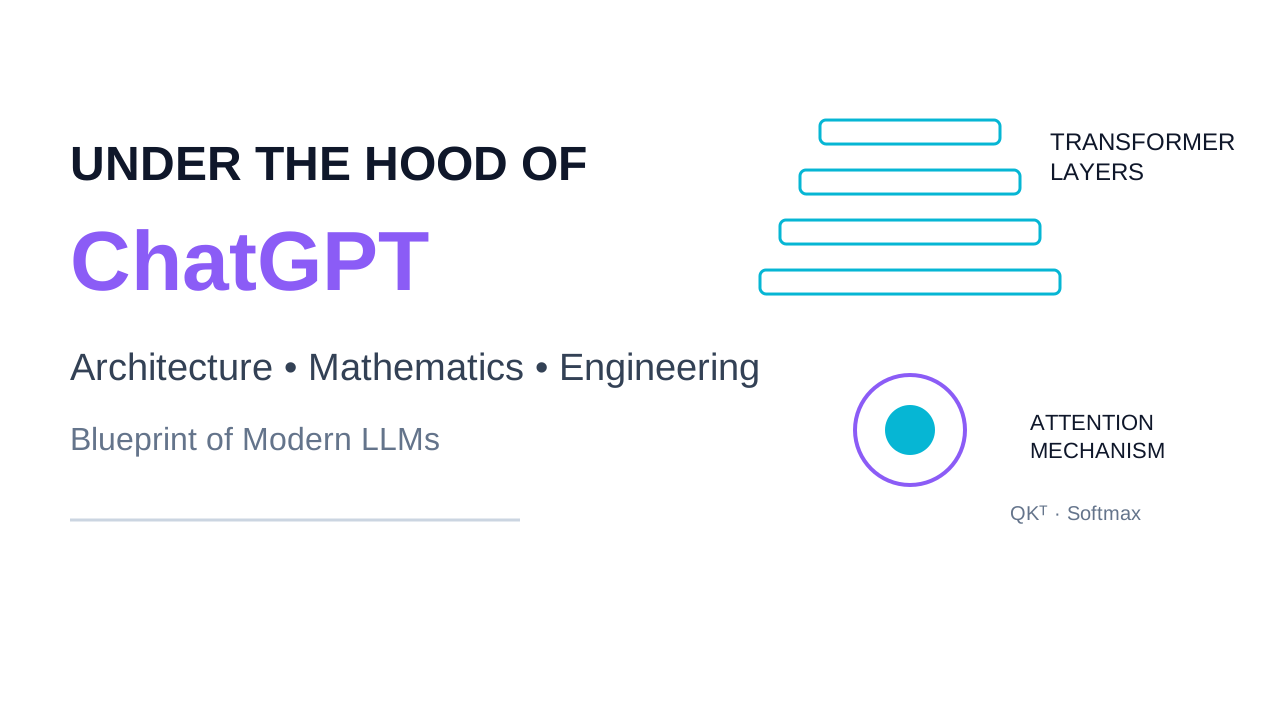
Once the model constructs the context-aware, position-encoded vectors, they pass through a stacked series of identical Transformer blocks (ranging from 32 layers in smaller models to well over 100 layers in massive foundational systems). The defining engine within these blocks is the Causal Self-Attention mechanism.
The fundamental goal of self-attention is to calculate how much semantic relevance every token in the sequence holds relative to all other tokens.
1. Generation of Q, K, and V Matrices
For a given input sequence matrix $X \in \mathbb{R}^{T \times d_{\text{model}}}$ (where $T$ is the sequence length), the model projects $X$ into three distinct spaces using learned weight matrices $W_Q, W_K, W_V \in \mathbb{R}^{d_{\text{model}} \times d_{\text{model}}}$:
- Query ($Q$): What the current token is actively searching for.
- Key ($K$): What information the token contains, serving as an index for other tokens to match against.
- Value ($V$): The actual core content that is passed forward once a semantic match is established between a Query and a Key.
$$Q = XW_Q, \quad K = XW_K, \quad V = XW_V$$
2. The Scaled Dot-Product Formulation
The core mathematical evaluation of attention is formulated as follows:
$$\text{Attention}(Q, K, V) = \text{softmax}\left(\frac{QK^T}{\sqrt{d_k}} + M\right)V$$
Let us break down each component of this equation to fully understand its mechanical purpose:
- The Matrix Multiplication ($QK^T$): This operation computes the raw dot product between every single Query vector and every single Key vector. The resulting matrix is a $T \times T$ grid where the element at row $i$, column $j$ represents the raw semantic affinity score between token $i$ and token $j$.
- The Scaling Factor ($\sqrt{d_k}$): As the dimensionality $d_k$ grows large, the variance of the dot products increases significantly, driving the values into regions of the softmax function with incredibly small gradients. Dividing by the square root of the key dimension scales the variance back to 1, ensuring stable gradient flow during backpropagation.
- The Causal Mask ($M$): ChatGPT is an autoregressive model; it predicts the future by looking exclusively at the past. When generating text, token $i$ must never be allowed to look at token $i+1$. To enforce this constraint, an upper-triangular masking matrix $M$ is added to the scaled dot product before the softmax step. In this matrix, valid historical positions are set to 0, while future positions are set to $-\infty$.When passed through the softmax function, $e^{-\infty}$ evaluates precisely to $0$. This completely zeroes out any attention weights pointing to future tokens, ensuring the model’s generation process remains strictly causal.
$$\text{Softmax Applied to Masked Matrix} \rightarrow \begin{pmatrix} 0.8 & 0.0 & 0.0 \\ 0.3 & 0.7 & 0.0 \\ 0.1 & 0.5 & 0.4 \end{pmatrix}$$
- The Softmax Function: This normalizes the row scores into a clean probability distribution between 0 and 1, ensuring the sum of attention weights for any given token equals exactly 1.0.
- Multiplying by $V$: The normalized attention weights act as a blending filter. Each token vector collects a weighted sum of the Value vectors from all historical tokens it deemed relevant, updating its own representation in the process.
Multi-Head Attention Multiplies Learning Perspectives
Instead of performing this operation once, Multi-Head Attention splits the $Q$, $K$, and $V$ matrices into $H$ distinct sub-spaces (heads). Each head maintains its own independent set of projection weights, which allows them to track completely different linguistic dynamics in parallel:
- Head 1 might track long-range grammatical dependencies (e.g., matching a pronoun to a noun 500 tokens back).
- Head 2 might track immediate subject-verb agreements.
- Head 3 might focus on identifying code syntax constraints.
The outputs of all heads are concatenated along the feature dimension and projected back through a final linear layer ($W_O$) to match the primary hidden dimension $d_{\text{model}}$.
Step 4: Normalization and the Feed-Forward Network (SwiGLU)
Following the attention block, the tensor passes through a residual connection layer combined with Root Mean Square Normalization (RMSNorm). RMSNorm stabilizes training by scaling the activations based on their root mean square, which regulates variance across deep networks without the computational overhead of calculating batch or sequence-level means.
Next, the normalized tensor enters the Feed-Forward Network (FFN) block. In modern LLMs, this is typically implemented as a SwiGLU (Swish Gated Linear Unit) variant. Unlike classic MLPs that rely on simple ReLU activations, a SwiGLU layer splits the input tensor into two parallel paths:
- One path passes through a linear projection followed by a Swish activation function: $\text{Swish}(x) = x \cdot \sigma(\beta x)$.
- The second path passes through a pure linear gate projection.
The model multiplies these two representations together, applying a highly non-linear filtering mechanism that allows the network to store complex factual knowledge and relational rules directly within its static weights.
Step 5: The Alignment Pipeline — SFT, RLHF, and DPO
A raw Transformer trained exclusively on next-token prediction is merely a highly sophisticated autocomplete engine. If you prompt it with “How do I fix a leaking pipe?”, it might respond by generating a list of entirely different plumbing questions, because that pattern matches its web-scrape pre-training data.
To transform this base model into a highly helpful conversational assistant like ChatGPT, it must pass through an extensive multi-stage alignment pipeline.
[ Base LLM ] Pre-trained on Next-Token Prediction
     │
     ▼
[ Supervised Fine-Tuning (SFT) ] Trained on High-Quality Instruction Demos
     │
     ▼
[ Alignment Optimization ]
 ├── Option A: RLHF (Reward Model via PPO Optimization Loop)
 └── Option B: DPO (Direct Log-Likelihood Preference Optimization)
1. Supervised Fine-Tuning (SFT)
Engineers gather a dataset composed of thousands of high-quality, human-curated prompt and response demonstrations. The base model is trained on these samples using standard cross-entropy loss, teaching the network the structural style of a chatbot: responding with polite, direct, and well-structured answers.
2. Reinforcement Learning from Human Feedback (RLHF)
To align the model’s outputs with human values, safety guidelines, and helpfulness metrics, the model undergoes RLHF:
- The Reward Model: The SFT model generates multiple distinct responses for a single prompt. Human annotators rank these outputs from best to worst. A secondary neural network—the Reward Model—is trained on these rankings to output a scalar score representing how much a human would appreciate a given response.
- PPO Optimization: The primary model is placed into a Reinforcement Learning loop using Proximal Policy Optimization (PPO). The LLM generates a response, the Reward Model scores it, and the PPO algorithm modifies the LLM’s weights to maximize that score. To prevent the model from drifting too far from its core capabilities or cheating the reward system, a Kullback-Leibler (KL) divergence penalty is integrated directly into the loss function, anchoring the model’s output distribution close to the original SFT baseline.
3. Direct Preference Optimization (DPO)
Modern alignment architectures frequently replace the complex, unstable PPO pipeline with Direct Preference Optimization (DPO). DPO bypasses training a standalone Reward Model entirely.
Instead, it mathematically re-parameterizes the reward function to express it directly in terms of the model’s choice probabilities. This allows developers to optimize the model on human preferences using a simple, stable binary cross-entropy loss over pairs of winning and losing responses, significantly streamlining the alignment pipeline.
PHASE 4 — ENGINEERING IMPLEMENTATION: AN AUTHENTIC PYTORCH MULTI-HEAD CAUSAL ATTENTION ENGINE
To truly understand the internal mechanics of a Transformer, we must translate theory into production-grade code. Below is a clean PyTorch implementation of a Causal Multi-Head Attention module, matching the architectural standards utilized in foundational modern LLMs.
Python
import math
import torch
import torch.nn as nn
import torch.nn.functional as F

class CausalMultiHeadAttention(nn.Module):
    def __init__(self, d_model: int, n_heads: int, dropout: float = 0.1):
        super().__init__()
        assert d_model % n_heads == 0, "d_model must be perfectly divisible by n_heads"

        self.d_model = d_model
        self.n_heads = n_heads
        self.head_dim = d_model // n_heads

        # Combined projection matrix for Query, Key, and Value
        # Projecting to 3 * d_model allows us to compute Q, K, V in a single fused linear pass
        self.qkv_projection = nn.Linear(d_model, 3 * d_model, bias=False)

        # Output projection matrix to return back to the primary hidden dimension
        self.out_projection = nn.Linear(d_model, d_model, bias=False)

        # Regularization dropout layers
        self.attn_dropout = nn.Dropout(dropout)
        self.residual_dropout = nn.Dropout(dropout)

    def forward(self, x: torch.Tensor) -> torch.Tensor:
        # Expected input shape: [B, T, C]
        # B = Batch Size, T = Sequence Length (Context Window), C = Hidden Channels (d_model)
        B, T, C = x.size()

        # Step 1: Execute linear projection for Q, K, V simultaneously
        # Shape change: [B, T, C] -> [B, T, 3 * C]
        qkv = self.qkv_projection(x)

        # Split the combined matrix into individual Query, Key, and Value tensors
        # Each tensor will have the shape: [B, T, C]
        q, k, v = qkv.split(self.d_model, dim=2)

        # Step 2: Reshape tensors to isolate individual attention heads
        # Target shape for parallel attention processing: [B, n_heads, T, head_dim]
        q = q.view(B, T, self.n_heads, self.head_dim).transpose(1, 2)
        k = k.view(B, T, self.n_heads, self.head_dim).transpose(1, 2)
        v = v.view(B, T, self.n_heads, self.head_dim).transpose(1, 2)

        # Step 3: Compute raw attention scores via matrix multiplication
        # Scale by 1 / sqrt(head_dim) to preserve gradient stability
        # Transposing K ensures matrix dimensions line up: [B, n_heads, T, head_dim] x [B, n_heads, head_dim, T]
        # Output attention score matrix shape: [B, n_heads, T, T]
        attn_scores = (q @ k.transpose(-2, -1)) * (1.0 / math.sqrt(self.head_dim))

        # Step 4: Apply the causal attention mask to prevent looking into the future
        # Create an upper-triangular boolean matrix of size [T, T]
        # diagonal=1 ensures we preserve the current token but mask all subsequent indices
        mask = torch.triu(torch.ones(T, T, device=x.device), diagonal=1).bool()

        # Fill masked positions with negative infinity.
        # When passed through softmax, these positions evaluate to exactly 0.0 weight.
        attn_scores = attn_scores.masked_fill(mask, float('-inf'))

        # Step 5: Convert scores to a clean probability distribution and apply dropout
        attn_weights = F.softmax(attn_scores, dim=-1)
        attn_weights = self.attn_dropout(attn_weights)

        # Step 6: Multiply weights by the Value tensor to pull context forward
        # Shape change: [B, n_heads, T, T] x [B, n_heads, T, head_dim] -> [B, n_heads, T, head_dim]
        out = attn_weights @ v

        # Step 7: Re-concatenate all attention head outputs back into standard sequence form
        # Shape change: [B, n_heads, T, head_dim] -> [B, T, n_heads * head_dim = C]
        out = out.transpose(1, 2).contiguous().view(B, T, C)

        # Step 8: Apply final projection and return out to the residual connection pipeline
        out = self.residual_dropout(self.out_projection(out))
        return out
Deconstructing the Code Architecture
This implementation highlights several architectural choices critical for production deployment:
- Fused Projections (
qkv_projection): Instead of executing three separate matrix multiplications for $Q$, $K$, and $V$, we project the input tensor into a unified space of size $3 \times d_{\text{model}}$ in a single step. Fusing operations combines CUDA memory transfers and maximizes GPU compute core efficiency. - Tensor Transpositions (
.transpose(1, 2)): By structuring the tensor shape as[B, n_heads, T, head_dim], we place the sequence length dimensionTnext to thehead_dimdimension. This layout allows PyTorch to leverage underlying matrix acceleration hardware (like NVIDIA Tensor Cores) to execute batch matrix multiplications across all heads simultaneously. - Contiguous Memory Management (
.contiguous().view(...)): Transposing dimensions changes the logical view of the tensor without updating its physical arrangement in memory. Calling.contiguous()forces a physical reallocation of memory, which ensures rapid, sequential data access prior to executing the final linear projection layer.
PHASE 5 — REAL-WORLD SYSTEMS: DEEP INFRASTRUCTURE AND SCALE
Moving from a single script to a massive system capable of running models across thousands of GPUs requires tackling substantial infrastructure hurdles. At this scale, network topology and distributed computing paradigms become just as crucial as model architecture.
Distributed Parallelism Models
A model boasting hundreds of billions of parameters cannot fit into the VRAM of a single GPU (an H100 GPU provides up to 80GB or 94GB of High Bandwidth Memory, whereas a 70B parameter model utilizing FP16 precision requires a minimum of 140GB just to store its base static weights).
To train and serve massive production models, infrastructure teams rely on distributed parallelism frameworks like DeepSpeed and Megatron-LM:
| Parallelism Strategy | Core Partitioning Vector | Primary Bottleneck | Optimal Hardware Fit |
| Tensor Parallelism (Megatron-LM) | Splits individual internal weight matrices within a layer across multiple GPUs (e.g., partitioning column/row structures in attention projections). | Intra-layer communication latency; requires massive high-bandwidth inter-connect networks. | NVLink environments within unified physical server nodes. |
| Pipeline Parallelism | Segregates whole layers sequentially across separate GPUs (e.g., Layer 1–20 on GPU 0, Layer 21–40 on GPU 1). | Execution bubbles; downstream GPUs sit completely idle waiting for upstream data activations. | Inter-node setups equipped with specialized scheduling logic (e.g., 1F1B scheduling). |
| ZeRO (Zero Redundancy Optimizer) | Replicates layers but splits optimizer states, gradients, and model parameters across nodes, fetching them dynamically as needed. | Repeated all-gather network communication overhead during both forward and backward runs. | Standard Ethernet or InfiniBand clusters looking for major memory savings. |
Memory Hierarchy Bottlenecks: SRAM vs HBM
In production environments, LLM inference is rarely compute-bound; it is severely memory-bandwidth bound.
When generating text, the model processes tokens one by one. To predict the next token, the GPU must fetch every single weight parameter from its slow High Bandwidth Memory (HBM) and move it into the fast internal SRAM processing registers.
For a 70-billion-parameter model, the GPU must load approximately 140GB of data into its registers just to generate a single token. This means the overall generation speed of an LLM is heavily restricted by the memory transfer speed of the system rather than the raw TFLOPS compute capacity of the processor.
PHASE 6 — AI ERA RELEVANCE: THE MODERNISED APPLICATION LIFECYCLE
In modern application engineering, ChatGPT is rarely treated as a standalone black-box endpoint. Instead, it serves as the central reasoning engine within complex, composite software architectures.
The KV Cache: The Ultimate Production Optimization
In an ordinary Transformer, generating a sequence of text causes computational complexity to scale quadratically ($O(T^2)$). To predict token $t+1$, the model recomputes the Query, Key, and Value representations for every single preceding token in the sequence.
To eliminate this massive computational redundancy, production systems implement KV Caching.
During the processing of the initial prompt, the model saves the computed Key and Value vectors for all input tokens into GPU memory.
When generating the next token, the model calculates the Query, Key, and Value vectors only for that single new token. It appends the new Key and Value vectors directly to the existing cache, and runs the attention calculation across the entire history.
This optimization reduces the computational cost of subsequent generation steps from $O(T^2)$ down to a highly efficient $O(1)$ scaling factor per token generated.
The Cost of Memory Footprint
However, KV caching introduces a significant infrastructure trade-off: it consumes an immense amount of VRAM. For a large model running at high batch sizes with thousands of tokens of context, the KV cache can quickly grow to tens of gigabytes.
To manage this footprint, modern platforms deploy PagedAttention (a core engine feature within vLLM). PagedAttention breaks the KV cache down into small, non-contiguous physical memory blocks, mimicking virtual memory paging in operating systems. This layout eliminates internal fragmentation and dynamically scales memory allocation, allowing production systems to scale batch sizes significantly.
RAG and Agentic Workflows
Modern software architectures expand an LLM’s capabilities by surrounding it with external tools and real-time context:
- Retrieval-Augmented Generation (RAG): Instead of relying entirely on its static training weights, the application converts a user’s prompt into a vector, queries a vector database (e.g., Pinecone, Milvus) to pull relevant, real-time documentation snippets, and prepends those facts directly into the prompt context window. The LLM then acts as an in-context synthesis filter, producing factual answers rooted in verified documentation.
- Agentic Frameworks: Modern workflows place the LLM inside a continuous execution loop. The model is given access to tools via structured API definitions (Function Calling). It analyzes a problem, writes an internal execution plan, emits a specific tool invocation token (e.g., calling an SQL engine), waits for the external system response, reads the result back into its context window, and decides whether to continue iterating or return the final answer to the user.
PHASE 7 — ADVANTAGES, LIMITATIONS, AND TRADE-OFFS
No technology is a silver bullet. Designing reliable production systems requires an objective understanding of an architecture’s inherent strengths, structural limits, and engineering trade-offs.
Structural Strengths
- True Parallelization: Eliminating sequential recurrence allows models to scale across massive cluster configurations, transforming raw compute capacity directly into emergent semantic capabilities.
- Universal Semantic Vectorization: The continuous latent space provides a robust, cross-lingual foundation that handles diverse code syntaxes, structured datasets, and natural human languages with equal dexterity.
- Extensible Context Fluidity: The $O(1)$ structural distance between historical inputs enables models to maintain accurate long-range dependencies, resolving context references spanning thousands of tokens.
Inherent Architectural Vulnerabilities
- The Attention Bottleneck: While the model can process long contexts, the attention matrix size still scales quadratically ($O(T^2)$) relative to sequence length. As a result, massive context windows (such as 100k+ tokens) demand exponential increases in VRAM allocation to store the attention score grids. This limitation has driven research into alternative linear architectures, like State Space Models (SSMs) and Mamba, which seek to achieve similar context capabilities with $O(T)$ memory scaling.
- Hallucination as an Inherent Design Feature: An LLM does not cross-reference an internal database of truth when generating a response. Its underlying loss function is designed purely to minimize next-token prediction error based on historical patterns. A hallucination is not a system failure; it is simply a mathematically probable sequence of tokens that happens to diverge from real-world facts. Developers must use external systems like RAG, guardrails, and validation layers to enforce factual compliance.
PHASE 8 — CAREER IMPACT & FUTURE: WHAT INFRASTRUCTURE ENGINEERS MUST MASTER
The evolution of LLMs is shifting the baseline expectations for software engineers, backend developers, and system architects. Simply calling an external LLM API is no longer a sufficient engineering differentiator.
The New AI Engineering Stack
To remain competitive in modern software development, technical professionals must expand their expertise into specialized areas of the AI infrastructure stack:
┌─────────────────────────────────────────────────────────┐
│              Modern AI Engineering Stack                │
├─────────────────────────────────────────────────────────┤
│  • Quantization Mechanics (AWQ, GPTQ, BitsAndBytes)     │
│  • Memory Optimization (PagedAttention, vLLM Engine)   │
│  • Custom Fine-Tuning Architectures (LoRA, QLoRA)       │
│  • Orchestration Frameworks (LangGraph, Fused Agents)   │
└─────────────────────────────────────────────────────────┘
- Quantization Mechanics: Understanding how to compress models from standard FP16 down to INT8 or 4-bit weights using techniques like AWQ or GPTQ without destroying model accuracy. Quantization reduces hardware requirements, enabling large models to run efficiently on more accessible edge hardware.
- Parameter-Efficient Fine-Tuning (PEFT): Mastering strategies like LoRA (Low-Rank Adaptation). Instead of tuning all billions of parameters in a model, LoRA freezes the original weights and injects small, trainable rank-decomposition matrices into the attention layers. This reduces optimization memory footprints by over 99%, allowing developers to specialize foundational models for specific business tasks on modest hardware budgets.
THE CONVERGENCE OF CODE, MATH, AND DATA
Under the hood, ChatGPT is not a sentient entity, nor is it a simplistic database wrapper. It represents an elegant convergence of high-dimensional geometry, parallelized matrix mathematics, and distributed systems engineering.
By breaking human language down into discrete tokens, mapping those tokens into continuous latent vectors, and leveraging causal multi-head self-attention to adjust their meaning based on context dynamically, the Transformer architecture transforms raw computational power into a highly adaptable reasoning engine.
As an engineer or computer scientist, understanding these foundational mechanisms strips away the mystique of generative AI. It equips you with the first-principles intuition needed to design, optimize, and deploy the next generation of intelligent systems, turning theoretical concepts into robust production architectures.