The Problem: The Gap Between an Idea and a Working Product Was Never About Typing Speed
For most of software history, the bottleneck between “I have an idea for an app” and “I have a working app” wasn’t creativity — it was the sheer volume of scaffolding required before you could even see whether the idea worked. Before a founder or a designer could test whether users actually wanted their product, someone had to stand up a frontend framework, wire up a router, design a database schema, implement authentication correctly (a task with more security landmines than almost any other piece of a typical web app), configure payment processing, set up hosting, and glue all of it together into something that actually ran end to end. None of that work validates the idea. All of it has to exist before the idea can be validated at all.
This gap created a specific, well-understood industry pain point: the “idea-to-prototype” tax. A technical founder with the skills to build all of this themselves might spend two to four weeks getting to a demoable MVP. A non-technical founder — a domain expert who deeply understands a problem in healthcare, logistics, or education but has never opened a terminal — faced a much starker choice: spend months learning to code, spend money they didn’t yet have hiring a developer, or use a no-code visual builder that could produce something demoable but that locked them into a proprietary platform with a low ceiling on what could actually be built. None of these options were satisfying, and all of them delayed the one thing that actually matters in early product development: getting something real in front of users fast enough to learn whether the idea is worth pursuing at all.
The rise of large language models capable of writing correct, idiomatic code changed the calculus, but only partially, and understanding exactly where the first wave of AI coding tools fell short is the key to understanding why a platform like Lovable was built the way it was. Early LLM code generation was excellent at producing a single function, a single component, or a single file when a developer already had a project open and could paste the output into the right place. It was much worse at the harder problem underneath “build me an app”: deciding what an application’s entire architecture should look like — which frontend framework, which database schema, how authentication should be wired to the data layer, how payments should be wired to authentication, how all of it should be deployed — and then actually generating a coherent, internally consistent codebase across dozens of files that all correctly reference each other, rather than a pile of individually plausible snippets that don’t actually compile together.
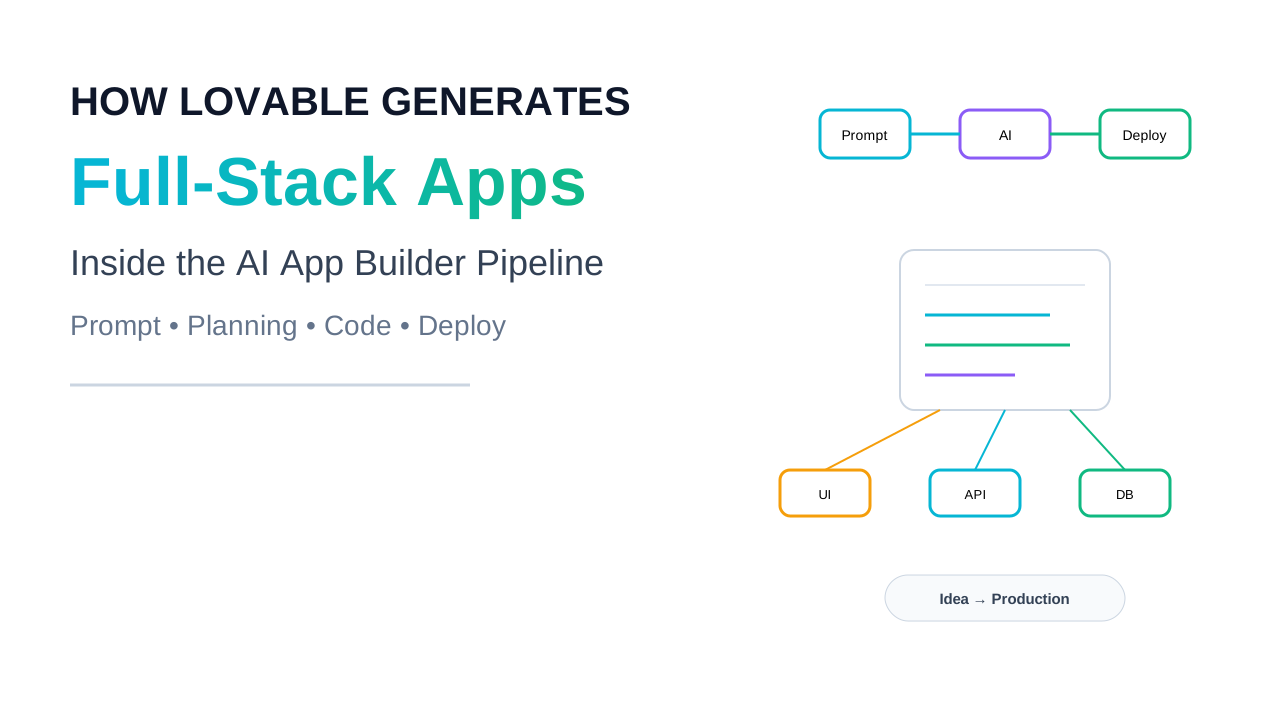
This is the specific problem “AI app builders” as a category, and Lovable specifically, were engineered to solve: not “help me write code faster” but “take a description of a product and produce a working, deployed, full-stack application — frontend, database, authentication, payments, hosting — as a single coherent, editable system,” collapsing weeks of scaffolding work into a single conversational session. Getting there required more than a good language model. It required a genuine architectural bet about which technologies to standardize on, and an equally deliberate bet about how much of the traditional software-engineering workflow — planning, iteration, testing, version control — could be reproduced conversationally rather than manually.
Building the Mental Model: Constrained Choice as the Enabling Idea
Why “generate anything, in any stack” was the wrong goal
It’s tempting to imagine the ideal AI app builder as one that can generate an application in literally any combination of technologies a developer might choose by hand — any frontend framework, any database, any hosting provider, any authentication approach. In practice, this maximal flexibility is close to the opposite of what makes reliable AI code generation possible. A model asked to reliably wire together authentication, a database schema, and a payment flow across an open-ended universe of possible technology choices has to somehow get all of those pairwise integrations right, for every possible combination, on every single generation — an enormously larger and more error-prone surface than getting one specific, well-understood combination right, over and over, extremely well.
The mental model underneath Lovable’s design is closer to the one behind highly opinionated frameworks in traditional software engineering — think of how Ruby on Rails deliberately picked one way to structure a web application instead of exposing every possible configuration, and became reliable specifically because it narrowed the possibility space. Lovable applies the same discipline to AI-generated full-stack applications: it standardizes on a single, consistent, modern stack — a React and TypeScript frontend styled with Tailwind CSS, built with Vite, backed by Supabase (which itself bundles a PostgreSQL database, authentication, file storage, and real-time subscriptions into one coherent backend platform) — and optimizes the entire generation pipeline around reliably producing that combination extremely well, rather than generically producing any combination adequately.
The analogy that captures the trade-off
Think of the difference between a custom home builder who will construct literally any architectural style you can dream up from scratch, versus a modular home manufacturer whose factory line is tuned to produce one well-engineered structural system extremely reliably, with genuine customization available within that system. The custom builder offers more theoretical freedom; the modular manufacturer offers something the custom approach struggles to match at speed: a foundation whose electrical, plumbing, and structural elements are already known to fit together correctly, because that specific combination has been produced and refined thousands of times before. Lovable’s standardized stack is the modular-home approach applied to full-stack software: the specific combination of React, Supabase, and the surrounding tooling isn’t a limitation bolted on as an afterthought — it’s the precondition that makes reliable, coherent, multi-file generation possible at all.
Conversational iteration as the second core idea
The other piece of the mental model worth fixing before going deeper is that Lovable isn’t a one-shot generator — describe an app once, receive a finished artifact, done. The actual interaction model is closer to how a human engineer works with a product manager over many rounds: an initial prompt produces a first working version, and every subsequent instruction — “add an onboarding flow,” “split this page into smaller components,” “the invoice total isn’t updating when I change quantity” — is applied as a real, incremental edit to the existing codebase, not a fresh regeneration from scratch. This distinction matters enormously for the internal mechanics, because it means the system has to solve a genuinely different and harder problem than initial generation: understanding an already-existing, potentially large codebase well enough to make a surgical, correct change to it without breaking everything else — the same core challenge that makes any AI coding agent hard, now applied specifically to a full-stack application with a live frontend, a live database schema, and live user data all needing to stay consistent with each other through every edit.
Internal Working Deep Dive: From a Sentence to a Deployed Application
This is the mechanism worth tracing carefully, because the gap between “an LLM that can write code” and “a system that reliably produces a coherent, deployed, full-stack application” is almost entirely in this pipeline.
Stage one: Plan before code
A meaningful architectural addition to Lovable’s pipeline, introduced as the platform matured through early 2026, is a distinct planning phase that runs before any code is written at all. Rather than immediately translating a prompt into files, the system first produces a structured, human-readable plan of what it intends to build — which pages, which data model, which integrations — and surfaces that plan for the user to review and adjust before a single line of code is generated. This exists to solve a problem that plagues one-shot code generation broadly: without an explicit intermediate representation of intent that a human can inspect and correct cheaply, the only way to catch a fundamental misunderstanding is to wait for the fully generated code and then untangle it after the fact, which is a far more expensive form of correction than adjusting a plan in plain English before generation even starts. This mirrors, in miniature, the same discipline experienced software teams use deliberately: a lightweight design review before implementation begins, catching the kind of structural misunderstanding that’s cheap to fix on paper and expensive to fix in code.
Stage two: Architectural decomposition against the fixed stack
Once a plan is approved, the system has to translate a natural-language product description into a concrete architecture: which pages and routes the frontend needs, what the underlying data model looks like as normalized database tables, which of those tables need authentication-aware row-level access rules, and which product features imply a third-party integration (payments implying Stripe, AI features implying a call out to a model provider). Because the target stack is fixed rather than open-ended, this decomposition step is dramatically more constrained than general-purpose code generation — the system isn’t choosing whether to use Supabase for auth and data, it’s reasoning about how this specific product’s requirements map onto Supabase’s specific primitives: which tables need which relationships, which operations need to be scoped to a specific user via row-level security, which data needs to update in real time via subscriptions versus which can be fetched on demand.
Stage three: Multi-file generation with cross-file consistency
This is the step that most directly separates a full-stack app builder from a single-file code completion tool. Generating a working application means producing a coordinated set of artifacts that all have to agree with each other: React components that call specific database queries, a database schema whose table and column names exactly match what those queries expect, authentication logic whose session-handling the frontend components correctly check before rendering protected content, and — where the product needs it — server-side logic (implemented as Supabase Edge Functions) that calls out to external APIs like a payment processor or a model provider, in a way that keeps sensitive credentials like API keys on the server side rather than ever shipping them to the browser. Getting this right isn’t a matter of generating each file independently and hoping they line up; it requires the generation process to carry a consistent, shared understanding of the data model and its naming across every file it touches in a single generation pass, the same discipline a careful human engineer applies when they change a database column name and know they have to go update every query, every type definition, and every UI component that referenced it.
Stage four: Immediate, visible execution
Rather than generating code and leaving verification entirely to the user, the environment renders the application live as it’s built, giving immediate visual feedback on whether the generated frontend actually looks and behaves like what was described. This tight feedback loop — generate, render, observe — is what allows the conversational-iteration model described earlier to actually work in practice: because the current state of the running application is always visible, a follow-up instruction like “the button should be on the right” is unambiguous in a way it wouldn’t be if the user only saw raw code.
Stage five: Automated verification before the user sees the result
As the platform matured, a further verification step was added specifically to catch the class of bug that’s expensive for a non-technical user to diagnose themselves: a virtual browser environment that exercises the freshly generated or edited application automatically, checking for visual regressions and broken interactions before the result is presented as finished. This exists to compensate for exactly the gap a non-technical user can’t be expected to fill — a professional developer reviewing generated code can often spot a broken interaction just by reading the diff; a founder who has never written code cannot, and needs the system itself to have already checked.
Stage six: The follow-up edit — the harder problem hiding inside “just add a feature”
When a user issues a follow-up instruction against an existing application, the system faces a meaningfully harder problem than initial generation: it has to locate the specific, relevant subset of an already-large, already-generated codebase, understand how the requested change interacts with the existing data model and existing components (does adding “client invoicing” to a project-management app require a new database table, a new column on an existing table, or just new UI over data that’s already there?), make the edit precisely enough not to silently break unrelated features, and — critically, because a live application usually has a live database with real schema and potentially real user data behind it — handle database schema changes as proper, reversible migrations rather than destructive rewrites. This is structurally the same problem as any AI coding agent working on an existing repository, but with an added layer of consequence: a mistake in a stateless frontend component is inconvenient, while a mistake in a database migration can mean real, already-stored data.
Stage seven: Deployment as a first-class, automatic step
The final stage — pushing the application live, with a working URL — is treated as an automatic, low-friction part of the same pipeline rather than a separate manual process a user has to configure themselves, alongside two-way synchronization with a GitHub repository so that the same codebase a non-technical founder is iterating on conversationally is, simultaneously, a completely ordinary, clonable, human-editable Git repository the moment a developer needs to take over. This detail matters more than it might first appear: it’s the mechanism that keeps the platform from becoming a dead end the moment a product outgrows what conversational generation alone can comfortably handle — the code was never proprietary or locked away, it was a real codebase the entire time.
Engineering Implementation: What the Underlying Pipeline Looks Like
Grounding this in a structurally realistic implementation makes the trade-offs concrete. The illustration below reflects the publicly described shape of this kind of pipeline — a planning phase, constrained multi-file generation against a fixed stack, and safe schema evolution — not a reproduction of any proprietary system internals.
from dataclasses import dataclass
from enum import Enum


class ChangeRisk(Enum):
    SAFE = "safe"                    # additive, non-destructive
    NEEDS_MIGRATION = "needs_migration"  # schema change, must preserve data
    DESTRUCTIVE = "destructive"      # would drop/alter data -- requires explicit confirmation


@dataclass
class AppPlan:
    """
    The structured, human-reviewable intermediate representation produced
    before any code is generated. Exists specifically so a misunderstanding
    can be caught and corrected in plain English, before it's baked into
    dozens of interdependent files.
    """
    pages: list[str]
    data_model: dict[str, list[str]]      # table name -> column names
    integrations: list[str]               # e.g. ["stripe", "supabase_auth"]
    needs_realtime: list[str]             # tables requiring live subscriptions


def generate_plan(prompt: str) -> AppPlan:
    """
    Translates a natural-language product description into a concrete,
    reviewable architecture -- decomposed against the FIXED target stack
    (React/TS + Supabase), not an open-ended universe of choices. This
    constraint is what makes the decomposition tractable and consistent.
    """
    # ... reasons about entities, relationships, and required integrations ...
    return AppPlan(pages=[], data_model={}, integrations=[], needs_realtime=[])


def generate_codebase(plan: AppPlan) -> dict[str, str]:
    """
    Produces the coordinated set of files for an approved plan. The critical
    property this function has to guarantee is CROSS-FILE CONSISTENCY: every
    table/column name referenced in a generated component must exactly match
    a name that actually exists in the generated schema, and vice versa.
    """
    schema_sql = render_schema(plan.data_model, realtime_tables=plan.needs_realtime)
    components = {
        page: render_component(page, plan.data_model) for page in plan.pages
    }
    edge_functions = {
        integration: render_edge_function(integration)
        for integration in plan.integrations
        if requires_server_side_secret(integration)  # e.g. Stripe, model provider keys
    }
    return {"schema.sql": schema_sql, **components, **edge_functions}


def classify_change_risk(existing_schema: dict, requested_change: dict) -> ChangeRisk:
    """
    Every schema-touching edit against an EXISTING app is classified before
    it's applied. This is the step that separates safe iterative generation
    from a rewrite that could silently discard a user's real, already-stored
    data -- the single highest-stakes failure mode in follow-up edits.
    """
    for table, columns in requested_change.items():
        if table in existing_schema:
            removed = set(existing_schema[table]) - set(columns)
            if removed:
                return ChangeRisk.DESTRUCTIVE  # would drop existing columns/data
        # a genuinely new table, or new columns added to an existing one,
        # is additive and safe by construction
    return ChangeRisk.SAFE if not _touches_existing_relations(requested_change) else ChangeRisk.NEEDS_MIGRATION


def apply_edit(app_id: str, instruction: str) -> dict:
    """
    The follow-up-edit path: locate the relevant existing files, generate a
    scoped change, and route it through risk classification before it ever
    touches a live application with potentially real user data behind it.
    """
    existing = load_current_codebase(app_id)
    relevant_files = locate_relevant_files(existing, instruction)  # narrow, not a full rewrite
    proposed_change = generate_scoped_edit(relevant_files, instruction)

    risk = classify_change_risk(existing["schema"], proposed_change.get("schema", {}))
    if risk == ChangeRisk.DESTRUCTIVE:
        return {"status": "pending_user_confirmation", "risk": risk.value, "change": proposed_change}

    apply_and_deploy(app_id, proposed_change, as_migration=(risk == ChangeRisk.NEEDS_MIGRATION))
    return {"status": "applied", "risk": risk.value}
Why each design decision exists
A separate planning step, decoupled from generation. Producing a reviewable intermediate representation before any code exists means a misunderstanding — the AI assuming a “project management tool” needs Kanban boards when the user actually meant a Gantt-chart timeline view — gets caught and corrected in a cheap, plain-English form, rather than discovered only after dozens of interconnected files have already been generated around the wrong assumption.
Decomposing against a fixed stack rather than an open one. Constraining generate_plan to reason about Supabase’s specific primitives — tables, row-level security, real-time subscriptions — rather than an open-ended universe of possible backends is precisely what keeps the cross-file consistency problem in generate_codebase tractable. The narrower the target, the more reliably a model can guarantee that a component’s queries and the schema’s actual column names agree with each other.
Risk-classifying every schema-touching edit before applying it. This is the single most consequential design decision in the whole pipeline, because it’s the one guarding against irreversible harm. A frontend styling mistake is trivially undoable; a migration that silently drops a column full of real user data is not. Explicitly separating SAFE, NEEDS_MIGRATION, and DESTRUCTIVE changes, and routing destructive ones through mandatory human confirmation rather than silent execution, mirrors exactly the discipline a careful human engineer applies before running a migration against a production database — never assume a schema change is harmless just because it was requested conversationally.
Locating relevant files rather than regenerating the whole app on every edit. locate_relevant_files exists for the same reason narrow, targeted code search matters in any AI coding agent: regenerating an entire multi-file application from scratch on every small follow-up instruction is slow, expensive, and — more importantly — a serious correctness risk, since a full regeneration has no guarantee of preserving unrelated parts of the app that the user never asked to change.
Common implementation mistakes in this category of system
A frequent failure mode in less careful implementations of this pattern is treating every follow-up edit as safe to apply immediately, without any schema-risk classification — this works fine until the first instruction that implies removing or renaming a column, at which point real user data can be silently lost with no warning. Another is skipping the planning step entirely and going straight from prompt to code, which trades a small amount of upfront latency for a much larger downstream cost: architectural misunderstandings that are cheap to fix in a plan are expensive to fix after generation, once dozens of files already depend on the wrong assumption. A third, specific to the server-side integration piece, is generating code that calls a third-party API directly from frontend code with an embedded secret key — a serious security mistake that a proper implementation avoids by routing any call requiring a secret credential through a server-side function, keeping the key off the client entirely.
Real-World Systems: How This Plays Out at Scale
Lovable’s own reported trajectory is itself a useful case study in what standardized-stack, conversational full-stack generation can scale to when it works. The platform is reported to have grown to serve several hundred thousand builders producing production-facing web applications, and its public partnership with Google Cloud specifically for infrastructure scaling reportedly targets supporting well over a million new projects generated per week — a scale that would be structurally difficult to support reliably without the architectural discipline of a fixed, well-understood target stack rather than open-ended generation across arbitrary technology combinations.
The realistic pattern of production usage described across independent reviews is consistent and worth taking seriously as an engineering lesson rather than dismissing as marketing: the platform is genuinely strong for MVPs, prototypes, internal tools, and early-stage SaaS products where speed to a working demo matters more than deep architectural customization, and reviewers consistently note that generated code is clean enough for a professional developer to take over and extend once a product outgrows what conversational iteration alone comfortably handles — which is precisely the payoff of the GitHub-sync design decision discussed earlier. Reviewers are equally consistent about where the approach hits real limits: highly complex custom business logic, and applications that need architecture genuinely outside the standardized stack, are explicitly described as weaker fits, and this isn’t a flaw so much as the direct, honest cost of the same constrained-stack decision that makes the tool reliable in the first place — the same narrowing that enables coherent multi-file generation also caps how far outside that lane the system can comfortably go.
AI Era Relevance: Why This Is a Preview of a Broader Shift in Software Creation
Full-stack app builders sit at the leading edge of a broader transformation in who gets to build software and how, and the specific engineering choices Lovable made are a genuinely useful lens for understanding that transformation rather than an isolated product story.
“Vibe coding” is a real shift in the relationship between intent and implementation, not just a buzzword. The core idea — describing what you want in natural language and treating conversational refinement as the primary editing loop, rather than hand-writing every change — is the same underlying pattern showing up across an entire category of tools in 2026, and understanding why it requires a planning phase, a constrained target stack, and careful risk-classification of edits is directly transferable to evaluating any tool in this space, not just one product.
This is agentic AI applied to the single highest-leverage artifact in software: the entire application, not just a snippet. Where a coding-assistant agent typically operates inside an existing, human-architected codebase, a full-stack app builder has to make the architectural decisions themselves, upfront, and then maintain consistency across that architecture through every subsequent conversational edit — a strictly harder version of the agentic-coding problem, because there’s no human architecture to fall back on if the model’s own initial decisions were wrong.
Standardized-stack generation is a specific, instructive answer to a general AI-reliability problem. The tension between “more flexibility” and “more reliability” that drove Lovable toward a fixed stack shows up constantly across AI system design — the same trade-off appears in choosing how constrained to make a tool’s available actions, how open-ended to make a RAG system’s retrieval sources, or how much freedom to give an autonomous agent’s plan. The lesson generalizes well beyond app builders: narrowing the possibility space deliberately is often what makes an AI system reliable enough to trust with consequential, multi-step output, rather than a limitation to be apologized for.
The rise of Claude MCP-based integration into tools like Lovable signals where this category is heading next. Being able to drive an app builder directly from a general-purpose coding agent’s own interface, rather than only through the builder’s own chat window, points toward a future where “full-stack app generation” isn’t a standalone destination product so much as one capability among several that a broader agentic workflow calls into as needed — the same pattern of composable, tool-calling agents wiring specialized capabilities together that’s reshaping AI-assisted software development more broadly.
Advantages, Limitations, and Trade-offs
Advantage: dramatically compressed time from idea to a testable, deployed product. Where scaffolding a comparable application by hand traditionally consumed weeks, a standardized, well-integrated stack lets a founder or designer go from a natural-language description to a live, clickable, deployed product in a single sitting — and because the underlying code is a genuine, ordinary codebase rather than a locked black box, that speed doesn’t come at the cost of being permanently stuck inside the tool.
Limitation: the standardized stack is a hard ceiling, not a soft preference. Every one of the reliability gains described throughout this article — coherent multi-file generation, safe schema evolution, consistent cross-file naming — comes directly from constraining the target to one well-understood combination of technologies. This means a product that genuinely needs a different database, a different backend language, or an architecture the standardized stack wasn’t designed around will hit a real wall, not a minor inconvenience, and no amount of conversational cleverness removes that constraint — it’s structural, not incidental.
Limitation: complex custom business logic remains a genuine weak spot. Reviewers across the space are consistent on this point: an app builder optimized for reliably producing a known-good combination of frontend, auth, database, and payments is, by the same design logic, less well-suited to intricate, bespoke logic that doesn’t resemble the common patterns the system was tuned against — a workflow-heavy internal tool with unusual approval chains and edge cases is a harder fit than a fairly standard SaaS CRUD application with authentication and billing.
Trade-off: conversational speed versus the discipline of traditional engineering practice. The entire value proposition rests on compressing weeks of manual scaffolding into a single conversational session, but that same compression can tempt a team into skipping practices — deliberate architecture review, security auditing, load testing — that remain genuinely necessary once a prototype becomes a real product serving real users and real payments. The honest framing, echoed consistently across independent reviews, is that these tools are an excellent way to reach a validated, demoable product fast, not a replacement for the engineering rigor a production system handling real user data and real money still requires.
Trade-off: credit-based, usage-metered pricing versus predictable cost at scale. Billing tied to the complexity and volume of AI interactions gives casual users an inexpensive way to seriously evaluate the tool, but it also means cost scales with iteration — a founder who wants to make many small conversational refinements pays proportionally more than one who gets it right in fewer, larger prompts, which is a meaningfully different cost model than the fixed-price tooling traditional development is built around.
Career Impact and What to Learn Next
The rise of full-stack AI app builders is reshaping, rather than eliminating, the roles around software creation. Product managers, designers, and non-technical founders increasingly use these tools to validate ideas and produce real, working prototypes without waiting on engineering bandwidth — a genuine shift in who can participate in early-stage product development, and a skill increasingly expected of anyone in a product or founder-adjacent role. For professional developers, the more consequential shift is upstream: understanding when a standardized-stack AI builder is the right tool for a given problem, and when a project’s genuine complexity calls for traditional, hand-architected development, is itself becoming a practical judgment call worth developing deliberately, alongside the increasingly common task of taking over a Lovable-generated codebase once a validated prototype needs the deeper engineering rigor — proper testing, security review, custom architecture — that production scale demands.
If this space is new to you, the most useful next steps are building something real with one of these tools yourself and paying close attention to exactly where the conversational approach starts to strain — that’s the fastest way to develop real intuition for where the standardized-stack trade-off actually bites; studying how Supabase’s specific primitives (row-level security, real-time subscriptions, edge functions) work in their own right, since that underlying platform knowledge transfers directly whether or not you’re using it through an AI builder; and following how integration patterns between general-purpose coding agents and specialized app builders continue to evolve, since that composability is a strong signal for where this category of tooling is headed next.
The deeper lesson inside how Lovable generates full-stack applications isn’t really about any single clever generation trick — it’s about the discipline of deliberately narrowing a problem until it becomes reliably solvable, and then building real product judgment around exactly where that narrowing helps and exactly where it costs you. Betting on one well-integrated, well-understood stack instead of chasing open-ended flexibility is precisely what makes coherent, multi-file, cross-consistent generation possible at all — and the honesty required to also state plainly where that same bet creates a hard ceiling is what separates a genuinely useful engineering tool from a tool that oversells itself. As AI-assisted software creation keeps expanding who can turn an idea into a working product, the tools that endure won’t be the ones that promise unlimited flexibility with no trade-offs — they’ll be the ones, like this one, that make a clear-eyed bet about what to constrain, build real reliability inside that boundary, and are honest with their users about exactly where the boundary sits.
Further Reading / External Links
- UI Bakery — What is Lovable AI? A Deep Dive into the Builder
- Indexify — Lovable AI: The Complete Guide to Building Full-Stack Apps Without Code in 2026
- Muzli Blog — Lovable for Designers: The Complete Guide to Building Apps with AI (2026)
- No Code MBA — Lovable Review 2026