How Perplexity Searches the Internet
The Problem: A Ranked List of Links Was Never the Actual Goal
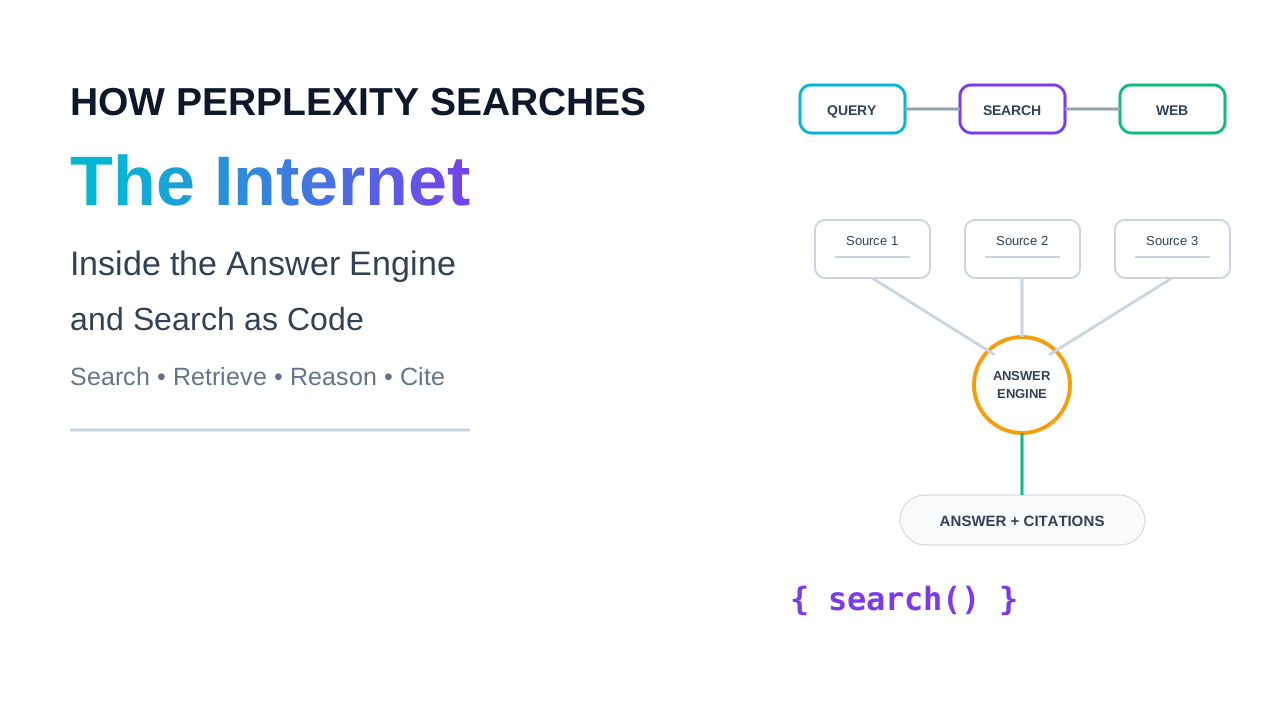
For nearly three decades, “search engine” meant one specific shape of product: type a query, receive ten blue links ranked by relevance, and go do the actual work of reading, comparing, and synthesizing yourself. This design wasn’t an oversight — it was the correct architecture for the audience it served. A search engine built for human users has to respect how humans actually consume information: skimming headlines, comparing snippets, clicking through to the two or three sources that look most credible, and building an answer in their own head. The entire engineering discipline of classic search — crawling, indexing, PageRank-style authority scoring, query matching — was optimized around producing a single, predictable output shape: a ranked results page that a human would scan.
Large language models exposed a gap in that design the moment they became capable of reading and synthesizing at scale. If a system can read fifteen sources, cross-reference their claims, and write a coherent, cited paragraph faster than a human can skim the first three search results, then handing that system a results page and asking it to behave like a human clicking through links is a mismatch — it’s making a fundamentally different kind of consumer conform to an interface built for a different kind of consumer. Perplexity’s founding bet, when it launched its answer engine in 2022, was that this gap was the actual opportunity: rather than returning links for a human to synthesize, build a system that does the retrieval and the synthesis, and shows its work through inline citations rather than leaving the citation-checking as homework for the user.
That bet solved the first, obvious problem — nobody wants ten tabs open when they could have one clear, sourced answer — but it created a second, much harder problem that only became visible as the ambition of the queries people asked kept growing. A single-shot “search the web, summarize, cite” pipeline is a fine architecture for a factual question with a fairly narrow information need. It falls apart once you ask something that genuinely requires dozens or hundreds of distinct searches, cross-referencing, filtering, and aggregation to answer correctly — something like “find every high-severity CVE disclosed between 2023 and 2025 for each of these fifteen vendors, cite each vendor’s own advisory, and confirm which patched version actually fixes it.” A traditional retrieval pipeline, even an AI-optimized one, is built around a fixed contract: accept a query, run one predetermined pipeline, return one processed result set. That contract works when the model’s job is to consume search results. It becomes the bottleneck the moment the model’s job is to orchestrate an investigation — deciding, task by task, what to search next based on what it just learned, the same way a human research analyst works, except needing to do it not three or four times but potentially thousands of times within a few minutes.
This is the exact problem Perplexity’s engineering team has written about explicitly and in detail across 2025 and 2026: the tension between search built for predictable, single-shot queries, and search built for open-ended, code-driven agents that need to compose their own retrieval strategy on the fly. Understanding how Perplexity actually searches the internet today means understanding both halves of that story — the original answer-engine pipeline that made it famous, and the newer, more radical architectural shift the company calls Search as Code, which rethinks what “a search API” should even look like once the primary consumer is an AI agent rather than a human typing into a box.
Building the Mental Model: From “Answer Engine” to “Programmable Search Substrate”
The foundational idea: retrieval before generation, not generation from memory alone
The first mental model worth fixing is the one that separates Perplexity from a plain chatbot answering from what it memorized during training. Every substantive query triggers live retrieval from the current web before any answer is written — the model doesn’t answer from a frozen snapshot of what it learned months or years ago, it answers from what it just read moments ago. This is the direct, practical reason Perplexity-style answers tend to be current in a way a pure language-model chat response often isn’t: the freshness comes from the retrieval step happening every time, not from the underlying model having a more recent training cutoff.
The second idea: an answer engine reads and synthesizes, it doesn’t just rank
The distinguishing design choice, relative to a traditional search engine, is what happens after retrieval. A classic search engine’s job ends once it hands back a ranked list. An answer engine’s job is only half done at that point — it then has to read the actual content of the retrieved pages, reconcile what they say (including cases where sources disagree with each other), and produce a coherent written answer with inline citations pointing back to exactly which source supports which claim. This is a genuinely different computational problem than ranking, and it’s the reason the underlying pipeline needs both a retrieval system tuned for a human audience’s expectations of authority and recency, and a language model tuned specifically for grounded synthesis rather than open-ended conversation.
The third, newer idea: search as something the model programs, not something the model merely calls
This is the mental model that separates Perplexity’s current architecture from the “answer engine” framing that made it famous, and it’s worth building carefully because it’s a genuinely different way of thinking about what a search API even is. In the traditional model — the one nearly every AI product still uses in 2026 — a search capability is exposed to a model as a single function call: the model produces a query string, the search system runs a fixed, predetermined internal pipeline against it, and returns a processed, ready-to-read result set. The model’s only lever of control is the query text itself; everything downstream of that — how results are ranked, filtered, deduplicated, how many are fetched, how they’re combined across multiple related searches — is baked into the search system’s own fixed logic, entirely outside the model’s reach.
Perplexity’s engineering team has argued, in detail, that this boundary was drawn in the right place for a human user — nobody wants to hand-configure a ranking algorithm before typing a question into a search box — but in the wrong place for an AI agent capable of writing and executing its own code. The alternative architecture, which the company calls Search as Code, moves that boundary dramatically lower: instead of exposing search as one fixed function a model calls, it exposes the individual building blocks of the search stack — raw retrieval, ranking, filtering, deduplication, semantic extraction — as a programmable SDK that a model can assemble into a custom-built pipeline, written as real, executable code, tailored to exactly what a specific task needs.
The analogy that makes this click
Picture the difference between ordering a fixed combo meal at a counter versus being handed a fully stocked professional kitchen. The combo meal — the traditional search-as-a-function-call model — is fast, predictable, and perfectly adequate when what you want closely matches one of the options already on the menu. But if what you actually need is something the menu was never designed to produce — a very particular combination of a dozen specific ingredients, prepared in a specific sequence, adjusted based on how the first few steps turn out — no amount of creative ordering at the counter gets you there. Being handed the kitchen itself, with the raw ingredients and the tools to combine them however the dish actually requires, is what lets you build something the menu-based system structurally could not offer. Search as Code is the professional kitchen: the model isn’t limited to configuring the parameters of a fixed pipeline, it’s writing and running actual code that composes retrieval, filtering, and extraction primitives however the specific task demands — potentially thousands of individual operations within a single work session, something no human typing queries by hand, and no model limited to one fixed search function per turn, could ever practically do.
Internal Working Deep Dive: The Full Pipeline, From a Question to a Cited Answer
This section traces two related but distinct pipelines: the classic answer-engine flow that handles the overwhelming majority of everyday queries, and the newer, code-driven architecture that handles Perplexity’s most demanding agentic and research workloads. Understanding both, and why the second one exists on top of the first rather than replacing it, is the core of understanding how the system actually works end to end.
The classic pipeline: query understanding, retrieval, ranking, and grounded synthesis
Step one: query understanding and decomposition. Before any retrieval happens, the system interprets what’s actually being asked — including recognizing when a query implies a specific domain that should reshape the search strategy entirely. A question that’s clearly academic in nature, one that’s clearly a math or science computation, one that’s clearly seeking recent video content, or one aimed at a specific community’s discussion — each of these benefits from a different retrieval strategy, which is the underlying reason Perplexity exposes distinct focus modes (Academic, which restricts sources to research papers; Wolfram Alpha–backed computation for math and science; Reddit-scoped retrieval for community discussion; YouTube-scoped retrieval that searches video transcripts specifically) rather than treating every query identically. For a query with several distinct information needs bundled together, the system also has to decide whether it can be answered with one retrieval pass or needs to be broken into several sub-questions retrieved separately and reconciled afterward.
Step two: live retrieval against a current, continuously updated web index. The system dispatches the (possibly decomposed) query against its retrieval infrastructure, which is built specifically to surface current, live content rather than relying on a search index that only gets refreshed on a slow cycle — this is the mechanical reason Perplexity can answer “what happened in the news this morning” in a way a system relying solely on a static, infrequently-refreshed corpus cannot.
Step three: identifying trustworthy sources and compressing them into dense, model-ready context. Retrieval doesn’t just return whole pages — a full web page dumped raw into a model’s context is exactly the kind of low-information-density content that degrades an LLM’s ability to reason precisely, the same “context rot” problem that shows up across every serious agentic AI system. Perplexity’s research team has published specifically on this problem under the banner of query-aware context compression: rather than handing the model an entire page, the system identifies the specific sub-document passages that are actually relevant to this query, and compresses retrieved content down to the highest-information-density form that still preserves what’s needed to answer accurately and cite correctly. This is a deceptively important engineering detail — the quality of an AI-generated answer is bounded as much by how well-curated its input context is as by the underlying model’s raw capability, and a system that retrieves the right pages but feeds the model bloated, noisy full-text loses much of that advantage.
Step four: grounded synthesis with inline citation. Only after retrieval and compression does language-model generation happen, and it happens under an explicit constraint that distinguishes an answer engine from a general-purpose chatbot: the model is directed to synthesize its answer specifically from the retrieved, cited context rather than from what it may have memorized during training, and to attach an inline citation to each claim pointing back to the specific source that supports it. This is what allows a user to verify a specific sentence against its source directly, rather than trusting the answer as an unverifiable black box — and it’s also, mechanically, what tends to reduce the specific failure mode of a language model confidently stating something that isn’t actually true, because the model’s job at generation time is framed as reporting what the retrieved sources say, not freely recalling facts from memory.
Step five: model routing and specialization. Not every query is served by the same underlying model. Perplexity develops its own models purpose-built for this pipeline — the Sonar family, tuned specifically for fast, search-grounded synthesis rather than general conversation — while also giving users on paid tiers the ability to route a given question to a different frontier model from another lab entirely, and even, on its highest tier, running a single query across multiple frontier models simultaneously and surfacing where they agree or disagree. This reflects a deliberate architectural choice: retrieval and synthesis are treated as separable concerns, with the retrieval and compression pipeline staying constant while the “brain” doing the final synthesis is swappable depending on what a user values most for a given query — speed, depth, or cross-checking against multiple independent models.
The newer, deeper pipeline: Search as Code for open-ended, agentic tasks
The classic pipeline above is a single, well-optimized, predetermined sequence — extremely good at what it’s designed for, but rigid in exactly the way described earlier: it can’t be reshaped mid-task based on what earlier retrieval steps revealed, and it can’t scale gracefully to a task that genuinely needs hundreds of distinct, interdependent search operations. For Perplexity’s agentic products — Perplexity Computer, the Agent API — a different architecture handles exactly that class of task, and it’s built around three tightly coupled layers.
The model as control plane. Rather than the model producing a single query string and waiting for a fixed pipeline to run, the model’s actual job is to reason about the overall task, break it into sub-tasks, decide what retrieval and processing strategy each sub-task needs, and then write real, executable code that implements that strategy — not a query parameter, an actual program.
A secure compute sandbox. That generated code doesn’t run inside the model’s own reasoning — it executes in an isolated sandbox environment that provides real, deterministic computation: loops, conditionals, parallel execution, batching, retries, deduplication, all the ordinary tools of a real programming environment, applied specifically to orchestrating search operations. This division of labor is deliberate and important: the model is well-suited to the parts of the task that require judgment — what evidence is actually needed, how to resolve disagreement between sources, when a search strategy needs to change direction — while the sandboxed runtime is well-suited to the parts that are mechanical and benefit from being done precisely and repeatably — fanning a query out into a dozen structured variants, deduplicating thousands of results by URL, filtering out sources that don’t meet a specific criterion.
An SDK exposing the search stack as atomic, composable primitives. This is the piece that makes the whole architecture actually programmable rather than just “search wrapped in a code sandbox”: Perplexity re-engineered its own search infrastructure into a library of low-level, individually callable operations — raw web retrieval, semantic parsing, ranking, filtering — that a model’s generated code can call directly, in whatever combination and sequence a specific task actually needs, rather than being limited to invoking one fixed, all-in-one search function. High-level, end-to-end search still exists inside this SDK as a convenient shorthand for simple, common cases — the model isn’t forced to reinvent basic retrieval from scratch for an ordinary question — but for a task complex enough to need it, the model can reach past that shorthand and orchestrate the underlying primitives directly.
Why this matters mechanically: what a fixed pipeline structurally cannot do
Perplexity’s own published engineering analysis names three specific, recurring failure modes that a fixed, single-shot search pipeline runs into once tasks get complex enough, and each one maps to a concrete mechanical limitation. Coarse context happens when a task needs one narrow, surgical piece of information but the only available search tool is tuned for broad recall, forcing irrelevant material into the model’s context whether it’s needed or not — or, in the opposite case, when a task needs many differently-shaped pieces of information but the model is stuck invoking the same one-size-fits-all pipeline repeatedly, driving up both cost and noise. Failure to leverage domain knowledge happens when a model, partway through a task, realizes something useful about how the search should be structured — blend two particular signal types in a specific way, prioritize a specific class of source, aggregate results by a particular key — but has no way to actually act on that insight because a fixed query-parameter interface simply doesn’t expose that kind of control. Inefficient control flow and context pollution happens when a task genuinely needs non-linear operations — fanning one question out into many query variants, fetching them in parallel, deduplicating and filtering the combined results — but a fixed pipeline forces every one of those steps through a separate, serial round-trip to the model, which is slow and which floods the model’s own context with noisy intermediate state that has no real bearing on the final answer.
A live, published case study makes this concrete: tasked with identifying and verifying over two hundred specific, high-severity security vulnerabilities across many vendors — each requiring the vendor’s own official advisory page as a source, not a third-party aggregator, and each requiring the specific patched version to be explicitly and correctly tied to the specific vulnerability — the code-driven architecture scored perfectly on accuracy while using a small fraction of the token budget a traditional single-shot retrieval pipeline required for the same task, and dramatically outperformed comparable systems built by other AI labs and specialized search-API providers evaluated on the identical task. The mechanism behind that result is exactly the pattern described above: the model’s generated code fanned a single instruction out into hundreds of precisely site-scoped, exact-phrase search queries targeting known official advisory URL formats, ran them in parallel, filtered out non-vendor sources programmatically rather than relying on the model to eyeball each result, used a lightweight secondary model call specifically to identify which vendor-year combinations were still sparse and needed further targeted queries, and finally applied a strict, code-defined verification step that only accepted a match if a specific vulnerability was explicitly and confidently bound to a specific fix version in the vendor’s own text — logic that would have been extremely inefficient to express purely through natural-language reasoning inside the model’s own context, but that’s straightforward and precise once expressed as real code.
Managing state across a long, code-driven investigation
A genuinely tricky engineering problem specific to this architecture is what to do with information a task needs to carry forward across multiple separate turns of model reasoning — for instance, fetching a batch of documents in one step, inspecting a sample of them to decide what to do next in a second step, and then building a further, more targeted search strategy in a third step based on what was learned. Passing all of that intermediate state back and forth through the model’s own token context is exactly the kind of context pollution the whole architecture is designed to avoid. Perplexity’s engineering team evaluated two approaches to this problem: letting the sandbox’s code-execution environment persist in memory across turns the way a long-running interactive coding session would (convenient and token-efficient, but prone to the same kind of cluttered, hard-to-track state that makes a very long, messy interactive notebook difficult to reason about), versus writing intermediate results explicitly to a persistent file system between turns, with an explicit save-and-reload step in the generated code each time. The team’s own published finding favored the more explicit, file-based approach for long, complex trajectories specifically because forcing state to be declared and saved explicitly, rather than left implicitly lingering in memory, made it more reliable for the model to keep track of exactly what it had already learned and why, over long, many-step investigations.
Engineering Implementation: The Shape of a Composable Search Primitive
Understanding this architecture is most useful when grounded in the shape of what a composable search SDK actually looks like in practice. The illustration below reflects the general pattern Perplexity has publicly described — atomic, individually callable primitives that generated code composes together — rather than a reproduction of any proprietary internals.
from dataclasses import dataclass
from typing import Callable


@dataclass
class SearchHit:
    url: str
    text: str
    vendor_hint: str | None = None


def web_search_many(queries: list[dict], limit_per_query: int = 8, concurrency: int = 12) -> list[list[SearchHit]]:
    """
    An atomic retrieval primitive, not a fixed end-to-end pipeline.
    The MODEL decides the query templates, the fan-out strategy, and the
    concurrency -- this function just executes exactly what it's told,
    in parallel, rather than owning any of the retrieval strategy itself.
    """
    # ... dispatches all queries concurrently against the live search index ...
    return []


def official_source_only(hits: list[SearchHit], is_official: Callable[[str], bool]) -> list[SearchHit]:
    """
    A filtering primitive the model's own generated code decides when and
    how to apply -- e.g. restricting results to a vendor's own advisory
    domain and rejecting aggregators, which would be awkward to express
    as a single query-string parameter but is trivial as a code predicate.
    """
    return [h for h in hits if is_official(h.url)]


def dedupe_by_url(hit_batches: list[list[SearchHit]]) -> list[SearchHit]:
    """
    A deterministic, mechanical operation -- exactly the kind of step
    that belongs in the sandbox's code runtime rather than being reasoned
    about token-by-token inside the model's own context.
    """
    seen, unique_hits = set(), []
    for batch in hit_batches:
        for hit in batch:
            if hit.url not in seen:
                seen.add(hit.url)
                unique_hits.append(hit)
    return unique_hits


def extract_structured(hits: list[SearchHit], schema: dict, instruction: str) -> list[dict]:
    """
    A model-backed extraction primitive: a smaller, focused model call
    applied to many candidates at once, used here as a VERIFICATION step
    -- separate from the main reasoning model driving the overall task --
    to enforce a strict, schema-defined relation (e.g. 'this page must tie
    one specific vulnerability to one specific fixed version') rather than
    trusting the top-level model's own judgment on every single candidate.
    """
    return []


def run_investigation(vendor_query_templates: list[tuple[str, str]]) -> list[dict]:
    """
    This is the kind of orchestration a MODEL generates and the sandbox
    executes -- not a fixed pipeline the search system owns. The specific
    fan-out, filtering, and verification strategy below is exactly the
    sort of task-specific logic a rigid, single function-call interface
    could never express.
    """
    queries = [
        {"vendor": vendor, "query": template}
        for vendor, template in vendor_query_templates
    ]
    hit_batches = web_search_many(queries, limit_per_query=8, concurrency=12)
    candidates = dedupe_by_url(hit_batches)
    official_candidates = official_source_only(candidates, is_official=lambda u: "advisories" in u)

    verified = extract_structured(
        official_candidates,
        schema={"cve": str, "fix_version": str, "confidence": float},
        instruction="Keep only pages that explicitly bind a vulnerability to a specific fixed version.",
    )
    return [v for v in verified if v.get("confidence", 0) > 0.75]
Why each design decision exists
Atomic primitives instead of one all-in-one function. Exposing web_search_many, official_source_only, dedupe_by_url, and extract_structured as separate, individually callable building blocks — rather than bundling all of this logic inside one opaque search() call — is precisely what lets a model’s own generated code decide the strategy rather than being locked into whatever strategy the search system’s designers happened to bake in ahead of time. A model facing a task that needs a different combination of these steps, in a different order, with different filtering logic, can simply write different code against the same primitives, without needing the underlying search infrastructure to have anticipated that exact combination in advance.
Deterministic operations live in code, not in model reasoning. Deduplicating thousands of URLs, or filtering a result set by a structural property of the URL itself, is mechanical, precise work that a real programming runtime performs perfectly and cheaply. Asking a language model to perform the equivalent operation by reasoning over a giant wall of text in its own context is slower, more expensive, and meaningfully more error-prone — this is the direct, practical reason the sandboxed code-execution layer exists as a distinct component rather than folding everything into model-side reasoning.
A separate, schema-constrained extraction call for verification. Using a focused, structured extraction call — applied uniformly across every candidate, checked against an explicit schema — rather than relying on the top-level reasoning model’s own unaided judgment to decide, one at a time, whether each retrieved page actually satisfies a strict relationship is what makes a task like the CVE-verification case study reliable at scale: consistency across hundreds of candidates matters more here than any single judgment call, and a narrow, repeatable extraction step delivers that consistency far more reliably than open-ended reasoning would.
A confidence threshold as an explicit, code-level gate. Filtering the final result set on an explicit numeric confidence threshold, expressed directly in code, is a concrete example of the model encoding its own domain judgment about acceptable error tolerance directly into the pipeline’s actual execution — exactly the kind of insight a rigid, query-parameter-only interface has no mechanism for a model to act on.
Common implementation mistakes when building this kind of system
A frequent mistake in less carefully engineered agentic-search systems is dumping full, uncompressed page content into a model’s context the moment it’s retrieved, rather than applying a dedicated compression step first — this is precisely the context-rot failure mode described earlier, where more tokens measurably degrade answer quality rather than improving it, and it’s avoidable with a disciplined compression step between retrieval and generation. Another common mistake is treating every query identically regardless of its actual character — routing an academic research question through the same general-purpose retrieval pipeline as a request for a recent product recommendation discards useful, cheaply available structure about what kind of sources are actually likely to be authoritative for that specific kind of question. A third, more architectural mistake specific to agentic systems is passing all intermediate task state through the model’s own token context rather than an explicit, persistent store — this both bloats cost and, as Perplexity’s own team found, tends to become genuinely harder for a model to reliably track across a long, many-step investigation, in much the same way an overly cluttered, long-running interactive coding session becomes hard for a human to reason about.
Real-World Systems: How This Plays Out in Practice
Perplexity’s own published benchmarking gives one of the clearest available head-to-head comparisons of this architectural bet against alternative approaches from other AI labs and specialized search-API companies, evaluated on identical, independently sourced benchmarks measuring exactly the kind of deep, knowledge-intensive research tasks this whole architecture was built for. Across a suite spanning open-ended research benchmarks and a purpose-built “wide research” benchmark modeled on the kind of complex, professional research tasks the company’s agentic products handle for real users, the code-driven architecture led on the large majority of benchmarks tested, with the size of its advantage growing sharply on the hardest, most open-ended tasks — the ones requiring the most extensive, non-linear orchestration of many interdependent search operations rather than a single well-defined lookup. Just as tellingly, the same underlying search infrastructure, evaluated with the newer code-driven interface against the older, single-shot pipeline built on identical retrieval systems, showed the code-driven version winning by a wide margin on every benchmark tested — direct evidence that the improvement comes specifically from how a model is allowed to control the search process, not merely from having better underlying retrieval data to draw on.
At the product level, this architecture underpins several distinct surfaces beyond the original consumer answer-engine chat interface: a dedicated Search API and Agent API that let external developers build on the same underlying infrastructure, a computer-use product built specifically around long-running, multi-step research and task completion, and the Comet browser, which extends the same search-and-synthesis capability into an agentic assistant that can act across a live browsing session rather than only answering a single question in a chat window. The consistent thread across all of these surfaces is the layered design described throughout this article: a fast, well-optimized, single-shot pipeline handles the ordinary case efficiently, while the more expensive, more flexible code-driven architecture is reserved for exactly the class of task — deep, multi-step, genuinely open-ended investigation — where its added complexity earns a real, measurable return.
AI Era Relevance: Why This Points at a Broader Shift in How AI Systems Are Built
The specific engineering story behind how Perplexity searches the internet is also a genuinely useful window into a broader architectural shift reshaping how serious AI systems are built across the whole industry in 2026.
Function calling and MCP were the right first step, and are already showing their limits. The dominant interface pattern for connecting a model to external tools and data — a fixed set of named functions the model can call, one at a time, each requiring its own round-trip to model inference — was a genuinely good fit for the earlier generation of relatively simple, low-volume AI tasks. Perplexity’s own account of moving beyond it for its most demanding workloads is a specific, concrete data point supporting a broader trend: as agents take on longer, more open-ended tasks requiring potentially thousands of tool interactions, the overhead and rigidity of a strictly serial, one-call-at-a-time interface becomes the actual bottleneck, not the underlying model’s intelligence.
Code generation as an orchestration layer, not just an end product, is a pattern spreading well beyond search. Treating code as the medium through which a model coordinates many lower-level operations — rather than treating code generation purely as a task where the code itself is the final deliverable — is a design pattern showing up across agentic AI more broadly, from coding assistants that write orchestration scripts to drive multi-file changes, to data-analysis agents that write and execute their own processing pipelines rather than describing an analysis in prose. Search as Code is a particularly well-documented, rigorously benchmarked instance of this broader pattern, which makes it a useful reference case for understanding the pattern generally.
Context engineering — deciding what a model doesn’t see, not just what it does — keeps re-emerging as the deciding factor in system quality. The query-aware compression work underlying Perplexity’s retrieval pipeline, and the deliberate choice to keep intermediate search state out of the model’s own token context in the agentic architecture, are both instances of the same broader principle showing up across virtually every serious agentic AI system built in 2026: raw access to more information is not the same thing as better performance, and the systems that perform best are consistently the ones that most carefully curate what actually reaches the model’s context, not the ones that simply retrieve the most.
RAG itself is evolving from a fixed pipeline into something models actively drive. The tension Perplexity’s engineering team describes — between retrieval-augmented generation as a rigid, predetermined pipeline versus retrieval as a set of composable primitives an agent actively orchestrates — mirrors a broader rethinking of RAG architecture happening across the field, as more systems move from “retrieve once, generate once” toward iterative, agent-driven retrieval loops that adapt mid-task based on what earlier retrieval steps actually turned up.
Advantages, Limitations, and Trade-offs
Advantage: dramatically better performance on genuinely open-ended, knowledge-intensive tasks. The published benchmark results are specific and measurable, not just directional: the code-driven architecture’s advantage over both the traditional single-shot pipeline and comparable systems from other providers grows sharply as tasks become more complex and more dependent on non-linear, adaptive search strategy — precisely the class of task that’s becoming more common as AI systems are trusted with longer, more consequential research work.
Advantage: meaningfully lower cost for complex tasks, not just better accuracy. The published case study’s token-usage reduction, on a task where the code-driven approach also scored far higher on accuracy, illustrates that this isn’t a pure speed-for-quality trade-off — precise, code-driven filtering and deduplication genuinely reduces the volume of irrelevant content that ever needs to reach the model’s context in the first place, which lowers cost and improves accuracy simultaneously rather than trading one against the other.
Limitation: this architecture is deliberately reserved for the tasks that actually need it. Running model-generated code inside a secure sandbox, coordinating multiple layers of infrastructure, and reasoning about a custom retrieval strategy is real, added engineering complexity and real added latency relative to a single, well-optimized fixed pipeline. For the large majority of everyday queries — a straightforward factual question, a simple current-events lookup — the classic single-shot pipeline remains the right tool, and Perplexity’s own architecture reflects this explicitly by keeping high-level, end-to-end search available as a convenient shorthand rather than forcing every query through full custom orchestration.
Limitation: teaching a model to use a custom SDK well is a nontrivial, ongoing problem. Unlike a widely used general-purpose programming library, a purpose-built internal SDK has essentially no representation in a model’s pretraining data, which means a model isn’t naturally fluent in it the way it might be fluent in, say, common Python data-processing libraries. Perplexity’s own account of needing dedicated, carefully tuned instructional material to teach models to use its SDK effectively — and of continuously refining both the SDK’s design and that instructional material through ongoing automated evaluation — illustrates a real, recurring cost of any custom-tool architecture: the tool is only as useful as the model’s actual fluency with it, and that fluency has to be actively built and maintained, not assumed.
Trade-off: even the most advanced version of this architecture is not saturated on the hardest tasks. Perplexity’s own published results are notably honest on this point: even its best-performing configuration, while leading every other system tested by a wide margin on the hardest, most open-ended “wide research” benchmark, still leaves substantial room for improvement on that same benchmark — a useful reminder that even a genuinely superior architecture doesn’t fully solve the underlying problem of deep, multi-step, real-world research; it meaningfully advances the frontier without claiming to have reached the ceiling.
Career Impact and What to Learn Next
Understanding how modern AI search actually works — not just as a user typing queries, but as an engineer reasoning about retrieval, context compression, and agentic orchestration — has become a genuinely practical skill spanning several adjacent, fast-growing roles: search and retrieval infrastructure engineering, AI agent and tool-use system design, and the broader discipline of context engineering that’s increasingly treated as distinct from, and just as important as, prompt engineering itself. Interview processes for roles touching agentic AI systems increasingly probe candidates on exactly the kind of trade-off explored in this article: when a fixed, well-optimized pipeline is the right tool versus when a task’s genuine complexity calls for a more flexible, code-driven architecture, and why naively maximizing the amount of retrieved content fed into a model’s context tends to hurt rather than help.
If this space is new to you, the most useful next steps are studying retrieval-augmented generation from first principles, since it’s the shared foundation underneath every answer-engine and agentic-search architecture discussed here; reading published, benchmarked comparisons of agentic search architectures directly, since the specific, measured trade-offs in a rigorous case study teach far more than a general description ever can; and, most practically, paying close attention the next time you use an AI research or search product to which sources it actually cites and how it handles a genuinely complex, multi-part question relative to a simple one — that difference in behavior is the clearest possible signal of how much orchestration is actually happening underneath the interface.
Final Thought
The deeper story behind how Perplexity searches the internet isn’t really about search at all — it’s about a broader, ongoing renegotiation of where the boundary should sit between what a model decides and what a fixed system decides on its behalf. The original answer-engine insight — that reading and synthesizing sources is work an AI system can now do faster and more thoroughly than a human clicking through links — solved the first version of this problem. The harder, more recent insight — that even an AI-optimized search pipeline becomes a bottleneck once the model’s job shifts from consuming search results to orchestrating an entire investigation — is pushing the boundary further still, toward architectures where the model doesn’t just ask a question of the search system, it actively programs it. That shift, from calling search to coding search, is a genuinely instructive preview of where a great deal of serious AI system design is headed: not toward bigger, more capable black-box tools that a model politely requests things from, but toward smaller, more composable primitives that a sufficiently capable model can assemble into exactly the tool a given task actually needs — a design principle worth understanding well beyond search itself.
Further Reading / External Links
- Perplexity Research — Rethinking Search as Code Generation
- Perplexity Research — Architecting and Evaluating an AI-First Search API
- Perplexity Research — Query-Aware Context Compression for Better Snippets
- Perplexity Help Center — What Is an Answer Engine, and How Does Perplexity Work as One?