Why Zero-ETL Matters in 2026+
For over a decade, ETL (Extract, Transform, Load) pipelines have been the backbone of data engineering. From batch jobs in Hadoop to modern streaming architectures using Kafka and Spark, organizations have relied on complex pipelines to move and transform data before analysis.
But in 2026, a disruptive paradigm is gaining serious traction: Zero-ETL.
Major cloud providers like AWS (Aurora Zero-ETL with Redshift), Google BigQuery Omni, and Snowflake Native Data Sharing are pushing a bold idea:
What if we eliminate data pipelines altogether?
This is not just a buzzword—it’s a fundamental shift in how data systems are designed, especially for:
- Real-time analytics
- AI/ML pipelines
- Event-driven architectures
- SaaS-scale distributed systems
Why this matters today:
- Data volumes are exploding (petabytes → exabytes)
- Real-time insights are now mandatory (not optional)
- Maintaining pipelines is costly and fragile
- AI systems demand fresh, consistent, low-latency data
Zero-ETL promises:
- No data movement
- No duplication
- No pipeline maintenance
But is it truly the end of traditional ETL?
Let’s break it down—from fundamentals to deep system design.
What is Traditional ETL?
Definition
ETL is a data integration process:
- Extract – Pull data from source systems (DBs, APIs, logs)
- Transform – Clean, aggregate, normalize
- Load – Store in a target system (data warehouse)
Example Pipeline
Imagine an e-commerce system:
- Orders stored in MySQL
- ETL job extracts data nightly
- Transforms into analytics schema
- Loads into data warehouse (e.g., Redshift)
Typical Architecture (Text Diagram)
[ OLTP DB ] → [ ETL Jobs ] → [ Data Lake ] → [ Warehouse ] → [ BI Tools ]
                  ↓
           (Spark / Airflow)
Problems with Traditional ETL
- Latency: Data is often stale (minutes → hours)
- Complexity: Dozens of pipelines to maintain
- Cost: Compute + storage duplication
- Data drift issues
- Schema mismatches
What is Zero-ETL?
Definition
Zero-ETL is a data architecture approach where:
Data is queried directly from source systems or automatically synchronized without explicit pipelines.
Instead of moving data, you access it in place or replicate it seamlessly.
Key Idea
Bring compute to data, not data to compute.
Core Concepts of Zero-ETL
1. Data Virtualization
Instead of copying data:
- Query data where it lives
Example:
- Query MySQL directly from the analytics engine
2. Real-Time Replication
Data is continuously synced using:
- Change Data Capture (CDC)
- Log-based replication
3. Unified Query Engines
Single query interface across multiple sources:
SELECT * FROM mysql.orders JOIN s3.logs ON ...
4. No Intermediate Storage Layers
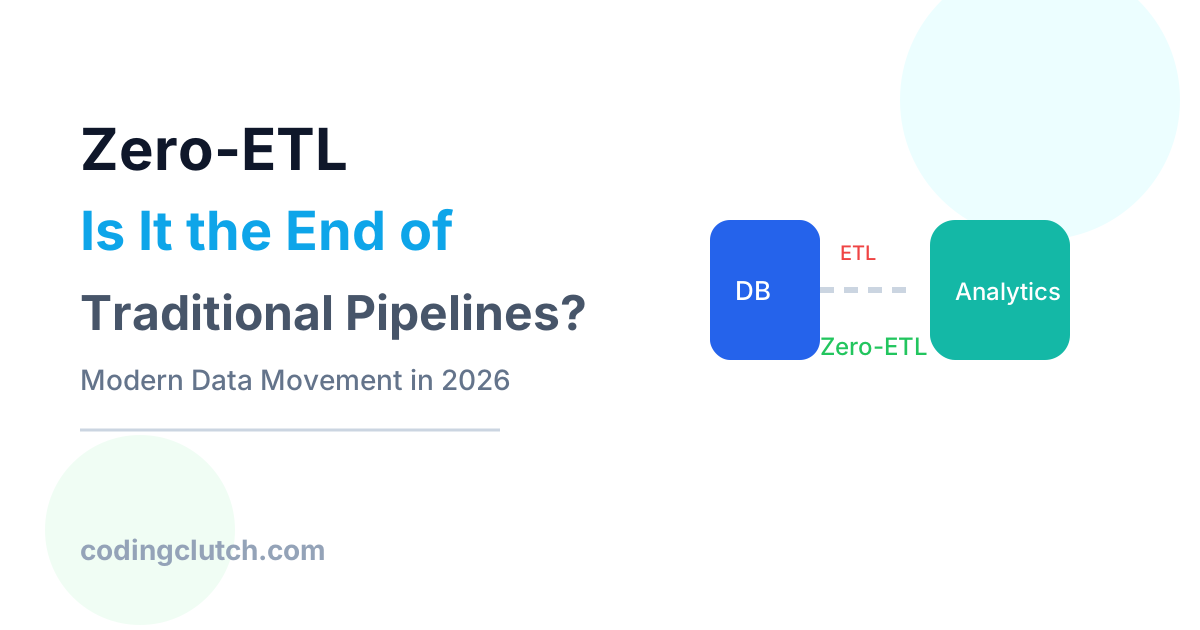
Traditional:
Source → Staging → Warehouse
Zero-ETL:
Source → Query Engine → Insights
Zero-ETL Architecture (Deep Dive)
High-Level Architecture
           +-------------------+
           |   Source Systems  |
           | (DBs, APIs, SaaS)|
           +---------+---------+
                     |
         (CDC / Direct Query / Federation)
                     |
        +------------v------------+
        |  Unified Query Engine   |
        | (Snowflake / BigQuery)  |
        +------------+------------+
                     |
               +-----v------+
               | AI / BI    |
               | Dashboards |
               +------------+

Internal Working
1. Change Data Capture (CDC)
CDC tracks changes in source databases:
- INSERT
- UPDATE
- DELETE
How it works:
- Reads DB logs (WAL, binlog)
- Streams changes to analytics system
Time Complexity:
- O(n) for number of changes
- Efficient for incremental updates
2. Data Federation Layer
A query planner:
- Parses SQL
- Pushes computation to source systems
Example:
SELECT * FROM postgres.users WHERE age > 25
Instead of copying data:
- Executes query on Postgres
- Returns result
3. Query Optimization
Techniques used:
- Predicate pushdown
- Column pruning
- Distributed execution
4. Storage Abstraction
Modern systems use:
- Columnar storage (Parquet, ORC)
- Distributed object storage (S3, GCS)
Code Example: CDC Pipeline (Python)
Let’s simulate a simple CDC system using Python.
# Python Example: Simulated CDC Stream

import time
import random

def generate_db_changes():
    operations = ['INSERT', 'UPDATE', 'DELETE']
    return {
        "operation": random.choice(operations),
        "table": "orders",
        "data": {
            "order_id": random.randint(1, 100),
            "amount": random.randint(100, 5000)
        }
    }

def stream_changes():
    while True:
        change = generate_db_changes()
        print(f"Streaming change: {change}")
        # In real-world: push to Kafka / stream system
        time.sleep(2)

if __name__ == "__main__":
    stream_changes()
Real-world equivalent:
- Debezium (CDC tool)
- Kafka Streams
- AWS DMS
Code Example: Federated Query (SQL)
-- Query across systems without ETL

SELECT
    u.user_id,
    u.name,
    o.order_amount
FROM mysql_db.users u
JOIN analytics_db.orders o
ON u.user_id = o.user_id
WHERE o.order_amount > 1000;
No data duplication. Query happens across systems.
Zero-ETL in AI & Modern Systems
1. Machine Learning Pipelines
Traditional:
- Data → ETL → Feature store → Model
Zero-ETL:
- Direct access to fresh data
- Real-time feature computation
Used in:
- Fraud detection
- Recommendation systems
2. LLM Applications
LLMs need:
- Fresh data
- Contextual queries
Zero-ETL enables:
- Direct querying of knowledge bases
- Real-time embeddings
3. Streaming Systems
Works well with:
- Kafka
- Pulsar
- Flink
Real-time pipelines → Zero-ETL interface
4. Cloud-Native Systems
Modern tools:
- Snowflake
- BigQuery
- Databricks Delta Lake
- AWS Aurora Zero-ETL
Real-World Use Cases
1. E-commerce Analytics
- Real-time sales dashboards
- No nightly ETL jobs
2. FinTech Fraud Detection
- Immediate transaction analysis
- Low-latency queries
3. SaaS Monitoring Systems
- Logs analyzed in real-time
- No pipeline delays
4. AI-driven Personalization
- User behavior processed instantly
Comparison: ETL vs Zero-ETL
| Feature | Traditional ETL | Zero-ETL |
|---|---|---|
| Data Movement | Required | Minimal / None |
| Latency | High | Low |
| Complexity | High | Lower |
| Cost | High | Reduced |
| Flexibility | Limited | High |
| Debugging | Difficult | Easier |
Trade-offs and Limitations
Zero-ETL is powerful—but not perfect.
1. Performance Bottlenecks
- Querying source systems directly can overload them
2. Limited Transformations
- Complex transformations still require pipelines
3. Security Concerns
- Direct access to production systems
4. Vendor Lock-in
- Many Zero-ETL solutions are cloud-specific
5. Data Governance Challenges
- Harder to enforce schemas and validation
When to Use Zero-ETL vs ETL
Use Zero-ETL when:
- Real-time analytics required
- Data volume is manageable
- Simple transformations
Use ETL when:
- Heavy transformations needed
- Historical aggregation required
- Data needs cleaning and normalization
Best Practices
1. Hybrid Approach
Combine:
- Zero-ETL (real-time)
- ETL (batch analytics)
2. Use CDC Efficiently
- Avoid full-table scans
- Use incremental updates
3. Optimize Queries
- Use indexing
- Predicate pushdown
4. Monitor Source Systems
- Prevent overload from queries
5. Security
- Role-based access control
- Data masking
Interview Perspective
Common Questions
- What is Zero-ETL?
- How does CDC work?
- Difference between ETL and ELT vs Zero-ETL?
- When would you avoid Zero-ETL?
- How do you design a real-time data system?
What Interviewers Expect
- Clear understanding of trade-offs
- System design thinking
- Knowledge of modern tools
- Ability to justify architecture decisions
Common Mistakes
- Assuming Zero-ETL replaces everything
- Ignoring data transformation needs
- Overlooking system load
Future Scope (Next 5 Years)
Trends
- AI-driven data pipelines
- Serverless data architectures
- Data mesh + Zero-ETL integration
- Real-time analytics becoming default
Career Relevance
If you’re:
- Backend developer → Understand data flow
- ML engineer → Need real-time features
- System designer → Must know trade-offs
Zero-ETL is highly relevant
Is Zero-ETL the End of Traditional Pipelines?
Short Answer: No.
Long Answer:
Zero-ETL is not a replacement—it’s an evolution.
Think of it like:
- Microservices didn’t kill monoliths
- They changed how we design systems
Similarly:
- ETL will still exist
- But its role will shrink
Zero-ETL is one of the most important shifts in modern data engineering.
Key Takeaways
- Eliminates unnecessary data movement
- Enables real-time analytics
- Reduces complexity and cost
- Not suitable for all use cases
When Should You Learn It?
- If you’re preparing for FAANG/system design interviews
- If you’re working with AI or real-time systems
- If you’re building scalable cloud applications
Final Thought
The future is not “ETL vs Zero-ETL” — it’s knowing when to use each intelligently.
Understanding Zero-ETL today gives you a competitive edge in designing next-generation systems.