A Deep Dive into Autonomous AI Systems that Can Think, Act, and Iterate
Why Agentic Workflows Matter in 2026+
The evolution of software engineering is entering a new phase—agent-driven systems. Traditional applications execute predefined logic. Modern AI systems, however, decide what to do next.
Welcome to the world of agentic workflows.
In 2026, companies are no longer just deploying LLM-powered chatbots—they are building autonomous agents that can:
- Browse the web for real-time data
- Execute code and validate outputs
- Edit files and manage systems
- Plan multi-step tasks dynamically
Frameworks like LangGraph (by LangChain ecosystem) are enabling developers to build stateful, multi-step AI workflows that resemble real-world decision-making systems.
Real-World Examples
- GitHub Copilot Agents → Debug and refactor code autonomously
- AI DevOps Assistants → Monitor logs, fix configs, redeploy
- Research Agents → Crawl web, summarize, synthesize insights
- Autonomous Data Pipelines → Extract → Transform → Validate → Store
The key shift is:
From “LLM answering questions” → to “LLM taking actions”
What is an Agentic Workflow?
An agentic workflow is a system where an AI agent:
- Perceives input (user query, system state)
- Plans a sequence of actions
- Executes tools (API calls, code, file operations)
- Observes results
- Iterates until the goal is achieved
Real-World Analogy
Think of a junior software engineer:
- Reads a ticket
- Searches documentation
- Writes code
- Tests output
- Fixes bugs
- Submits PR
An agentic system mimics this loop.

Why LangGraph?
LangGraph is designed to solve the limitations of traditional LLM pipelines:
| Problem | Traditional LLM Chains | LangGraph |
|---|---|---|
| Stateless execution | Yes | No |
| Multi-step reasoning | Limited | Native |
| Looping workflows | Hard | Easy |
| Tool orchestration | Manual | Structured |
| Fault recovery | Weak | Built-in state |
Core Idea
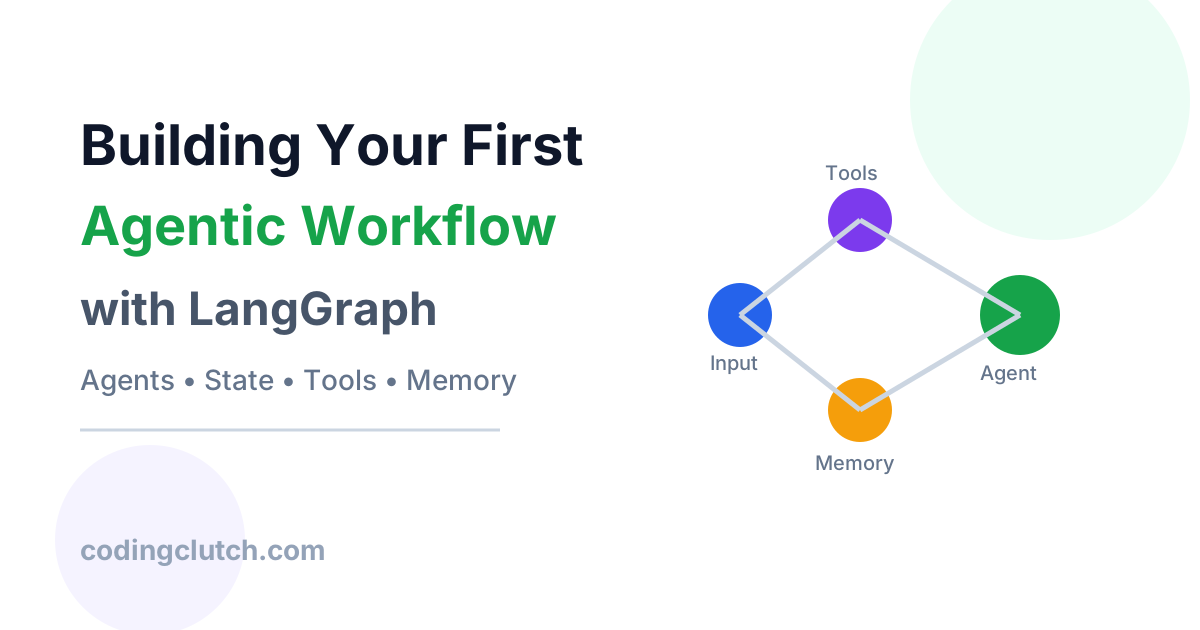
LangGraph represents workflows as a graph of nodes:
- Nodes = tasks (LLM calls, tools, logic)
- Edges = transitions between steps
- State = shared memory across steps
Core Concepts (Step-by-Step)
1. State
The state is a shared object passed between nodes.
from typing import TypedDict

class AgentState(TypedDict):
    input: str
    output: str
    intermediate_steps: list
Think of it as a global context.
2. Nodes
Each node is a function:
def agent_node(state: AgentState):
    # Process input
    return {"output": "processed"}
Types of nodes:
- LLM Node → reasoning
- Tool Node → action (API, code)
- Decision Node → routing logic
3. Edges (Control Flow)
Edges define transitions:
- Linear: A → B → C
- Conditional: A → (B or C)
- Loop: A → B → A
4. Graph Execution
LangGraph executes:
Start → Node1 → Node2 → Decision → Loop/End
Architecture Deep Dive
High-Level Architecture
User Input
   ↓
State Initialization
   ↓
Planner Node (LLM)
   ↓
Tool Execution Node
   ↓
Result Evaluation Node
   ↓
Decision Node (Continue / Stop)
   ↓
Loop OR Final Output
Internal Working
- Planner (LLM)
- Decides next action
- Generates tool calls
- Executor
- Runs tools (web search, code)
- Observer
- Captures output
- Controller
- Updates state
- Decides next node
Data Flow Model
State_t → Node → State_t+1
This resembles a finite state machine (FSM) with memory.
Building Your First Agentic Workflow (Hands-On)
Tech Stack
- Python 3.10+
- LangGraph
- LangChain
- OpenAI / local LLM
- Tools (Web search, Python REPL)
Step 1: Install Dependencies
pip install langgraph langchain openai
Step 2: Define State
from typing import TypedDict, List

class AgentState(TypedDict):
    query: str
    steps: List[str]
    result: str
Step 3: Define Tools
Example: Web Search Tool
def search_web(query: str) -> str:
    # Simulated search
    return f"Results for {query}"
Example: Code Execution Tool
def execute_code(code: str) -> str:
    try:
        exec(code)
        return "Execution successful"
    except Exception as e:
        return str(e)
Step 4: Define Nodes
Planner Node
def planner(state: AgentState):
    query = state["query"]

    if "calculate" in query:
        return {"steps": ["use_code"]}
    else:
        return {"steps": ["search"]}
Tool Node
def tool_executor(state: AgentState):
    step = state["steps"][-1]

    if step == "search":
        result = search_web(state["query"])
    elif step == "use_code":
        result = execute_code("print(2+2)")

    return {"result": result}
Decision Node
def should_continue(state: AgentState):
    if "done" in state.get("result", ""):
        return "end"
    return "continue"
Step 5: Build Graph
from langgraph.graph import StateGraph

builder = StateGraph(AgentState)

builder.add_node("planner", planner)
builder.add_node("tool", tool_executor)

builder.set_entry_point("planner")

builder.add_edge("planner", "tool")
builder.add_edge("tool", "planner")

graph = builder.compile()
Step 6: Run Agent
result = graph.invoke({"query": "search Python tutorials"})
print(result)
Adding Real Agent Capabilities
1. Web Browsing
Use tools like:
- SerpAPI
- Tavily
- Browser automation (Playwright)
2. File Editing
def edit_file(filename, content):
    with open(filename, "w") as f:
        f.write(content)
    return "File updated"
3. Code Execution Sandbox
Use:
- Python REPL tool
- Docker sandbox
- Jupyter kernels
Algorithms & Complexity
Execution Complexity
Let:
- N = number of nodes
- T = number of iterations
Time Complexity:
O(T × N × LLM_cost)
Where LLM cost dominates.
Space Complexity
O(State Size × T)
State grows with history.
Trade-offs and Limitations
Advantages
- Flexible workflows
- Human-like reasoning
- Modular architecture
- Easy tool integration
Limitations
- Expensive (LLM calls)
- Latency issues
- Hallucination risks
- Hard to debug
Comparison: LangGraph vs Alternatives
| Feature | LangGraph | LangChain Agents | AutoGPT |
|---|---|---|---|
| Control | High | Medium | Low |
| State | Persistent | Limited | Yes |
| Debugging | Good | Medium | Poor |
| Production readiness | High | Medium | Low |
AI & Modern System Relevance
1. AI Systems
- Multi-agent collaboration
- Autonomous coding assistants
- Retrieval-Augmented Generation (RAG) pipelines
2. ML Pipelines
- Data cleaning agents
- Feature engineering automation
- Model evaluation loops
3. Distributed Systems
- Event-driven agents
- Microservices orchestration
4. Cloud-Native Systems
- Kubernetes + AI agents
- Serverless AI workflows
Real-World Use Cases
1. Developer Assistants
- Debugging code
- Writing tests
- Refactoring systems
2. Research Automation
- Web crawling
- Data summarization
- Insight generation
3. DevOps Automation
- Log analysis
- Incident response
- Auto-remediation
4. Business Automation
- Report generation
- Email automation
- CRM updates
Best Practices
1. Design Clear State
- Avoid bloated state
- Use structured schemas
2. Limit Loop Iterations
Prevent infinite loops:
if iterations > 5:
    stop()
3. Tool Validation
- Validate inputs
- Sanitize outputs
4. Logging & Observability
- Track each node execution
- Use tracing tools (LangSmith)
5. Security Considerations
- Sandbox code execution
- Restrict file access
- Avoid prompt injection
Interview Perspective
Common Questions
- What is an agent in AI systems?
- Difference between LLM chain and agent?
- Explain LangGraph architecture
- How do agents use tools?
- How do you prevent infinite loops?
What Interviewers Expect
- Understanding of stateful systems
- Ability to design workflows
- Knowledge of LLM limitations
- Practical coding experience
Common Mistakes
- Treating agents as simple chatbots
- Ignoring cost and latency
- Overusing LLM calls
- Not handling failures
Future Scope (Next 5 Years)
Agentic workflows are becoming:
- Core to AI-native applications
- Integral in software engineering automation
- Key to AGI research pipelines
Trends to Watch
- Multi-agent systems
- Self-healing infrastructure
- Autonomous SaaS platforms
- AI copilots for every domain
Agentic workflows represent a paradigm shift in software engineering:
- From static logic → dynamic decision-making
- From APIs → autonomous systems
- From tools → intelligent collaborators
Key Takeaways
- LangGraph enables structured, stateful AI workflows
- Agents can plan, act, observe, and iterate
- Real-world applications are already scaling rapidly
- Mastering this gives you an edge in AI + backend engineering roles
When Should You Learn This?
- If you’re preparing for FAANG/product companies
- If you’re working in AI/ML/backend systems
- If you want to build next-gen applications
Final Thought
“In the near future, writing software won’t just mean writing logic—it will mean designing intelligent systems that can reason, adapt, and act.”
And LangGraph is one of the most powerful tools to get you there.