Why This Comparison Matters in 2026+
The way we build software is undergoing a fundamental shift. We are no longer just writing deterministic programs—we are designing autonomous systems that can plan, reason, and execute tasks independently. These systems, often referred to as agentic AI workflows, are becoming core components of modern software stacks.
In 2026, enterprises are increasingly adopting AI agents to:
- Automate software development workflows
- Handle customer support autonomously
- Perform data analysis and reporting
- Execute multi-step business operations
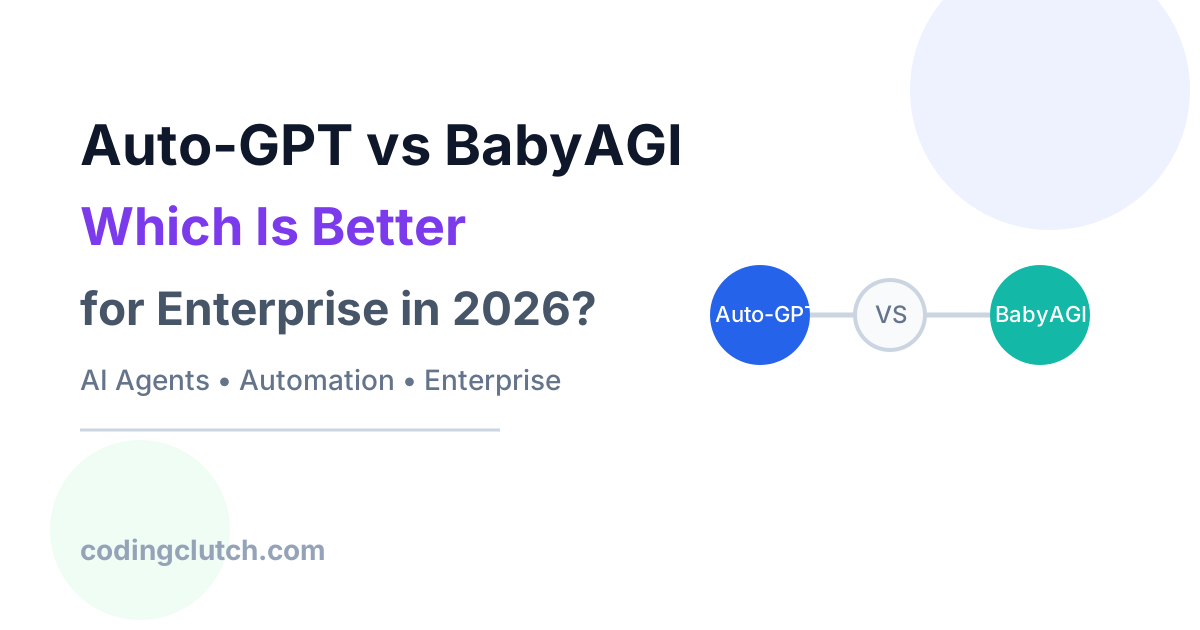
Two early pioneers in this space—Auto-GPT and BabyAGI—have evolved significantly since their initial releases. While both started as experimental open-source projects, they now represent two distinct philosophies in building autonomous agents.
For decision-makers and engineers, the key question is:
Which framework is better suited for enterprise-grade systems in 2026?
This article answers that question in depth, covering architecture, scalability, performance, trade-offs, and real-world applications.
Understanding Agentic AI Systems
Before comparing Auto-GPT and BabyAGI, we need to understand what an agentic system actually is.
What is an AI Agent?
An AI agent is a system that:
- Perceives input (user query, API response, data stream)
- Plans actions (decides what to do next)
- Executes tasks (calls tools, writes code, queries databases)
- Reflects and improves (iteratively refines output)
Core Components of an Agent
Think of an agent like a junior developer:
- LLM (Brain) → reasoning and decision-making
- Memory (Notes/Docs) → past context and learning
- Tools (APIs/Functions) → ability to act
- Planner (Task Manager) → breaks work into steps
Textual Architecture Diagram
User Input
    ↓
LLM Reasoning Engine
    ↓
Task Planner
    ↓
Execution Loop
    ├── Tool Calls (APIs, Code Execution)
    ├── Memory Updates (Vector DB / Cache)
    └── Reflection / Feedback
    ↓
Final Output
This loop is where Auto-GPT and BabyAGI differ significantly.

Auto-GPT: Overview and Philosophy
What is Auto-GPT?
Auto-GPT is designed as a fully autonomous agent framework that:
- Accepts a goal
- Breaks it into tasks
- Executes tasks iteratively
- Self-corrects using feedback loops
Core Idea
“Give me a goal, and I will figure out everything else.”
Key Features (2026 Evolution)
- Multi-agent collaboration support
- Tool integrations (web browsing, code execution, APIs)
- Persistent memory (vector databases like FAISS, Pinecone)
- Reflection loops for self-improvement
- Plugin ecosystem for enterprise integration
BabyAGI: Overview and Philosophy
What is BabyAGI?
BabyAGI focuses on task-driven execution with a minimal architecture. It uses a simpler loop:
- Create tasks
- Prioritize tasks
- Execute tasks
- Generate new tasks
Core Idea
“Maintain a dynamic task list and execute it efficiently.”
Key Features (2026 Evolution)
- Lightweight task management system
- Simple priority queues
- Minimal overhead
- Easy to customize
- Better observability and control
Core Architectural Differences
Auto-GPT Architecture
Auto-GPT uses a recursive planning loop:
Goal → Planning → Execution → Reflection → Re-planning → ...
Components
- Goal Interpreter
- Planner
- Executor
- Memory Module
- Critic/Reflection Engine
BabyAGI Architecture
BabyAGI uses a task queue model:
Task Queue → Execute Task → Generate New Tasks → Reorder Queue
Components
- Task List (Queue)
- Task Executor
- Task Creator
- Task Prioritizer
Technical Deep Dive
1. Task Management Algorithms
BabyAGI: Priority Queue
BabyAGI uses a priority queue to manage tasks.
- Insert: O(log n)
- Remove highest priority: O(log n)
- Space: O(n)
This makes it predictable and efficient.
Auto-GPT: Dynamic Planning Graph
Auto-GPT builds a dynamic execution graph, where:
- Tasks are generated recursively
- Dependencies are implicit
- Re-planning happens frequently
Complexity is harder to define, but it can grow exponentially in worst cases due to recursive loops.
2. Memory Systems
Auto-GPT Memory
- Vector databases (FAISS, Pinecone)
- Long-term + short-term memory
- Semantic search
Time Complexity:
- Retrieval: O(log n) (approx with indexing)
BabyAGI Memory
- Simple storage (often list-based or lightweight vector DB)
- Less reliance on long-term context
Trade-off:
- Faster but less intelligent recall
3. Execution Loop
Auto-GPT Loop
# Python example (simplified)

while not goal_achieved:
    plan = generate_plan(goal, memory)

    for step in plan:
        result = execute(step)
        memory.store(result)

    feedback = evaluate_results(memory)
    goal = refine_goal(feedback)
Key Characteristics:
- Recursive
- Adaptive
- Expensive in computing
BabyAGI Loop
# Python example

task_list = ["Initial task"]

while task_list:
    task = task_list.pop(0)

    result = execute_task(task)

    new_tasks = generate_tasks(result)
    task_list.extend(new_tasks)

    task_list = prioritize(task_list)
Key Characteristics:
- Linear flow
- Predictable
- Efficient
Comparison: Auto-GPT vs BabyAGI
1. Complexity
| Feature | Auto-GPT | BabyAGI |
|---|---|---|
| Architecture | Complex | Simple |
| Learning Curve | High | Low |
| Debugging | Difficult | Easier |
2. Performance
| Feature | Auto-GPT | BabyAGI |
|---|---|---|
| Latency | High | Low |
| Token Usage | High | Low |
| Cost | Expensive | Cost-efficient |
3. Scalability
| Feature | Auto-GPT | BabyAGI |
|---|---|---|
| Horizontal Scaling | Difficult | Easier |
| Distributed Systems | Complex | Manageable |
| Observability | Limited | Better |
4. Enterprise Readiness
| Feature | Auto-GPT | BabyAGI |
|---|---|---|
| Reliability | Medium | High |
| Control | Low | High |
| Governance | Hard | Easier |
Real-World Use Cases
Auto-GPT in Production
Best suited for:
- Autonomous research agents
- Code generation pipelines
- Multi-step reasoning workflows
- AI copilots
Example:
- Generating full backend services from requirements
- Autonomous bug-fixing systems
BabyAGI in Production
Best suited for:
- Task automation systems
- Workflow orchestration
- Customer support pipelines
- Data processing jobs
Example:
- Automating ETL pipelines
- Ticket resolution systems
AI & Modern Relevance (2025–2026)
Integration with Modern Frameworks
Both systems are now used alongside:
- LangGraph
- LangChain
- LlamaIndex
- OpenAI Assistants API
- CrewAI (multi-agent systems)
In Machine Learning Pipelines
- Auto-GPT → Experiment planning, model tuning
- BabyAGI → Pipeline orchestration
In Cloud-Native Systems
- Kubernetes-based agents
- Serverless execution (AWS Lambda, GCP Functions)
- Event-driven architectures
Enterprise Considerations
1. Observability
Auto-GPT:
- Hard to trace decisions
BabyAGI:
- Task-based logs → easier debugging
2. Security
Auto-GPT Risks:
- Uncontrolled tool execution
- Infinite loops
BabyAGI Advantages:
- Controlled task execution
- Easier sandboxing
3. Cost Optimization
Auto-GPT:
- High token usage
- Recursive loops increase cost
BabyAGI:
- Predictable cost
- Better for production budgets
Interview Perspective
Common Questions
- What is an AI agent architecture?
- Difference between task-based and goal-based agents?
- How would you design an autonomous system?
- Trade-offs between flexibility and control?
What Interviewers Expect
- Understanding of agent loops
- Knowledge of memory systems
- Ability to discuss scalability and cost
- Awareness of real-world constraints
Common Mistakes
- Ignoring cost implications
- Overusing Auto-GPT for simple workflows
- Not implementing guardrails
Best Practices for Enterprise Systems
1. Use Hybrid Architecture
Combine both:
- BabyAGI → task orchestration
- Auto-GPT → complex reasoning
2. Add Guardrails
- Limit iterations
- Set token budgets
- Validate outputs
3. Use Observability Tools
- Logging systems
- Tracing (OpenTelemetry)
- Monitoring dashboards
4. Optimize Memory
- Use vector DB selectively
- Cache frequent queries
- Prune old data
5. Secure Tool Execution
- Sandbox environments
- API whitelisting
- Rate limiting
When to Use What?
Use Auto-GPT When:
- You need deep reasoning
- Tasks are ambiguous
- High autonomy is required
Use BabyAGI When:
- Tasks are structured
- You need predictability
- Cost is a concern
Future Scope (2026–2030)
The future is not about choosing one—it’s about composing systems.
Trends
- Multi-agent collaboration
- Hierarchical agents (manager → worker agents)
- Integration with real-time data streams
- Autonomous DevOps systems
Career Relevance
Engineers who understand:
- Agent architectures
- LLM orchestration
- Distributed AI systems
will be highly valuable in the next 5 years.
Final Verdict: Which is Better for Enterprise?
Short Answer
BabyAGI is better for enterprise production systems in 2026.
Why?
- Predictability
- Lower cost
- Easier debugging
- Better control
But…
Auto-GPT still wins in:
- Innovation
- Complex reasoning
- Autonomous exploration
Auto-GPT and BabyAGI represent two different philosophies in building AI systems:
- Auto-GPT → Intelligence-first approach
- BabyAGI → Control-first approach
For enterprise systems, where reliability, cost, and governance matter, BabyAGI is generally the better choice.
However, the real power lies in combining both approaches into hybrid agent architectures.
Key Takeaways
- Understand the difference between goal-driven vs task-driven systems
- Optimize for cost, control, and observability
- Use Auto-GPT selectively for complex reasoning
- Use BabyAGI for scalable production systems
Final Thought
The future of software engineering is not just writing code—it’s designing systems that can write, debug, and evolve themselves.
And mastering frameworks like Auto-GPT and BabyAGI is your first step into that future.