The Uncomfortable Truth Behind Every Great AI Response
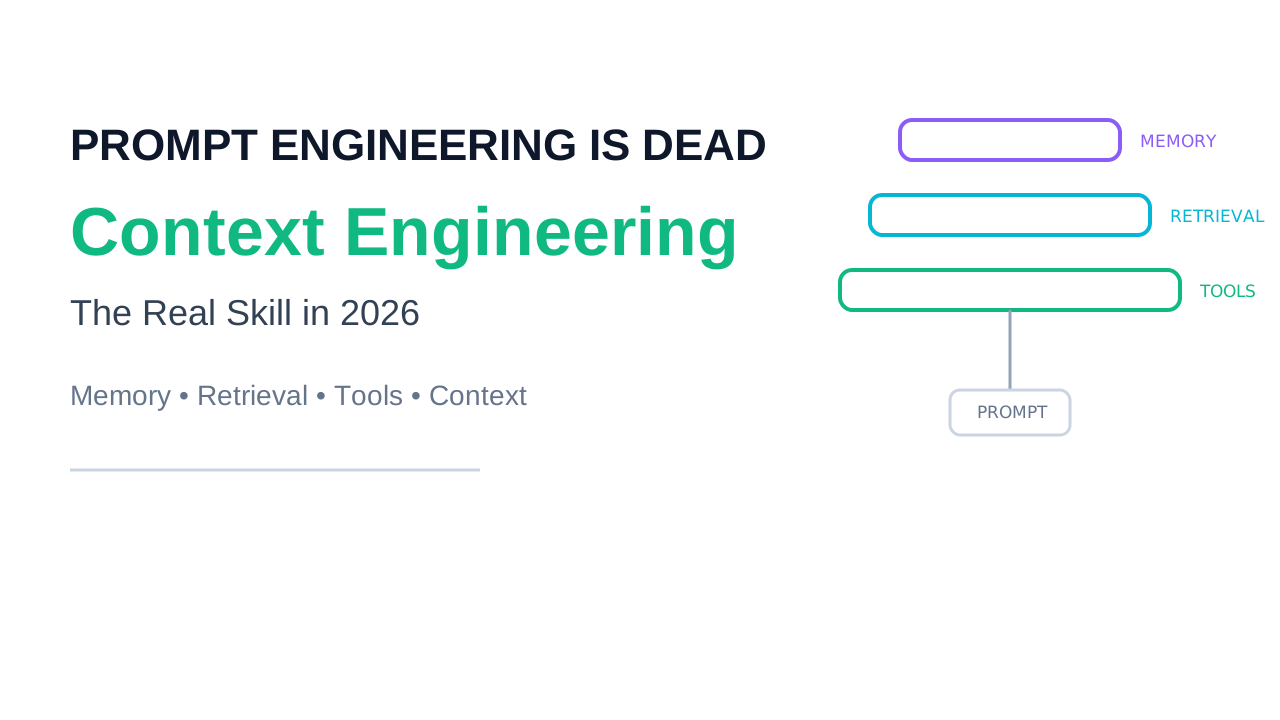
Here’s something the prompt engineering community has been quietly dancing around for a while: the most important variable in any language model response isn’t the cleverness of the prompt. It’s everything else — the memories, retrieved documents, available tools, conversation history, and structured instructions that were assembled and handed to the model before it wrote a single token.
The prompt is the last mile. Context is the highway.
“Prompt engineering” as a standalone discipline — the idea that crafting the right question is the primary skill for getting good results from AI — made sense in 2022, when the primary interface to a language model was a single text box and the primary lever you had was how you phrased your input. That era is over. Modern AI systems are not prompted; they are orchestrated. Every serious production AI deployment in 2026 — every AI assistant that actually works reliably, every agent that completes multi-step tasks without hallucinating — is built on an architecture that carefully assembles what goes into the model’s context window before the model ever starts generating.
The shift in vocabulary from “prompt engineering” to “context engineering” isn’t just a rebranding exercise. It’s a recognition of a fundamentally different set of design concerns: not “how do I phrase this question” but “what information does this model need right now, where does it come from, how much of it fits, how do I structure it so the model uses it reliably, and how does context change across a multi-turn, multi-step agentic workflow?” These are systems engineering questions, not copywriting questions, and they require a systems engineering mindset.
This article is the deep treatment that the concept deserves. We’ll start from the failure modes that made “just write a better prompt” insufficient, build a precise mental model of what a fully assembled context actually contains, go deep on every component — memory, tools, retrieval, MCP, conversation history, structured instructions — understand how they interact in a live agent workflow, and end with what this shift means for your career.
Phase 1: The Problem — Why “Just Write a Better Prompt” Stopped Being Enough
The First Era: The Single-Box Paradigm
For a brief window around 2022 and into 2023, prompt engineering was a genuinely novel and high-leverage skill. Models like GPT-3 and early GPT-4 were capable enough to do surprising things, but they were sensitive to phrasing in ways that felt almost magical — the difference between “write me a story” and “write me a story from the perspective of an unreliable narrator who doesn’t realize they’re the villain” was the difference between mediocre and interesting output. Learning these sensitivities, developing intuition for which phrasing elicited which kinds of responses, and understanding techniques like chain-of-thought and few-shot examples — these were real skills that produced real improvements.
The problem is that this framing treated the model as a vending machine where the prompt is the coin: put in the right prompt, get out the right response. It was always a simplification, but it was a useful simplification when the model’s context was mostly blank — just your prompt, maybe a brief system message, and whatever came back. Under those conditions, the prompt was almost everything, and optimizing it made sense.
That context is rarely blank anymore. A modern AI response is generated in the presence of a system prompt potentially thousands of words long, retrieved documents from a vector database, tool call results from several API calls the model triggered, a conversation history spanning multiple turns, structured output formatting instructions, and possibly memories retrieved from a user-specific long-term memory store. In that environment, tweaking the phrasing of a user’s message is approximately the same as rearranging deck chairs. The quality of the response is determined almost entirely by the quality, relevance, and organization of everything else in the context window — and “prompt engineering” as a discipline simply has no vocabulary for that.
The Gap Between What’s Taught and What Actually Matters
Prompt engineering literature focuses on techniques: chain-of-thought prompting, few-shot examples, role assignment (“you are an expert in…”), output formatting constraints, tree-of-thought, self-consistency, and dozens of named techniques that have emerged from the research literature. These techniques are real — they produce measurable improvements in model output under controlled conditions. But they all share a tacit assumption: that the content you’re trying to get the model to reason about is contained in the prompt itself, or in the model’s parametric memory (what it learned during training).
The real problem is when that assumption breaks down — which is almost always in production. When the information the model needs isn’t in the prompt (because it’s too long, too recent, too private, or too dynamic), no amount of prompt engineering technique recovers it. A brilliantly crafted chain-of-thought prompt asking a model to reason about a customer’s specific account status can’t reason about data the model was never shown. A perfectly formatted few-shot example telling a model to follow company policy can’t make it follow a policy it doesn’t know exists.
This is the core failure mode: prompt engineering optimizes the query; context engineering optimizes the knowledge and capability the model has access to when answering that query. The second lever is, in most production scenarios, worth far more than the first.
The Agentic Breaking Point
The argument above applies even in simple single-turn chatbots. In agentic systems — where a model needs to take actions, use tools, remember previous steps, and make decisions over multiple turns — prompt engineering alone doesn’t just fall short, it becomes almost irrelevant as a primary design concern.
Consider an agent that needs to: look up a user’s purchase history, identify a relevant policy in an internal document store, call a refund API, and draft an email confirmation. The total information flowing through this agent — the history, the retrieved policy, the tool call results, the instructions about output format, the conversation context — dwarfs the few hundred characters of the original user message by an order of magnitude. Whether you phrase that message with the chain-of-thought technique or without it matters approximately nothing compared to whether the retrieval pulled the right policy document, whether the tool call returned a clean response, whether the output format instructions are compatible with the email system consuming the draft, and whether the context was assembled in an order the model processes reliably.
This is the breaking point that forced the industry to think beyond prompting. The discipline of “how do I word this” gave way to the discipline of “how do I architect the information the model receives end to end.” Context engineering is the name for that discipline, and it’s now the foundational skill for anyone building production AI systems.
Phase 2: Building the Mental Model — What Context Actually Is
The Context Window Is a Workspace, Not a Message Slot
The most important mental model shift in context engineering is understanding the context window not as a slot where you type a message, but as a workspace the model reads in its entirety before writing a single token. Everything in that workspace — every character, every instruction, every retrieved document, every prior turn of conversation, every tool result — shapes the model’s output equally, regardless of where it came from or who put it there.
This has a counterintuitive implication: the “prompt” (the user’s message) is just one of many contributors to that workspace, and often not the most influential one. A one-line user message asking “what’s my refund status?” sits inside a context window that might also contain: a multi-hundred-line system prompt establishing the agent’s persona, permissions, and formatting rules; three retrieved customer service policy documents totaling two thousand tokens; the tool call results from two database queries; and a conversation history with six prior turns. In that context, the one-line user message is a tiny fraction of the total information the model is reasoning over.
Context engineering is the discipline of designing that entire workspace, deliberately, for every query: deciding what goes in, what stays out, in what order, structured how, and updated by what process as the conversation or task progresses.
The Five Layers of a Fully Assembled Context
Every serious production AI context, whether in a simple chatbot or a complex multi-step agent, is composed of some combination of five distinct information layers:
The instruction layer contains the system prompt, persona, behavioral constraints, output format requirements, and capability boundaries. This is the most persistent layer — it rarely changes within a session. Its job is to tell the model what it is and how to behave, independent of any specific task.
The knowledge layer contains retrieved documents, database records, API responses, code snippets, and any domain-specific information the model needs to answer correctly that isn’t in its parametric memory. This layer is dynamic — it changes with every query, refreshed by whatever retrieval or tool-call process brings in current, relevant information. In a RAG system, this is the top-k retrieved chunks. In an agent, it’s the accumulated results of tool calls.
The memory layer contains information persisted from previous interactions — not just the current session’s history, but potentially user preferences, prior task outcomes, and any state the system has explicitly chosen to remember and surface for the current query. Unlike the knowledge layer (which is retrieved based on relevance to the current query), the memory layer is curated based on what the system has been designed to carry forward.
The conversation layer is the chronological message history — the record of what was said, what was done, and what was returned, in the current session. This layer provides the model with the narrative thread of the current interaction so it can respond coherently to “what did you find?” or “try that again, but more formally.”
The output specification layer contains instructions about the form, not the content, of the response: JSON schema for structured outputs, maximum length constraints, required sections, citation formatting, the channel the output will be consumed by. This layer ensures the model’s response is usable by whatever system or person receives it, not just coherent in isolation.
A context engineering practitioner designs each of these five layers explicitly, tests how they interact, and decides what belongs in each layer versus what should be left out — because what you leave out of a context window is just as important a decision as what you put in.
The Precision/Recall Trade-off Inside the Context Window
There’s a fundamental tension in context engineering that parallels the precision/recall trade-off in information retrieval, and understanding it is the key to making good context design decisions.
Recall in context terms means including enough information that the model has everything it might need. A context with high recall misses nothing relevant — every policy document, every related prior conversation, every tool result. High recall prevents the model from hallucinating due to information gaps.
Precision means including only the information that is actually necessary for the current task. A context with high precision is focused and lean — the model’s attention isn’t diluted by irrelevant material, and the risk of the model “losing” critical information in a sea of tangentially related content (the “lost in the middle” problem) is minimized.
The naive approach to context engineering is to maximize recall — when in doubt, include everything. This produces bloated contexts that exceed cost budgets, slow down responses, and subtly degrade quality as the model struggles to prioritize within a window stuffed with only-somewhat-relevant content. The skilled approach is to engineer precisely: retrieve only what is genuinely relevant (tight retrieval quality and reranking), keep conversation history to the turns that matter (summarizing rather than verbatim-including everything), and structure the context so the most critical information is positioned where models attend most reliably.
This is why good context engineering looks less like creative writing and more like database schema design or API contract design: it’s about disciplined information architecture, not linguistic cleverness.
Phase 3: Internal Working Deep Dive — The Anatomy of a Production Context
How Context Is Actually Assembled Before a Model Sees It
The moment between a user sending a message and a model receiving it is far more eventful than it appears. In a production AI system, that interval contains a cascade of operations — retrieval, memory lookup, tool provisioning, history management, format injection — that collectively build the context the model will reason over. Understanding each operation, why it exists, and what goes wrong when it’s handled carelessly is the full substance of context engineering as a practice.
The Instruction Layer: System Prompts as Contracts
The system prompt is the oldest and most familiar piece of context engineering, but it’s worth treating it with the precision it deserves. A well-designed system prompt is not a creative writing exercise — it’s a contract between the developer and the model. It specifies:
Identity and role boundaries. What is this agent? What is it explicitly authorized to help with? What is it explicitly not authorized to do? Vague identity statements (“You are a helpful assistant”) are nearly useless; precise ones (“You are a billing support agent for a B2B SaaS company; you may access and explain invoices, initiate refunds up to $500 without escalation, and escalate to human agents for disputes above $500 or involving account closure”) give the model actionable behavioral constraints.
Output format contracts. If downstream systems consume the model’s output programmatically, the system prompt needs to specify the exact expected format — including JSON schema when structured output is required, markdown conventions when rendered text is expected, and explicit prohibitions on the formats that would break parsing (no code fences around raw JSON, no markdown in plain-text email bodies).
Behavioral constraints and fallback policies. What should the model say when asked something out of scope? How should it handle ambiguity — ask a clarifying question, make a reasonable assumption and state it, or default to refusal? How should it respond to adversarial prompts that attempt to override its instructions? These aren’t optional refinements; they’re the difference between an agent that behaves predictably in production and one that surprises you in the worst possible moment.
A crucial engineering discipline around system prompts is testing for instructional conflicts. As a system prompt grows — layered with permissions, constraints, format rules, persona notes, and special cases — it becomes possible for instructions to contradict each other, and the model’s handling of contradictions is not always predictable. “Always be concise” conflicts with “provide complete information.” “Never speculate” conflicts with “make reasonable inferences when data is incomplete.” Identifying and resolving these conflicts before deployment is a context engineering task with no equivalent in classical prompt engineering, because it requires reasoning about the whole instruction set as a coherent, self-consistent document rather than individual phrasings in isolation.
The Knowledge Layer: Retrieval as Context Construction
The knowledge layer is where context engineering and Retrieval-Augmented Generation (RAG) intersect directly. When a user asks a question that requires specific, current, or private knowledge, the context engineering system’s job is to retrieve exactly the right material and inject it into the context window before the model responds.
The key insight — one that RAG practitioners sometimes understate — is that retrieval is a context design decision, not a data pipeline decision. The questions that matter aren’t just “which vector database should I use” or “what embedding model should I use” (important, but secondary). They are: how should retrieved documents be presented in the context — as labeled source blocks, as inline context, as structured records? In what order should multiple retrieved chunks appear — highest relevance first (near the beginning of context, where models tend to attend most strongly), or lowest first (leaving the most important material closest to the query)? How much should retrieved text be compressed before injection — verbatim inclusion versus a model-generated summary — and what is the trade-off between fidelity and length? Should retrieved sources be explicitly labeled for citation, and if so, how does that labeling interact with the output format specification?
Each of these is a context engineering decision with measurable quality implications. A team that optimizes its retrieval model but injects the results as an unlabeled wall of text in the middle of a long context, after the conversation history and before the format instructions, will consistently underperform a team that retrieves with slightly less precision but injects retrieved material at the beginning of context, with clear source labels, in descending relevance order. The model is the same in both cases; the context assembly is different, and that difference dominates.
The Memory Layer: Choosing What to Carry Forward
Memory in context engineering is not the same as the conversation history. It’s the result of a curation decision: from everything that has been said, done, and learned across this user’s history with the system, what specific information should be surfaced for this particular query?
This curation problem is harder than it appears. A naive approach surfaces the most recent interactions (“here are your last five sessions”), which may be completely irrelevant to the current query — a user’s conversation last Tuesday about invoice disputes tells the model nothing useful when they come back today to ask about a new product feature. A better approach retrieves memories semantically — what past interactions are most similar in topic or intent to the current query — and presents only those, with recency weighting to avoid overloading the context with distant history.
The most sophisticated production memory systems don’t store raw conversational text at all. They run a model-generated summarization pass over completed sessions, extract structured facts (“user is on the Enterprise plan,” “user prefers Python over JavaScript,” “user had a billing dispute in March that was resolved via credit”), and index those facts for rapid, precise retrieval. These structured episodic records are far more token-efficient than verbatim history and far more reliably retrieved against a new query than unstructured conversation text. The cost of this approach is the inference cost of the summarization pass — and for high-value personalization use cases, it’s almost always worth it.
The Tool Layer: Tools as Context Amplifiers
Tools fundamentally change the context engineering problem in an important way: they make the context window dynamic. Before a model with tool access generates a final response, it may execute one or more tool calls, and each tool result becomes new material that gets injected into the context for the next generation step. This means context engineering for agentic systems isn’t just about what you put in at the start — it’s about what the model’s actions during a task add to the context over time, and how you structure that accumulating information so the model can reason over it reliably.
The Model Context Protocol (MCP) is the infrastructure layer that standardizes how tools are exposed to models. Rather than every AI application team hand-writing custom integration code for every tool they want their model to use, MCP defines a standard discovery and invocation protocol: a model-compatible description of what a tool does, what arguments it expects, and what it returns. From a context engineering perspective, MCP’s significance is that it standardizes the representation of tools within the context — the JSON schema that describes a tool, and the JSON format that carries a tool call and its result through the context window — making it possible to design general context assembly strategies that work across any MCP-compatible tool set rather than requiring custom handling for each one.
Tool result injection is a particularly underrated context engineering concern. When a model calls a tool and receives a result, how that result is formatted and positioned in the context has a significant effect on whether the model uses it correctly in subsequent reasoning. A JSON blob containing three levels of nested keys from a database query is technically complete information; it’s also cognitively difficult for a model to navigate compared to a brief prose summary of the same data with the key values pulled to the top level. Some context engineering pipelines run a lightweight “context normalization” pass over tool results — flattening, summarizing, or reformatting raw API responses — before injecting them, specifically to improve the model’s ability to reason over them efficiently. This extra step is invisible to the user and costs a small amount of latency, but it can measurably improve response quality in complex tool-heavy workflows.
The Conversation Layer: History as Signal and Noise Simultaneously
Conversation history is the most familiar component of a context window, and also the one most commonly handled poorly. The naive approach accumulates all previous turns verbatim and prepends them to every subsequent request — which is fine for short conversations and increasingly problematic for long ones, in three specific ways.
First, verbatim history grows without bound. A conversation that has run thirty turns deep might contain a token count that approaches or exceeds the entire context window budget, leaving little room for retrieved knowledge, tool results, and the current query. At this point, the context engineering system must either truncate history (losing potentially important earlier turns) or implement summarization — compressing the earlier portion of the conversation into a summary that preserves the essential thread while reducing token count significantly.
Second, early turns are often less relevant than recent ones. The model’s ability to attend to what’s most relevant is imperfect, especially in a crowded context window. Carrying forward a verbatim thirty-turn history places early, now-irrelevant exchanges where they compete for the model’s attention with the actual relevant information. A context engineering system that selectively prunes turns already fully addressed (resolved questions, completed tasks) and keeps only the active thread produces a better model focus at lower token cost.
Third, contradictions between old history and the current state go unresolved. If a user’s preference or context has changed during a long conversation, verbatim history may present both the old and new state in the same context, leaving the model to reason about which one applies. Explicit state management — extracting current facts from history and maintaining them as a structured state rather than leaving them buried in conversation text — prevents this class of context inconsistency.
Position Matters: The Lost-in-the-Middle Effect as a Design Constraint
One of the most empirically well-established phenomena in language model behavior is that models attend more reliably to information at the beginning and end of a context window than to information in the middle. Research and production experience consistently confirms this: a document buried in position 8 of a 12-document retrieved context gets meaningfully less reliable attention than the same document in position 1 or 12. This is not a model bug to be fixed; it’s a structural property to be designed around.
The practical implication for context engineering is that the sequence in which components are assembled into the context window is a first-class design decision, not an afterthought. Critical instructions belong at the very beginning of the context. The most relevant retrieved material should lead the knowledge layer rather than follow lower-priority content. The query the model is actually responding to should be adjacent to the material most relevant for answering it, not separated by ten thousand tokens of tangentially related history. These structural choices are invisible in the output — a user can’t see how the context was assembled — but they’re directly measurable in response quality, especially for complex multi-document or multi-turn scenarios.
Phase 4: Engineering Implementation — Building a Context Assembly Pipeline
Context engineering is most clearly understood by seeing it as a pipeline: a sequence of operations that transforms a raw user query into a fully assembled context window ready for model consumption. Here’s what a production-grade pipeline looks like.
The Context Builder Pattern
from dataclasses import dataclass, field
from typing import Any

@dataclass
class ContextWindow:
    """
    The fully assembled context passed to a model.
    Designed to make every layer explicit, separable, and independently testable.
    """
    system_prompt: str
    retrieved_docs: list[dict]
    memory_items: list[dict]
    tool_definitions: list[dict]
    conversation_history: list[dict]
    output_spec: str
    token_budget: int = 16_000

    def assemble(self) -> list[dict]:
        """
        Assembles all layers into a messages array in deliberate order:
        1. System prompt  (instructions first — highest model attention zone)
        2. Memory items   (persistent user context)
        3. Retrieved docs (current query's knowledge, labeled and ordered by relevance)
        4. Tool definitions (capability declaration)
        5. Conversation history (pruned to budget)
        6. Output spec injected into the final user turn
        """
        messages = []

        # System layer: single persistent instruction block
        messages.append({"role": "system", "content": self.system_prompt})

        # Memory layer: surface only episodic items relevant to current session
        if self.memory_items:
            mem_text = self._format_memory(self.memory_items)
            messages.append({
                "role": "system",
                "content": f"Relevant user context from previous sessions:\n{mem_text}"
            })

        # Knowledge layer: retrieved docs with explicit source labels, relevance-ordered
        if self.retrieved_docs:
            docs_text = self._format_retrieved_docs(self.retrieved_docs)
            messages.append({
                "role": "system",
                "content": f"Relevant reference material:\n{docs_text}"
            })

        # Conversation history: budget-aware, pruned oldest first
        history = self._prune_history_to_budget(
            self.conversation_history,
            self._remaining_budget(messages)
        )
        messages.extend(history)

        return messages

    def _format_retrieved_docs(self, docs: list[dict]) -> str:
        # Explicit source labels let the model cite correctly
        # Most relevant doc first (highest cosine score)
        return "\n\n".join(
            f"[{i+1}] Source: {doc['source']}\n{doc['text']}"
            for i, doc in enumerate(docs)
        )

    def _prune_history_to_budget(
        self, history: list[dict], remaining_tokens: int
    ) -> list[dict]:
        """
        Keeps the most recent turns that fit within the remaining token budget.
        Always preserves at minimum the last 2 turns (current exchange context).
        Older turns that summarizable are replaced with a summary block.
        """
        # Simple implementation: keep tail of history that fits
        # Production: run a summarization pass on the evicted head
        kept = []
        running_count = 0
        for turn in reversed(history):
            turn_tokens = len(turn["content"].split()) * 1.3  # rough token estimate
            if running_count + turn_tokens > remaining_tokens:
                break
            kept.insert(0, turn)
            running_count += turn_tokens
        return kept

    def _remaining_budget(self, assembled_so_far: list[dict]) -> int:
        rough_tokens = sum(
            len(m["content"].split()) * 1.3
            for m in assembled_so_far
        )
        return self.token_budget - int(rough_tokens)
Why each layer has an explicit role tag. Structuring each context layer as a distinct system message (rather than one concatenated system prompt monolith) gives the model clear organizational signals about where different kinds of information come from. More practically, it makes the pipeline testable: you can inspect exactly what’s in each layer, modify one without touching others, and measure the quality impact of changing the knowledge layer independently of the instruction layer.
Why history is pruned last, not first. The knowledge layer (retrieved documents) and memory items should always take priority over accumulated conversation history when the context budget runs low. Retrieved material is what makes the current answer accurate; conversation history is what makes it coherent. Accuracy generally matters more, which means pruning the history when budget is tight, not the retrieved knowledge. Teams that accumulate history verbatim until it fills the context window and crowds out retrieved knowledge are making the wrong trade-off.
Context Evaluation: Measuring What You Can’t Directly Observe
The hardest part of context engineering isn’t building the pipeline — it’s knowing whether it’s working. The model’s output is the only visible signal, and tracing a bad output back to a context assembly failure requires deliberate measurement infrastructure.
The most effective evaluation strategy runs two quality measures in parallel:
Retrieval quality evaluation measures whether the knowledge injected into the context was actually the knowledge the response needed. This requires building a small “golden set” — a few dozen representative queries with ground-truth “which source documents should have been retrieved” labels — and measuring recall (did the right document appear in the top-k?) and relevance (were the retrieved documents actually used in the answer?). A retrieval quality score below roughly 0.8 precision means the context’s knowledge layer is actively introducing noise, and no amount of model capability or prompt optimization will consistently overcome that.
Context utilization evaluation measures whether the model used the context it was given. A response that contradicts retrieved material (the retrieval pulled the right document but the model ignored it and hallucinated instead) is a different failure mode than a response that lacks the right material entirely — and requires different fixes. Evaluating whether the model’s claims are grounded in the provided context (rather than in its parametric memory) is the direct test of whether the context was assembled correctly and positioned effectively.
The Three Mistakes That Kill Context Quality in Production
Mistake 1: Treating the system prompt as append-only. Production system prompts often evolve through accretion: each time a new edge case appears, a new instruction is added. After six months, the system prompt contains contradictory instructions, redundant rules, and conditional statements that interact in unpredictable ways. Maintaining a system prompt as a living document — with regular audits, versioning, and conflict resolution — is as important as maintaining production code.
Mistake 2: Skipping context normalization for tool results. Raw API responses, database query results, and web-retrieved content are not model-ready by default. They’re full of headers, metadata, nested structures, and format noise that wastes tokens and degrades reasoning quality. A lightweight normalization step — even just a simple text extraction and key-field-first reformatting — consistently improves the model’s ability to reason over tool results, often by more than switching to a larger model would.
Mistake 3: Using the same context assembly strategy for all query types. A simple factual lookup (“what is our return policy?”) and a complex multi-step analysis (“compare our Q2 performance against our three main competitors using the attached reports”) require fundamentally different context designs: different retrieval depths, different history pruning strategies, different output specifications. Routing queries to query-type-specific context assemblers — rather than running every query through one generic pipeline — is a significant quality improvement that teams frequently defer and always benefit from eventually.
Phase 5: Real-World Context Engineering at Scale
OpenAI’s Operator System Prompt Architecture
OpenAI’s GPT product ecosystem now features a structured three-tier instruction hierarchy: the OpenAI platform’s top-level policies, the operator’s system prompt (what a business using the API configures for their product), and the user’s messages. This hierarchy is itself a context engineering design — it determines which instructions can override which other instructions, and under what conditions. Operators can grant users the ability to expand or restrict certain model behaviors within limits set by the platform, and the model is expected to reason coherently over this instruction stack. Engineering a reliable, consistent behavior given three potentially conflicting instruction sources is a real context engineering challenge, and it’s one OpenAI has addressed explicitly at the protocol level rather than leaving to individual operators to figure out.
Google’s Multi-Turn Search Grounding
Google’s AI Overviews and AI Mode products face a context engineering challenge at a scale most teams won’t encounter: assembling a context from web search results in real time, for billions of queries, with sub-second latency budgets, while ensuring the retrieved material is authoritative, current, and compatible with safety policies before it ever reaches the generation model. The “search grounding” layer — which retrieves, filters, deduplicates, and formats web content into a model-ready context — is itself a complex engineering system with more engineering investment behind it than most standalone AI products. The insight this illustrates: at scale, the quality of context assembly is the dominant determinant of answer quality, and it deserves engineering investment proportional to that importance.
Anthropic’s Extended Thinking and Tool Integration
Claude’s extended thinking capability is a context engineering pattern where the model’s own intermediate reasoning is made visible and preserved in the context as a structured block before the final response generation. This matters for context engineering because it demonstrates a general principle: the context window can contain not just external information but the model’s own prior reasoning, explicitly structured so the final answer can be grounded in a visible, inspectable chain of thought rather than reconstructed from the model’s implicit processing. Applied in agentic systems, this same principle — explicitly preserving intermediate reasoning as named context blocks — significantly improves the reliability of multi-step tasks where later steps need to reason about decisions made in earlier ones.
The Emergence of Context-as-Infrastructure
What unites these examples from Google, OpenAI, and Anthropic is that they all treat context assembly as infrastructure — a first-class engineering concern with its own systems, its own engineering team (implicitly or explicitly), and its own quality metrics — rather than as a runtime detail handled inline by whoever wrote the prompt. This is the organizational maturity indicator for AI teams: teams that treat context engineering as infrastructure ship more reliable products, iterate faster on quality improvements, and recover from production failures more quickly than teams where context assembly is an ad hoc collection of string concatenations spread across a codebase.
Phase 6: AI Era Relevance — Why Context Engineering Is the Core Skill for Agentic AI
The Context Window Is the Model’s Entire World
This is the single most clarifying thing to understand about agentic AI systems: a language model is not a reasoning engine with ambient awareness of the world. It is a function over its input. Its entire knowledge about the current task, the current user, the current state of the world, and its own prior actions lives in one place: the context window. It has no out-of-band awareness, no background knowledge about your specific situation, no memory of yesterday’s interaction unless something put that memory into the current context. The model’s intelligence and capability are fixed by training. The quality of what it does with that capability is determined entirely by what you put in front of it.
This is a deeply clarifying frame for thinking about the reliability failures of AI agents. When an agent loops unnecessarily, it’s usually because the context doesn’t clearly convey what has already been accomplished. When an agent ignores a retrieved document and hallucinates an answer anyway, it’s usually because the document was poorly positioned or formatted in the context. When an agent fails to follow an output format requirement, it’s usually because the format instructions were buried in a long system prompt behind dozens of higher-priority behavioral instructions. These aren’t model capability failures — they’re context design failures, and they’re fixable without a model change.
Context Engineering in RAG, Multi-Agent, and Long-Running Tasks
The connection between context engineering and RAG is direct: RAG is a context engineering strategy for the knowledge layer. The retrieval step assembles the right documents; context engineering decides how those documents get formatted, positioned, and integrated with the other layers before the model sees them.
In multi-agent systems (covered in depth in our companion article), context engineering becomes more complex because the context window is dynamic — it changes as each agent takes actions and produces outputs that feed into subsequent agents’ contexts. A well-designed multi-agent system ensures that the right information from each agent’s work is surfaced in the right form for the agents that depend on it, without carrying forward the entire accumulated history of everything every prior agent did. This selective surfacing — deciding what from Agent A’s work needs to be in Agent B’s context — is pure context engineering, and it’s one of the most important quality levers in the entire multi-agent architecture.
For long-running tasks that span hours or days — a research task that runs overnight, an agent that processes a batch job and reports results in the morning — context engineering must address what LangGraph’s checkpointing model addresses architecturally: how do you preserve exactly the right state so that when the task resumes, the model’s context reflects precisely where things stand, without re-running completed work or losing important intermediate results?
The A2A and MCP Layers as Context Engineering Infrastructure
MCP (the Model Context Protocol) and A2A (the Agent2Agent protocol) are, from a context engineering perspective, standardization layers for specific context components. MCP standardizes how tools are described and how their results are formatted in the context — removing one source of variation from the context assembly pipeline. A2A standardizes how one agent passes a task and its context to another agent across a multi-agent system — ensuring that the context hand-off between agents is structured and complete rather than ad hoc. Both protocols represent the industry’s recognition that context assembly is important enough to warrant standardization, not just convention.
Phase 7: Advantages, Limitations, and Trade-offs
Why Context Engineering Pays Off Disproportionately
It’s the highest-leverage improvement lever for existing systems. If you have a production AI system that’s producing mediocre results, the fastest path to improvement is almost always a context audit — examining exactly what’s in the context window at inference time, identifying the most obvious gaps and structural problems — before considering model upgrades, fine-tuning, or architectural changes. Model upgrades are expensive and require redeployment; better context assembly can often be shipped in a day and measured immediately.
It works across model generations. Prompt engineering techniques are often model-specific: a chain-of-thought strategy that works well for one model may produce verbose, over-hedged output for a newer model that doesn’t need the scaffolding. Context engineering principles — position critical information prominently, use precise retrieval, normalize tool results, manage history budget intelligently — are structural properties that remain effective regardless of which model sits underneath the pipeline.
It enables personalization without fine-tuning. User-specific memory retrieved into the context window is what makes an AI system feel like it knows you, without requiring a model trained on your data. This is both more privacy-preserving (your memory is in a retrieval store, not baked into shared model weights) and more dynamically updatable (you can add, edit, or delete memories without any model operation).
Where It Falls Short
It doesn’t fix retrieval failures. Context engineering manages what happens to retrieved information once it’s retrieved; it can’t compensate for retrieval that brings in the wrong information in the first place. A context designed with perfect structure and positioning still produces a wrong answer if the wrong documents were retrieved. The quality floor is determined by retrieval precision and recall, not by context assembly alone.
Context windows are still finite. Even a model with a million-token context window eventually fills up in a sufficiently long, data-intensive agentic task. Context engineering strategies — summarization, selective pruning, tiered memory — manage this constraint, but they don’t eliminate it. Tasks that genuinely require more context than any window can hold require architectural solutions (multi-agent decomposition, external state management) that go beyond context assembly.
Quality is difficult to evaluate without deliberate measurement infrastructure. A bad prompt produces a visibly bad response. A bad context assembly design produces responses that are subtly, inconsistently wrong in ways that are hard to trace without instrumented evaluation pipelines. Teams that don’t build context evaluation infrastructure early tend to attribute context design failures to model limitations, leaving meaningful quality improvements on the table.
Phase 8: Career Impact & What You Should Actually Learn
The Skill Reclassification That’s Already Happening
The job market for AI skills is currently reclassifying. “Prompt engineering” roles, which existed as a distinct category in 2023, are being absorbed into either product design (the creative, UX-facing side of AI interaction design) or, far more often, software and AI engineering (the system design side of making AI actually work in production). What’s emerged in its place, in engineering job descriptions at companies that are genuinely sophisticated about AI, is something more like “AI systems engineer” or “context systems engineer” — roles explicitly about designing the full information architecture that a model operates within, not just the words of an instruction.
The skills that transfer are the technical ones: understanding retrieval quality metrics, knowing how to structure a knowledge layer, designing token-budget-aware context assemblers, building evaluation pipelines for context quality, integrating MCP tools into an agent’s context, and managing conversation state for long-running agent tasks. These are engineering skills with engineering depth, not writing skills with a technical veneer.
What to Actually Build and Study
For engineers who want to develop genuine context engineering competency: build a RAG system from scratch (not using a high-level abstraction) and measure context quality at each retrieval depth and position variant. Build a multi-turn agent with explicit context budget management and observe what happens when context fills up. Instrument a context assembly pipeline with token counts and retrieval quality scores at every layer. Read the primary research on the “lost in the middle” effect (Liu et al., 2023) and the papers on long-context language model attention patterns — they’re readable and directly applicable to context design decisions.
The meta-skill is developing the ability to look at a context window — the actual text that a model received, in order — and diagnose why the output was or wasn’t what you wanted. This diagnostic ability is what separates engineers who can reliably improve AI system quality from those who are guessing.
The Window Is the Work
There’s a useful reframe for how to think about language model intelligence: the model is smart, but it’s only as smart as you let it be, and “letting it be smart” means giving it the information, structure, and tools it needs to apply its capabilities to your actual problem. A brilliant analyst locked in a room with no reference material, no memory of prior work, no tools, and a vague question will produce a worse answer than a merely competent analyst with the right files, a clear brief, and the relevant tools on their desk. The model is constant; the room you build around it is your job.
Context engineering is the discipline of building that room well. It’s the recognition that the model’s context window is not a passive medium for transmitting questions — it’s the entire informational environment the model operates within, and its design has more influence over output quality than any other variable in the system. It’s the shift from asking “how do I phrase this?” to asking “what does this model need to know, what tools does it need to use, what does it need to remember, and how do I structure all of that so it can actually think?”
The engineers and teams who internalize this shift will build AI systems that don’t just work in demos but work reliably in production — systems that get the right answer more often, not because they found a magic phrase but because they built the architecture to make correct answers possible. That’s the work. That’s the skill. And it’s only getting more important as the tasks we give AI systems get harder, longer, and more consequential.