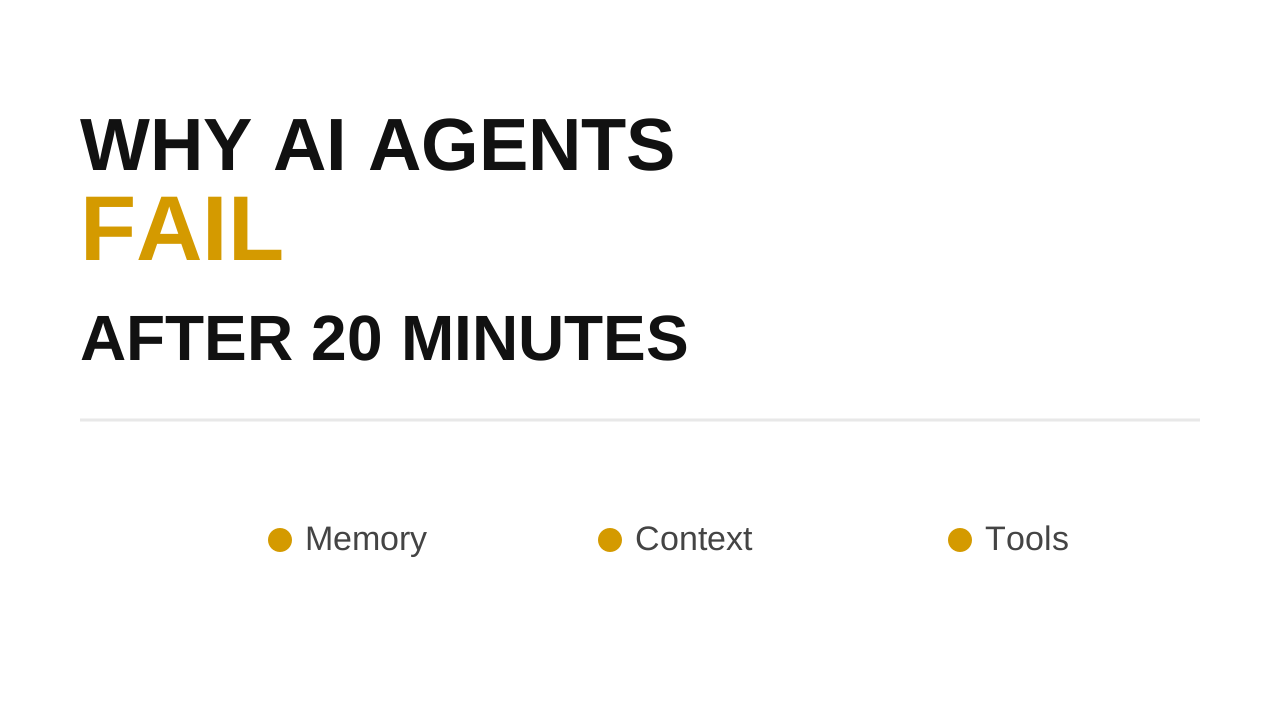
The Problem: Why Agents Fall Apart Over Time
AI agents — software systems that chain LLM reasoning with external tools — work wonders at first, but virtually every builder encounters a brick wall. Beyond a certain point (often 20–30 turns or a few dozen minutes of interaction), the agent starts contradicting itself, forgetting instructions given minutes or seconds ago, or choosing inappropriate tools despite seemingly having all information. These failures aren’t due to a “dumb” model; rather, they stem from architectural and engineering issues with memory, context, and tool management. In practice, agents crumble because we treat the LLM’s context window like an infinite database, ignore the need for persistent state, and overload the model with too many tool options.
Consider a live demo gone wrong: an agent happily chats with a user for a dozen steps, then suddenly forgets the user’s name or repeats questions it already answered. Although the conversation still “technically” contains those details, the model no longer retrieves them effectively. Researchers call this phenomenon context rot. Context rot means that as conversation history grows, the signal-to-noise ratio drops: early instructions and constraints fade from influence, while recent noise (failed attempts, error messages, stale data) dominates. The practical result is insidious: the agent fails silently and confidently, contradicting earlier commitments and unknowingly repeating errors.
In a revealing 2026 study, agents were given strict “no-bullets” instructions and tracked over 16 turns. By turn 5, they still complied 73% of the time; by turn 16, compliance had dropped to 33%, despite no change to the instructions. The root cause? The model “lost” the old rule in its attention. As one analysis bluntly put it, “If your agent violates a constraint it followed correctly 10 turns ago, the model did not change. The attention weight on that constraint dropped below the threshold required to enforce it. That is a memory architecture problem, not a model problem”. In other words, the LLM isn’t magically getting worse – our system is misusing it.
Similar symptoms appear in multi-agent systems, where agents pass tasks to each other. In one taxonomy of multi-agent LLM failures, context loss during handoffs was a top issue: as agents relay information, context windows fill, and each agent “loses track of earlier decisions and starts contradicting itself”. Overall, a rigorous study of 1,600+ multi-agent runs found 41–87% of standard tasks failed, with ~79% of failures due to specification, coordination, and context management issues, not model capability. This means the biggest bottlenecks are engineering and design.
To summarize, AI agents fall apart because memory and context are mishandled. We expect a stateless LLM to remember an arbitrarily long task history, or we dump dozens of tool definitions into its prompt without thought. The truth is that every AI agent is a mini-system with its own state machine. If we don’t explicitly architect that state – short-term and long-term – and curate the context carefully, it will naturally degrade. As one engineer put it on a developer forum: “Long-running AI agents often fail due to memory design issues rather than model limitations. They forget preferences and repeat mistakes because they rely solely on the current context window… Implementing a memory system… stabilizes behavior and enables the agent to build on past experiences, reducing the likelihood of starting from scratch.”
Mental Models: Memory, Context, and Tools
To tackle these failures, we need clear intuition about three core concepts: short-term context, long-term memory, and tool selection. A useful analogy is a computer program: the LLM’s context window is like RAM (volatile working memory), while any external store (vector DB, database) is like disk (persistent storage). Just as a computer will lose everything in RAM on reboot, an LLM loses all unconserved context when a session ends. And like real RAM, the context window is limited and expensive to read; overflowing it or leaving too much idle data in it causes “lost in the middle” problems where important data is overlooked.
In detail: The context window is volatile and capacity-limited. Everything you want the model to consider must fit in that prompt. Left in isolation, this is great for fresh reasoning: any “short-term” task state, tool outputs, recent instructions can be placed directly into the prompt so the model can use them immediately. But these tokens compete for attention. Context is expensive per access – every token forces the model to re-read it on each call – and degrades under load. (Indeed, transformer models systematically underweight tokens buried in very long contexts.) In short: Context works best as working memory, not a database. We can visualize this as an agent’s “RAM layer” that holds only what’s needed for the current task.
By contrast, persistent memory stores long-term information outside the prompt. This could be a vector database of embeddings, a database of user profiles, or structured memory on disk. Its job is to capture stable facts and patterns that should endure across turns or even sessions. Think of it as the agent’s “hard drive”. For example, user preferences (e.g., “I prefer code in Python with type hints”), hard constraints (“never disclose password”), or identity facts belong here. This memory doesn’t have to be re-injected every step; instead, the agent should retrieve relevant pieces each time. In practice, we distill or compress what goes into persistent memory: raw tool logs or ephemeral reasoning steps do not belong there.
The routing decision between these layers is crucial. A simple rule is: “Would this information still be relevant 30 days from now?” If yes, it goes in persistent memory; if not, it stays in working memory. For example, if the agent learns you like bulleted meeting notes, that’s persistent. But if it calculates “Turn 5 result = 42”, that’s just working memory. (In code, this might be implemented by classifying each new fact: hard constraints and stable preferences to the persistent store, short-term facts to an in-session buffer.)
So our mental model is: LLM context = RAM (short-term), memory DB = storage (long-term). We must actively manage both. If we dump everything into the prompt (like letting RAM fill up with stale data), we get token bloat and later turn failures. If we only rely on external memory without refreshing context, the model has no working content and can flail. A practical agent keeps working memory lean (trimming old info, compressing with summaries, etc.) and calls out to persistent memory only for truly durable knowledge. In fact, one popular framework even uses two separate retrieval steps: an LLM selects a few relevant memory vectors to inject (as opposed to flooding the prompt with the entire store).
Finally, tools are like the agent’s external “capabilities” (search, code execution, calculators, databases, etc.) Each tool has a name and description, and the agent can call them if needed. Mentally, think of this as an action space. But unlike human tools, an LLM doesn’t have built-in instincts for tool use – it must be reminded of each tool by name and use prompt logic to decide which one fits the current task. Because the context window is finite, listing too many tools or verbose schemas can overwhelm the agent’s limited attention. Conversely, too few tools might leave the agent blind to needed capabilities. Effective tool management is thus a matter of retrieval and selection: given a user query, the agent should first filter the universe of tools (via keyword match, embeddings, or learned ranking) to a relevant shortlist, then let the LLM pick and invoke from that list. As we’ll see, choosing how to do this dynamically is both an engineering art and an active research area.
In summary, by envisioning the agent as a system with working memory (context), persistent memory (database), and tool set (capabilities), we can start to see why it fails. We expect too much from “working memory” alone, leading to forgetting and contradictions. We overload it with tool definitions, causing attention competition and wrong tool calls. The fix is layered: use the context window as a focused scratchpad, push enduring facts to a memory store, and intelligently manage which tools are in play.
How Agents Work Under the Hood
In a well-architected AI agent, information and data flow through several components on each user turn. The core loop works roughly as follows:
- User or Environment Input: A request comes in (e.g., a user says, “Book me flights to Paris next Tuesday.”).
- Memory Retrieval: Before replying, the agent queries its memory stores. This involves two steps: (a) Semantic search: use an embedding of the user query (e.g., via OpenAI embeddings or similar) to find relevant vectors in the persistent memory database. (b) Tool retrieval: similarly, retrieve any tools whose descriptions match the query. Both steps yield a shortlist of context snippets and available tools. For example, the agent might pull up: “User’s seat class preference = economy” from memory, and identify the
book_flightandcheck_calendartools as relevant. - Context Assembly: Construct the prompt. This typically includes a system prompt (“You are an agent that books flights for a user…”), any relevant memory or background facts retrieved, the conversation history (usually pruned or summarized), and descriptions of the selected tools. For instance:
   System: You are an AI travel assistant.
   Memory: The user prefers economy class and morning flights.
   Tools available:
     - book_flight(date, destination): queries a flight API.
     - search_flights(params): finds cheap flights.
     - ...
   Conversation:
     User: Book me a flight to Paris next Tuesday.
Agent: - LLM Planning & Reasoning: The agent calls the LLM (e.g. GPT-4o) with this prompt. The LLM “thinks through” the query. It may produce a plan (e.g. “First check calendar, then search flights, then call book_flight”), or directly decide on a tool call. This output might use a special format (JSON or function call) indicating, say,
{"tool": "search_flights", "args": {"destination": "Paris", "date": "2026-07-05"}}. Crucially, the LLM’s entire output is constrained by the context we provided; it can only act on what is in the prompt (and any internal knowledge weights). - Tool Invocation: If the LLM’s response calls for a tool, the agent executes it outside the model. For example, calling
search_flightswith the given arguments might query an API and return flight options. The agent then takes this result and injects it into the context for the next step. (If multiple steps are needed, the agent may iteratively loop: each tool call and its result is added as a new message, and the LLM is invoked again to continue the chain of thought.) - Output or Continue: This process repeats until the agent has a final answer (e.g., “Flight booked successfully! Your flight ID is X”). The agent then presents that to the user and optionally stops the session or awaits further input.
- Memory Update: After the response is generated, the agent decides what information to store. Persistent memories might include: “User likes economy flights” (if not already stored), or a summary of what happened (“Flight to Paris booked for 2026-07-05 economy”). Working memory (the context buffer) is advanced by appending this turn’s Q&A and removing anything too old to matter.
Each component here can fail:
- If context management is wrong, the prompt will contain either too little (forgot something) or too much (buried signal).
- If memory retrieval is poor, the agent won’t even know its past preferences or task constraints.
- If tool selection is off, the LLM might pick the wrong function or none at all.
- If tool results accumulate unchecked, the context will bloat with stale data (for example, outdated code versions or old API outputs).
Consider a real-world long-coding session: an agent that reads code, writes code, runs tests, and so on. Each file read, code diff, and test result adds hundreds or thousands of tokens to the context. After hours, the agent’s context is bloated with irrelevant past code versions and error logs. It reasons about a world that no longer exists, inevitably hallucinating or making contradictory edits. This is precisely context pollution – the working memory layer filled with junk.
Multi-agent workflows exacerbate this. One agent might plan, another execute, and a third verify. They must communicate state back and forth, often simply by appending to each other’s context windows or via a shared memory service. If not done carefully, the plan from turn 1 vanishes by turn 10, and the next agent acts on incomplete info. The MAST study flagged “context loss during handoffs” as a common fatal mode.
In production, companies build substantial infrastructure around agents to mitigate these issues. For example, engineers often implement a priority retrieval: only the most semantically relevant memory snippets are injected each turn, rather than the whole transcript. Others use a scratchpad pattern, where only the most recent reasoning steps are kept in context, and prior steps are summarized. OpenAI’s own guidance (for its GPT Agents SDK) emphasizes “context engineering”: trimming old messages, summarizing mid-session, and offloading information to vector memory as needed.
No detail can be glossed over. For instance, even the order of information in the prompt can matter. The model attends most to the beginning and end of its input, so system instructions and recent tools are weighted heavily, while middle messages can be “lost”. Thus, architects must chunk context: critical constraints first, then a sliding window of recent turns, and memory at just the right place. Similarly, when processing a long conversation, some systems periodically summarize earlier parts. For example:
# Pseudocode: Trim and summarize context to manage window size
if token_count(context_messages) > MAX_WINDOW / 2:
    summary = llm.chat([
        {"role": "system", "content": "Summarize the above conversation so far for future reference."},
        *context_messages
    ])["choices"][0]["message"]["content"]
    # Replace old context with summary
    context_messages = [{"role": "system", "content": f"Previously, {summary}"}]
Each pipeline and data flow decision has trade-offs. In one study (LoCoMo benchmark), a two-layer memory architecture (working vs persistent) improved multi-turn task accuracy from ~73% to ~92% while reducing average context tokens by 4×. The agent architecture that learns what to store off context (rather than blindly appending) saw lower latency and far fewer “lost in the middle” errors. This tells us: when done right, explicit memory saves both compute and quality.
Engineering Implementation: Code and Trade-offs
Let’s move from architecture to practice. Here are illustrative patterns and code sketches showing how memory, context, and tool logic might be implemented in a production-quality agent.
1. Persistent Memory via Embeddings. A common pattern is to use a vector database (e.g., Pinecone, Weaviate, Milvus) to store “memory” entries as text embeddings. Each time the agent learns something (user preference, task outcome), it creates an embedding and upserts it to the DB. On each user turn, it encodes the query and does a similarity search to retrieve, say, the top-5 relevant past entries. These hits are then injected into the prompt. Example (using pseudo-Python and OpenAI’s embedding API):
# Initialize persistent memory store
pinecone.init(api_key="...", environment="us-west1")
index = pinecone.Index("agent_memory")
dimension = 1536  # e.g. ada-002 embedding size

def embed_text(text):
    result = openai.Embedding.create(model="text-embedding-ada-002", input=text)
    return result["data"][0]["embedding"]

def retrieve_memory(user_id, query, top_k=5):
    vec = embed_text(query)
    results = index.query(user_id=f"user_{user_id}", vector=vec, top_k=top_k, include_metadata=True)
    return [match["metadata"]["text"] for match in results["matches"]]

def store_memory(user_id, text):
    vec = embed_text(text)
index.upsert(vectors=[(f"mem_{uuid.uuid4()}", vec, {"text": text})], namespace=f"user_{user_id}")- Why this solves a problem: We offload long-term storage to an external system. Memory retrieval is bounded (we only fetch
top_kentries), keeping context small. - Key parts: Each memory entry is a short text snippet. We prefix it with
user_{user_id}namespace so each user’s data is isolated. Retrieval uses cosine similarity to find semantically related memories to the query. - Production notes: In production, one might build in deduplication (avoid storing duplicate facts), versioning, and TTL. We’d likely store “schemas” in metadata (e.g., category=“preference”) to allow intelligent filtering. The embedding model should match the LLM’s domain (e.g., use the same provider to ensure semantic alignment). The vector index is usually kept in memory for fast search, though we persist it on disk or the cloud.
2. Context Management & Summarization. Keeping a sliding window or summarizing is essential to prevent “token bloat”. One tactic is to periodically compress the chat history using the LLM itself. For example:
# Example: Trim conversation if it exceeds token budget
def trim_conversation(conv):
    while count_tokens(conv) > MAX_TOKENS:
        # Remove the oldest user+assistant pair
        conv.pop(1)  # remove second item (first is usually system prompt)
        conv.pop(1)
    return conv

# Example: Summarize and replace long tail of history
def summarize_and_trim(conv):
    if count_tokens(conv) > THRESHOLD:
        prompt = [
            {"role": "system", "content": "You are a helpful assistant. Summarize the key points of the conversation so far."},
            *conv
        ]
        summary = openai.ChatCompletion.create(model="gpt-4o", messages=prompt)["choices"][0]["message"]["content"]
        # Replace history with summary
        conv = [{"role": "system", "content": f"(Summary of previous conversation: {summary})"}]
return conv- What problem it solves: Without trimming, each new turn adds tokens until the context window maxes out, after which newer turns push out the oldest. Either way, older content is lost or floods the model. Summarization condenses that history into a few tokens while preserving meaning.
- Parts:
count_tokens()Might use tiktoken to estimate. We remove whole messages (trim) or call the LLM to compress. In the second function, we keep only the summary in context. - Production notes: Summarization costs additional LLM calls and latency, but it’s often cheaper than long dialogues. It’s crucial to be careful: incorrect summaries can “hallucinate” false details. Many systems try hierarchical summarization (chunks of conversation summarized, then those summaries summarized further) or only summarize when necessary, not every turn.
3. Tool Selection via Retrieval. Instead of showing the LLM all possible tools (which can fill thousands of tokens with JSON schemas), we can retrieve only the relevant subset per query. A simple approach uses embeddings on tool descriptions:
# Suppose we have a list of tool dicts with 'name' and 'description'
tool_list = [
    {"name": "search_flights", "description": "Search flights given destination and date", "func": search_flights},
    {"name": "check_calendar", "description": "Check user calendar availability", "func": check_calendar},
    # ... many more ...
]

# Precompute tool description embeddings once at startup
tool_texts = [tool["description"] for tool in tool_list]
tool_embeddings = [embed_text(desc) for desc in tool_texts]

import numpy as np
faiss_index = faiss.IndexFlatL2(dimension)
faiss_index.add(np.array(tool_embeddings))

def select_tools(user_query, k=5):
    q_vec = np.array(embed_text(user_query), dtype="float32")
    D, I = faiss_index.search(np.array([q_vec]), k)
    selected = [tool_list[i] for i in I[0]]
    return selected

# On a query:
candidate_tools = select_tools(user_input, k=5)
tool_descs = "\n".join(f"{t['name']}: {t['description']}" for t in candidate_tools)
prompt = f"You have the following tools:\n{tool_descs}\n\nUser: {user_input}\nAgent:"
response = llm.chat([{"role": "system", "content": prompt}])- What problem it solves: Listing too many tools bloats the prompt and confuses the model. By showing only the top-k relevant tools, we reduce context and focus the agent.
- Parts: We use FAISS (a popular vector search library) to index tool descriptions. Each query yields the 5 nearest tools by semantic similarity. These are presented in the prompt for the LLM to choose from.
- Production notes: In practice, one might update tool embeddings when tools change. Meta’s research shows that adaptively controlling
kper query is even better: a learned policy can decide how many tools to expose based on query complexity. (For example, sometimes only 3 tools are needed, other times 15.) Also, it’s wise to combine embedding search with filters (e.g., domain categories or keywords) to avoid irrelevant picks. After the LLM responds, the agent must parse whether it’s a direct answer or a structured call to one of these tools; robust parsing or explicit function-call interfaces are needed.
4. Handling Tool Responses. Once a tool is invoked, its (often long) output must be handled. Instead of dumping the entire output into context, a smart agent filters and compresses it. For example, if a flight-search tool returns a JSON of 20 flights, we might extract only the cheapest or most relevant to pass on. If a code execution tool returns 1000 lines of logs, we might search within it for key errors or success messages and summarize them before adding to the prompt. This prevents the context from being overwhelmed by verbose intermediate outputs.
5. Layered Agent Architecture. In complex systems, teams often build sub-agents or stages to isolate noise. For instance, one agent (“planner”) might take the user’s goals and generate a high-level plan. Another (“executor”) handles each step. A “critique” agent might verify outputs. By funneling information through these modular stages (and resetting contexts between them), the system avoids one agent’s clutter affecting another. This won’t magically fix forgetting, but it localizes the scope. The Multi-Agent Failure Taxonomy suggests that context rot is often solved in production not by bigger models, but by better orchestration and state management. In practice, teams implement session boundaries and cached states. For example, after one agent finishes its job, its final output is stored in a database, and the next agent is given only that output (plus minimal context) as input.
Trade-offs and Gotchas: Every design choice has pros and cons. Using a vector DB adds latency (each turn needs an embedding query) and complexity (maintenance, cost). Summarization may drop nuance. Selecting fewer tools reduces context but risks missing a critical tool (too-small a shortlist could omit the needed function). As one practitioner noted: giving an agent 50+ tool schemas consumed 72k tokens of context on startup – roughly 40% of a 200k-token window. This “attention dilution” caused wrong-tool calls and “lost in the middle” failures. The workaround became “context budgeting”: manually selecting tools, trimming schemas, splitting the agent into layers. Modern solutions use a Tool RAG approach: only load tool descriptions on demand, not all at once.
Another example: persistent memory may speed up future queries but can go stale. If we store “the user has a meeting on Tuesday” and then the calendar changes, the agent might wrongly reject a booking for Tuesday unless we design a proper TTL or forgetting mechanism. Similarly, overly aggressive summarization can “hallucinate” facts into memory. Engineers must implement verification layers – for instance, a “judge agent” that checks if a retrieved memory still applies before using it.
In summary, building a robust agent is a balancing act. The code must handle embeddings, retrieval, dynamic prompt assembly, and error cases in production. But the key is that every capability (memory, context shaping, tool calling) is explicitly managed in code; none of it is magic in the LLM. As one engineer concluded, the failures we see are not fundamentally about picking a better LLM, but about how we build the system around it.
Real-World Systems and Scale
These concepts are not just theoretical – the major AI platforms and companies are wrestling with them. OpenAI’s ChatGPT now explicitly includes memory. As of 2025, ChatGPT “remembers” user-provided details and gathers insights from past chats to personalize future responses. For example, if you tell ChatGPT, “I like bulleted meeting notes,” it will recall that preference in later conversations. This is implemented via the ChatGPT memory service (essentially a user-specific knowledge base) and shows that persistent memory for agents is production-ready. OpenAI’s documentation also highlights session management: their Agents SDK includes a Session object to carry short-term context, and their best practices emphasize trimming and summarizing history.
Microsoft 365 Copilot similarly builds in memory. Its documentation boasts that Copilot “offers you tailored experiences by remembering key details and preferences from your conversations”. Behind the scenes, Copilot Chat uses a memory database to store things like your work style or recurring tasks, which it then re-injects into new chats. Importantly, users and admins have controls to view or erase this memory, acknowledging that memory is an independent state.
Google’s Gemini platform (2025) provides a mature example of layered memory. Gemini 2.5 (codenamed “Flash” and “Ultra”) supports streamed context up to millions of tokens, but it still separates session context from true long-term memory. In fact, Google explicitly distinguishes “Gemini Memory (beta)” – a persistent store of user preferences and project details (e.g., personal writing tone, frequent projects) – from ephemeral conversation context. All of this is user-controlled: you can delete your Gemini memory or disable it for privacy. This tiered design illustrates the industry’s approach: you need both vast context and distinct memory channels to handle real tasks.
In industry applications, these architectures are key. For instance, autonomous trading systems use memory-based agents to retain market hypotheses over time; robotics teams use memory to accumulate world knowledge across missions. Even voice assistants (e.g., Alexa, Siri) have implicitly used memory (in the form of user profiles and preferences) for years. The rise of retrieval-augmented chatbots means that any system aiming to “ground” LLMs on real data is effectively doing a RAG pipeline – a form of memory. As more companies deploy multi-turn AI (in customer service, healthcare, finance, etc.), demand for engineers who understand these memory/context/tool patterns has surged.
Relevance in the AI Era
Why should AI engineers care about these “plumbing” issues? Because we’re in the midst of an agent revolution. Modern applications increasingly rely on LLM-powered agents that autonomously fetch data, call APIs, and make decisions over extended interactions. Without robust memory and context design, these agents can’t deliver reliable value.
For example, consider Retrieval-Augmented Generation (RAG) – a widely adopted pattern where LLMs fetch documents or knowledge snippets to answer queries. RAG is literally a form of external memory: the LLM is augmented by a database of facts. But RAG alone doesn’t solve the dialogue memory problem. An agent may use RAG to look up a product price (static knowledge) while also needing to remember the user’s shopping preferences (dynamic knowledge). Distinguishing between these is crucial. A production agent often needs both kinds of memory in the same turn; otherwise it either repeats mistakes or produces irrelevant answers.
Likewise, as multi-agent workflows (agents cooperating or competing) become common, shared memory and strict context protocols are critical. Large organizations building LLM orchestration layers (like task planners, data analysts, or automated DevOps tools) now must hire engineers who understand distributed state. The 2025 AI Landscape report notes “Agentic RAG introduces planning before retrieval, memory and context retention across queries, tool calling integration, and multi-step reasoning” – essentially a laundry list of our topic. This is not buzz; it’s what makes (or breaks) systems at scale.
Moreover, evolving hardware and model trends only underline the issue. Even with GPT-4o giving 256k–1M token windows, context rot still happens, just a bit later. Mega-context doesn’t magically remember user preferences or office-policy constraints across sessions. In fact, as model context grows, we have to be even more judicious: a million-token window filled with irrelevant tool logs would be disastrous. So the smarter solution of memory layers and selective retrieval becomes more important, not less.
Finally, from a systems perspective, building agents is now cloud-native work. We see microservice memory stores (vector DBs), orchestration services, context caches, and even streaming token processors (like Google’s incremental context). AI engineers are essentially becoming distributed systems architects, responsible for pipelines that feed LLMs with just the right info. Understanding memory/context is analogous to understanding transactions, caching, and logging in traditional software: it’s core infrastructure.
Advantages, Limitations, and Trade-offs
Every approach has its strengths and caveats:
- Using the Context Window (All in Prompt): Advantage: Simplicity. No extra components, and the model sees everything simultaneously. Drawbacks: As we’ve seen, it leads to bursty token usage (token bloat) and “lost in the middle.” Early instructions may eventually be ignored, and costs skyrocket. Even high-end models cannot fix the fundamental issue of decaying attention over long context. This approach fails silently – it may appear to work until it doesn’t.
- Persistent Memory (External Vector DB): Advantage: Enables true long-term recall and personalization. The agent can learn on the job. For example, Mem0’s tests (with two-layer memory) showed accuracy jumping from 72.9% to 91.6% in extended dialogues. Drawbacks: Overhead and complexity. Building a fast, reliable vector index is non-trivial. Semantic search may sometimes return irrelevant or outdated memories (“memory poisoning” if we blindly trust it). There’s also a risk of privacy issues if sensitive info is stored. And queries become multi-step: embed → search → inject, adding latency.
- Trimming and Summarization: Advantage: Keeps the working memory focused and bounded, reducing cost. Helps maintain coherence by ensuring the model isn’t distracted by ancient history. Drawbacks: Summaries inevitably lose detail. Critical nuances might be omitted. Errors in summarization propagate – if we summarize an instruction incorrectly, all future reasoning is skewed. Moreover, summarizing itself costs an LLM call, impacting performance.
- Tool Calling (Function API): Advantage: Extends the agent’s capabilities tremendously (code execution, web search, domain-specific functions). When done right, it can solve tasks a plain LLM cannot. Drawbacks: Tool calls complicate context. Each call’s output must be integrated, and failed or irrelevant outputs pollute context. Tools also introduce brittleness: the agent must format inputs perfectly or calls fail. Errors must be caught in code. Importantly, when an agent has too many tools available, it suffers “attention competition”: similar-sounding tools confuse the model, increasing wrong calls. We saw that by preloading 50+ schemas into context, agents were essentially 40% through their prompt budget before thinking, leading to misclassification of user intents.
- Adaptive Tool Selection: Advantage: Meta’s research shows that adaptively choosing a shorter list of tools yields better outcomes. Fewer choices make the model’s job easier, improve selection accuracy, and save tokens. Drawback: Requires a separate selection mechanism (embedding search, RL policy, or classifier). There’s a trade-off in how many tools to consider: too few, and you might not include the right one (lower coverage); too many, and you hurt precision. Meta achieved a good balance with an RL-based policy that saw, on average, 7 tools instead of a fixed 50, matching coverage while boosting accuracy.
In general, the theme of trade-offs is pervasive. Larger Context Windows (e.g., GPT-4o-128k vs 16k) postpone context rot but don’t eliminate it. Smaller Models have smaller windows, making these issues even more acute. More powerful embeddings can better retrieve memory or tools, but still rely on upstream data quality. Every solution shifts the load: pumping more memory into context just moves the forgetting threshold further out, but still forgets eventually. Only by architecting memory explicitly can an agent achieve consistency over very long tasks.
A practical mantra some builders use is: “Focus on state management, not just modeling.” In fact, one analysis found that 79% of agent failures were due to specification and coordination errors, not to model weaknesses. Thus, on the engineering level, the limitations we face are often logistical. There is no silver bullet – even with GPT-5 looming, careful engineering (tool RAG, layered memory, disciplined specs) is the proven path forward.
Career Impact & Future Directions
The imperative to handle memory, context, and tools is reshaping AI roles. AI engineers and system designers now need familiarity with vector databases, retrieval algorithms, and distributed state – skills once foreign to classic ML. Job postings for “AI Agent Engineer” or “LLM Specialist” frequently list experience with RAG, LangChain/Mem0, and cloud-native services as requirements. In technical interviews, you might be asked to sketch an agent architecture that avoids context rot, or to design a retrieval system for an LLM – essentially testing your understanding of the issues we’ve covered.
Looking forward, these topics will only grow in importance. We anticipate:
- Dedicated Memory Services: Just as we have DBAs for databases, future teams may have “Memory Engineers” responsible for curating and scaling agent memory stores (vector or graph-based).
- Standardized Memory Frameworks: Organizations like OpenAI are already publishing SDKs. We expect open-source frameworks (e.g., LangChain, LlamaIndex) to add richer memory primitives (perhaps hierarchical memory, memory chaining utilities).
- Privacy and Compliance Roles: Storing user data in agent memory raises privacy questions. Compliance officers will need to partner with engineers to classify what can be remembered (health data, financial info, etc.) and build erase protocols.
- Interview Prep: Knowledge of these issues is becoming part of the tech zeitgeist. Up-to-date AI engineers will study agent benchmarks (LoCoMo, ToolBench, MAST) and be able to articulate how context/window/memory affect performance.
For readers wanting to level up: learn how to use a vector DB (e.g., practice with Pinecone or RedisAI), experiment with LangChain’s memory classes, and build a toy agent that calls two tools via OpenAI’s function calling. Understand the difference between feeding everything into one prompt versus orchestrating a multi-step retrieval. These skills – memory design and context engineering – are in high demand and will remain essential as AI systems scale.
The surprising truth is that “AI agents failing after 20 minutes” is almost always an engineering story, not a model story. The LLM itself is usually fine; it’s our architecture that lets it forget or get confused. By viewing the agent as a system with two memory layers (working vs persistent) and a controlled set of tools, we turn vague, painful failures into explicit design problems. We learn to treat the context window as temporary RAM, offload long-term state to databases, and carefully mediate the tools and memories we feed back to the model.
This shift in perspective is powerful. Instead of seeing agents as ephemeral chatbots, we see them as stateful digital assistants. That mindset informs every part of the solution: we prune and summarize context, dynamically retrieve and update facts, and limit tool sets to what’s truly relevant. As AI practitioners, our job is now akin to building operating systems: we must engineer memory management, attention scheduling, and inter-component protocols.
Looking ahead, the article’s key insight remains: the future of reliable AI agents lies in better memory and context architecture, not just bigger models. Mastering these ideas means enabling agents that truly learn, adapt, and work coherently over time. In doing so, we unlock the next era of AI – one where virtual assistants, multi-agent teams, and AI workflows can operate for hours or days without collapsing. That deeper reliability is the ultimate payoff for tackling these “hidden” engineering problems today.