The AI Career Roadmap: From Beginner to AI Engineer in 12 Months
Phase 1: The Problem — Why “Learn AI” Is Bad Career Advice
Search “how to become an AI engineer” and you’ll find a hundred lists that all look the same: learn Python, learn linear algebra, take a Coursera course, build a chatbot, apply to jobs. Follow that path faithfully and you’ll end up with a resume full of tutorials and no real signal of competence — because tutorials are not the problem employers are trying to solve.
Here’s the actual problem. Between 2023 and 2026, the AI job market split into two very different tracks that get talked about as if they’re the same thing.
The first track is traditional ML engineering — the discipline of training models, tuning hyperparameters, managing datasets, and deploying models via classical MLOps pipelines. This track has existed since roughly 2012 and its skill tree is well understood: statistics, linear algebra, PyTorch, model evaluation, feature engineering.
The second track, which exploded in size after the release of GPT-4-class models, is AI engineering — building products on top of foundation models rather than training them from scratch. This is a fundamentally different job. An AI engineer at a typical company in 2026 rarely trains a model. Instead they design retrieval pipelines, orchestrate multi-step agent workflows, manage context windows and token budgets, evaluate model outputs against business metrics, and build the scaffolding — tool use, memory, guardrails — that turns a raw LLM API call into a reliable product feature.
The confusion between these two tracks is why so many self-taught learners waste six months on the wrong curriculum. Someone spends months on backpropagation math and CNN architectures, then applies for a role titled “AI Engineer” and discovers the interview is about designing a RAG pipeline, debugging a flaky agent loop, and reasoning about latency versus quality trade-offs in a production system — topics their curriculum never touched.
There’s a second, quieter problem underneath this: the skill half-life in this field is short. A roadmap built in 2023 around “prompt engineering” as a standalone discipline is already outdated, because prompting alone stopped being a differentiator once models got better at following instructions natively. What replaced it — agentic orchestration, evaluation-driven development, and context engineering — didn’t exist as a named discipline three years ago. Any roadmap that doesn’t account for this churn is going to leave you specialized in yesterday’s bottleneck.
So the real task of a 12-month roadmap isn’t “cover everything AI.” It’s sequencing: what to learn first because everything else depends on it, what to learn because it’s the actual bottleneck companies are hiring to solve right now, and what to deliberately skip because it’s either obsolete or premature for where you are.
That’s what this guide is built around.
Phase 2: The Mental Model — Three Layers, Not One Ladder
Most roadmaps present AI skills as a single ladder: beginner → intermediate → advanced. That model breaks down here because AI engineering isn’t one skill stacked on itself — it’s three distinct layers, each with its own logic, and you need working competence in all three before you’re hireable.
Layer 1: The Substrate. This is programming fluency, basic statistics, and enough understanding of how models actually work (tokens, embeddings, attention at a conceptual level) that you’re not treating the model as pure magic. Think of this as the plumbing — you don’t need to be a plumbing engineer, but if you don’t know what a pipe is, nothing above it makes sense.
Layer 2: The Application Layer. This is where most 2026 AI engineering jobs actually live: calling model APIs, designing prompts and context strategies, building retrieval systems, chaining tool calls, handling structured outputs, and building evaluation harnesses that tell you whether a change made things better or worse. This layer is analogous to being a backend engineer who happens to use a very unusual, probabilistic API instead of a deterministic database.
Layer 3: The Systems Layer. This is where reliability, cost, latency, and scale live — deploying agents that don’t loop forever, managing context windows across long conversations, building observability into non-deterministic systems, and understanding when to fine-tune versus when to engineer around a frozen model. This is the layer that separates someone who can build a demo from someone who can ship a product that survives contact with real users.
A useful analogy: think of a chef. Layer 1 is knowing how heat, salt, and acid work. Layer 2 is being able to actually cook a full menu reliably. Layer 3 is running a kitchen during a Friday night rush without anything catching fire. Most bootcamp-style courses only ever teach you to follow one recipe once, which is why so many “AI portfolio projects” look identical and convince no one.
The roadmap below is structured to move you through all three layers in parallel rather than sequentially — because sitting in Layer 1 for four months before touching an API is exactly the mistake that produces stale, theory-heavy resumes.
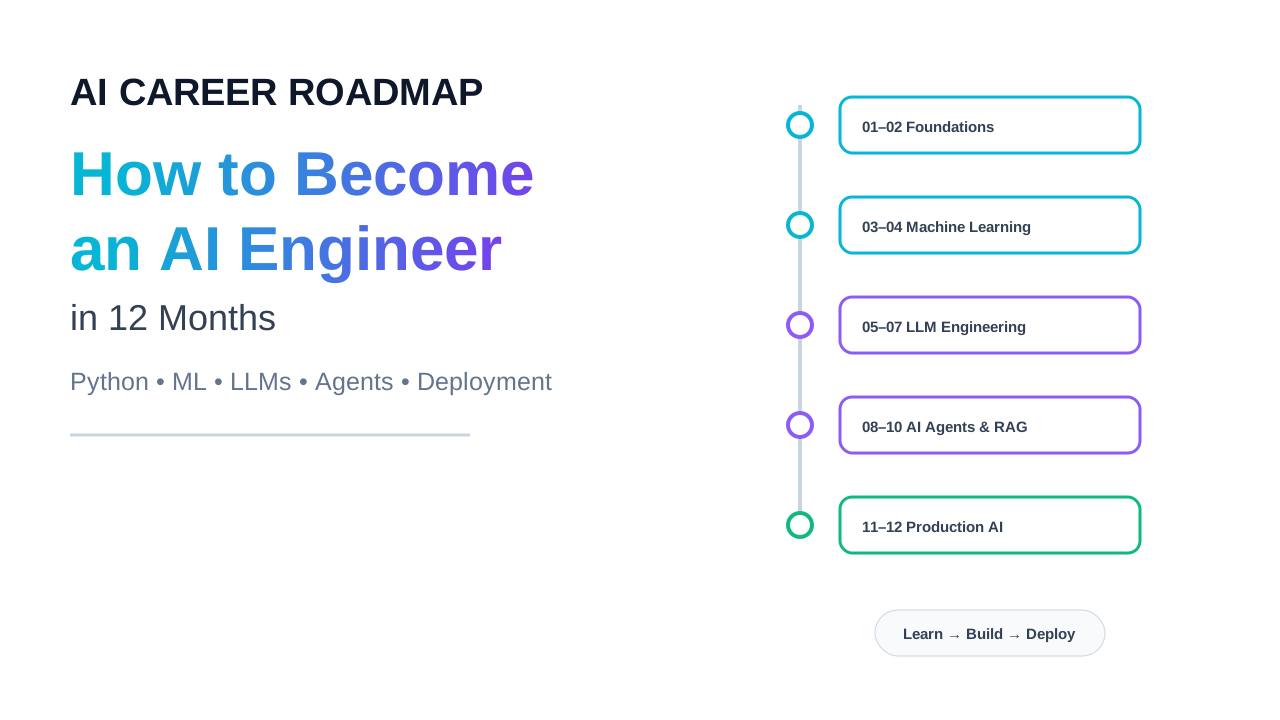
Phase 3: The 12-Month Roadmap — What Happens Behind Each Milestone
This is the core of the guide. Each month builds on a specific bottleneck from the month before it, not just a new topic.
Months 1–2: Programming and Model Literacy
The goal here isn’t “learn Python” in the abstract — it’s reaching fluency with the specific patterns AI engineering leans on constantly: working with JSON and structured data, writing async code (because most model API calls are I/O-bound and slow), and handling errors and retries gracefully, since LLM APIs fail, rate-limit, and time out far more often than typical REST APIs.
Alongside this, build a working mental model of how a transformer-based model actually processes a request — not the calculus of backpropagation, but the practical shape: text becomes tokens, tokens become embeddings, attention lets the model weigh which earlier tokens matter for predicting the next one, and the model outputs a probability distribution over the next token, sampled repeatedly to generate text.
Why this matters practically: understanding tokenization is why you’ll immediately grasp why a prompt with a huge JSON blob costs more and behaves worse than one with clean, minimal context. Understanding attention at a conceptual level is why you’ll intuitively know that stuffing 50 pages into a context window doesn’t mean the model “reads” all of it with equal weight.
Milestone check: Can you explain, without notes, why a longer prompt isn’t automatically a better prompt? If not, you’re not ready for month 3.
Months 3–4: The Application Layer — APIs, Prompting, and Structured Output
This is where most beginners either accelerate or stall permanently, because it’s the first month where you’re building something a stranger could actually use.
Work directly with a model API (any major provider) and get comfortable with:
- System vs. user vs. assistant roles and how they shape behavior differently than a single blob of text
- Structured output — forcing the model to return well-formed JSON matching a schema, which is the backbone of almost every production integration, since downstream code can’t parse free-form prose reliably
- Temperature, top-p, and max tokens as levers, and why they matter: temperature controls how deterministic vs. exploratory the sampling is, which matters enormously for tasks like code generation (low temperature) versus creative brainstorming (higher temperature)
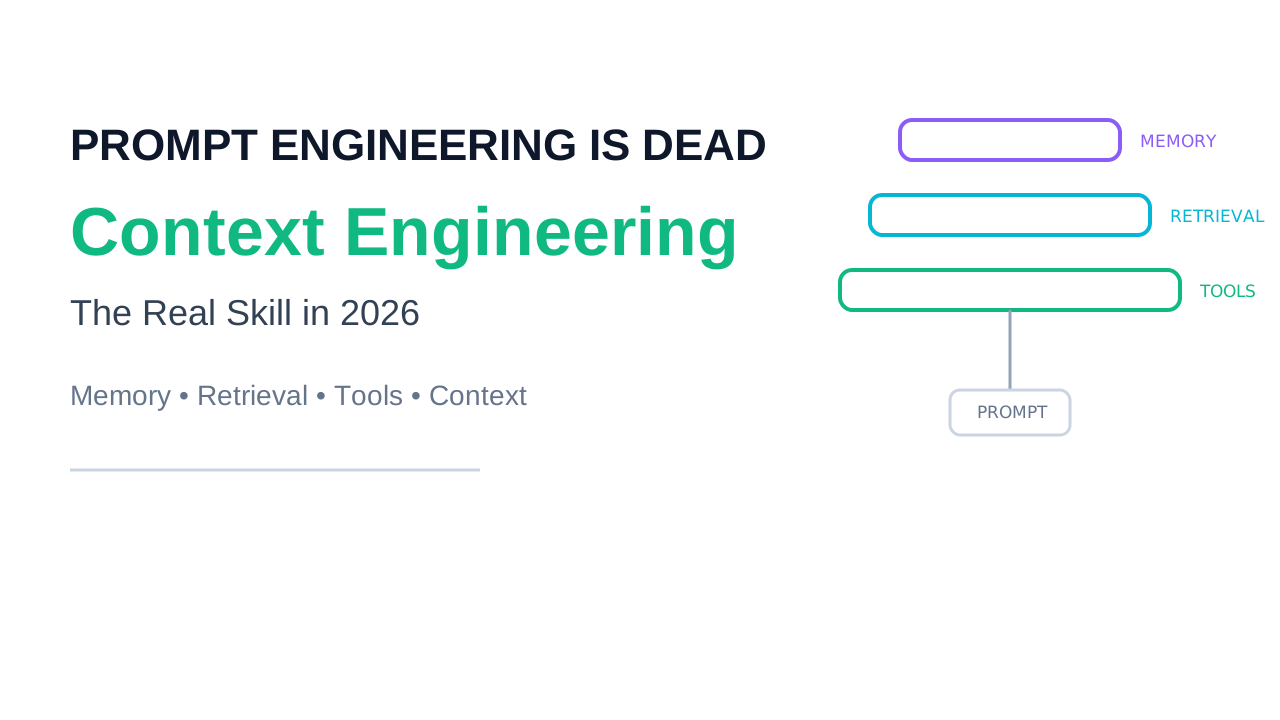
This is also the month to internalize something counterintuitive: prompting is not the bottleneck it was in 2023. Modern frontier models follow clear instructions well by default. The actual skill is context engineering — deciding what information the model needs to see, in what order, and how much of it, to make a good decision. A model given the wrong or excessive context will fail even with a perfect prompt; a model given precisely the right context often succeeds with a mediocre one.
Milestone check: Build a small tool that takes unstructured text input and reliably returns valid structured JSON, with retry logic for the cases where it doesn’t. This single exercise touches API literacy, structured output, and error handling — the actual daily texture of the job.
Months 5–6: Retrieval-Augmented Generation (RAG) — Solving the Knowledge Problem
By month 5 you’ll have hit an obvious wall: the model doesn’t know about your data. It doesn’t know your company’s documents, your codebase, or anything after its training cutoff. RAG exists specifically to solve this without retraining the model.
Understand the pipeline end to end, because this is asked about in nearly every AI engineering interview:
- Chunking — splitting source documents into pieces small enough to embed meaningfully but large enough to retain context. Poor chunking (e.g., splitting mid-sentence, or chunks too large to be specific) is the single most common cause of bad RAG results, more so than the choice of embedding model.
- Embedding — converting each chunk into a vector that captures semantic meaning, so that “car” and “automobile” land near each other in vector space even though they share no characters.
- Retrieval — given a user query, embedding it the same way and finding the nearest chunks by vector similarity, often combined with traditional keyword search (hybrid retrieval) because pure vector search misses exact-match cases like product codes or names.
- Re-ranking — a second, more expensive pass that reorders the top candidates by relevance, because the first-pass retrieval optimizes for speed over precision.
- Generation — injecting the retrieved chunks into the model’s context alongside the user’s question, so the model answers grounded in real, current data rather than its frozen training knowledge.
Why this is the real bottleneck at most companies: it’s rarely the generation step that fails. It’s steps 1–4. A team can swap in the newest, smartest model and get worse answers if their chunking and retrieval are sloppy, because the model can only be as good as the context it’s handed. This is the single most valuable insight to internalize in the entire roadmap — it reframes “AI quality problems” as data engineering problems wearing an AI costume.
Milestone check: Build a RAG system over a real, messy document set (not a clean demo dataset) and manually evaluate 20 queries. You will discover firsthand that most failures are retrieval failures, not generation failures.
Months 7–8: Agents and Tool Use — From Answering to Acting
An agent, stripped of hype, is a loop: the model decides what to do next, takes an action (usually calling a tool — a function, an API, a database query), observes the result, and decides again, until it either finishes the task or hits a stopping condition.
The engineering challenge here isn’t getting an agent to work once in a demo — that’s trivial. The challenge is the failure modes that only show up under real use:
- Infinite or near-infinite loops, where the agent keeps calling the same tool because it never correctly interprets a failed result
- Tool selection errors, where the model has ten tools available and picks the wrong one, especially as the tool list grows
- Context accumulation, where a long-running agent’s transcript grows so large that it exceeds context limits, gets expensive, or the model starts losing track of the original goal — a phenomenon sometimes called “context rot”
- Silent failure propagation, where a tool call fails or returns a partial result, and rather than surfacing the error the model hallucinates plausible-looking output instead
This month is also where you learn multi-agent patterns — when it’s actually useful to split a task across specialized sub-agents (e.g., a researcher agent and a writer agent) versus when that’s just adding coordination overhead to a task a single well-scoped agent could handle. The honest answer, learned only by building and breaking things: single agents with well-defined tools solve the large majority of real business problems; multi-agent systems are for genuinely parallel or genuinely specialized sub-tasks, not a default architecture.
Milestone check: Build an agent with at least three tools that can fail (e.g., a flaky API, a search that sometimes returns nothing) and make the agent handle those failures gracefully instead of hallucinating past them.
Months 9–10: Evaluation, Observability, and Fine-Tuning Judgment
This is the layer that almost no self-taught roadmap covers, and it’s precisely the layer that separates junior from mid-level AI engineers.
Evaluation in a probabilistic system is fundamentally different from unit testing deterministic code. You can’t assert output == expected_string. Instead, production AI teams build evaluation harnesses using a mix of:
- Rule-based checks for objective properties (valid JSON, required fields present, no banned content)
- Model-graded evaluation, where a second model call scores the first model’s output against a rubric — powerful, but with its own failure modes (grader bias, inconsistency) that need to be understood, not blindly trusted
- Human review on a sample, which remains the ground truth check against which the automated evaluations are themselves validated
The instinct to build evaluation before scaling up a feature — rather than shipping and hoping — is the single biggest maturity signal in an AI engineer’s practice, and it’s the thing interviewers probe for most directly by asking some version of “how would you know if this got worse.”
Alongside evaluation, build judgment about when fine-tuning actually helps versus when it’s a waste of effort. The honest, unglamorous truth: most product problems are solved by better context, retrieval, and prompting — not fine-tuning. Fine-tuning earns its cost when you need a narrow, repeatable behavior at high volume and low latency (e.g., classification, consistent formatting, a very specific tone) that prompting alone can’t reliably achieve, or when you need to shrink a task down to a much smaller, cheaper model. Reaching for fine-tuning before exhausting prompting and retrieval is one of the most common wastes of engineering time in this field.
Milestone check: Take a project from an earlier month and write an evaluation suite for it with at least 20 test cases and a scoring method, then use it to actually improve the system and prove the improvement numerically.
Months 11–12: Production Systems and Portfolio Consolidation
The final two months are about integration, not new topics. Take your RAG system and your agent and combine them into one coherent, deployed project that a stranger can actually try — not a Jupyter notebook, but something with a real interface, real error handling, and observability (logging what the model was asked, what it retrieved, what it returned, and whether it succeeded).
This is also the moment to build cost and latency awareness, because it’s a constant conversation in real AI teams: which parts of your pipeline need the most capable (and expensive) model, and which can run on a smaller, faster one? A well-designed system routes tasks — a cheap model for classification, a capable one for the final generation step — rather than using the most expensive model for everything by default.
By the end of month 12, your portfolio should demonstrate the full loop: a real problem, a retrieval or agent system solving it, an evaluation suite proving it works, and visible awareness of cost, latency, and failure handling. That combination — not the sophistication of any single component — is what reads as “hireable” rather than “took some courses.”
Phase 4: Engineering Implementation — What a Minimal RAG Retrieval Step Looks Like
To make Phase 3 concrete, here’s a simplified but realistic sketch of the retrieval step described above, in Python-like pseudocode, with the reasoning behind each decision.
def retrieve_context(query, vector_store, keyword_index, top_k=8):
    # Hybrid retrieval: combine semantic and keyword search.
    # Pure vector search misses exact matches (IDs, names, codes);
    # pure keyword search misses paraphrases and synonyms.
    query_embedding = embed(query)

    semantic_hits = vector_store.search(query_embedding, top_k=top_k)
    keyword_hits = keyword_index.search(query, top_k=top_k)

    # Merge and deduplicate before re-ranking, since the same chunk
    # can legitimately surface from both search paths.
    candidates = deduplicate(semantic_hits + keyword_hits)

    # Re-ranking is a second, more expensive relevance pass —
    # first-pass retrieval optimizes for recall and speed,
    # not precision, so this step recovers precision.
    ranked = rerank(query, candidates)

    # Only pass the top few chunks into the model's context.
    # More context is not free: it costs latency, money, and
    # can dilute the model's attention on what actually matters.
    return ranked[:5]
The decision to hybrid-search rather than rely on vector search alone is a production lesson, not a theoretical one — teams that skip keyword search discover, often in front of a customer, that their system can’t find a document by its exact product code because “SKU-4471” doesn’t have a strong semantic neighbor. The decision to re-rank rather than trust the first-pass ranking directly is similarly earned the hard way: initial retrieval is tuned for speed across millions of chunks, and that speed trades away precision that a smaller, second-pass model can recover cheaply because it’s only ranking a handful of candidates.
The common mistake at this stage isn’t a syntax error — it’s skipping the deduplication and re-ranking steps because they don’t feel necessary on a small demo dataset, and then being surprised when the same pipeline performs badly against a real, messy production corpus.
Phase 5: Real-World Systems — How This Actually Runs at Scale
OpenAI and Anthropic, as model providers, invest heavily in the serving layer beneath everything discussed above — batching requests, managing KV-cache reuse across similar prompts, and load-balancing across enormous GPU fleets so that latency stays low even as request volume spikes unpredictably. As an application-layer engineer you don’t build this, but understanding that it exists explains why prompt caching (reusing a stable prefix like a system prompt across many requests) is both cheaper and faster — you’re benefiting directly from that infrastructure.
Amazon and Netflix apply RAG-like architectures less for chatbots and more for internal knowledge systems — helping engineers find relevant runbooks, past incident reports, and internal documentation during on-call situations, where the cost of retrieval failure (an engineer missing a relevant past incident) is measured in outage minutes, not just user annoyance. This is a useful reminder that RAG’s biggest real-world footprint isn’t customer support bots — it’s internal tooling.
Uber and other logistics-heavy companies lean heavily on agentic systems for operational tasks: an agent that investigates a pricing anomaly by querying several internal systems, cross-referencing them, and producing a structured report is a far more common production pattern than a general-purpose autonomous agent, because the tool set is scoped, the task is bounded, and failure is easy to detect.
The throughline across all of these: production AI systems succeed by being narrow and well-instrumented, not by being maximally general. The “build a chatbot that can do anything” instinct common among beginners is almost the opposite of what gets funded and shipped inside real engineering organizations.
Phase 6: AI-Era Relevance — Why This Roadmap Is Different From a 2022 One
Everything in Phase 3 is shaped by a single structural shift: the bottleneck in AI product development moved from model capability to system reliability. In 2022, the hard problem was getting a model to produce coherent, useful text at all. In 2026, base model capability is rarely the limiting factor for most product ideas — reliability, cost control, and evaluation are.
This is why the roadmap spends two full months on evaluation and observability rather than on model internals or training — because that’s where the actual, currently-unsolved difficulty lives for the majority of AI engineering roles. It’s also why agentic orchestration (Months 7–8) gets equal weight to RAG rather than being treated as an advanced afterthought: multi-step, tool-using systems have become the default shape of AI products, not a specialized niche.
The practical implication for a learner: don’t chase whatever model release is trending this week. Chase the durable skills — retrieval quality, evaluation discipline, failure handling, cost-aware architecture — because those transfer cleanly regardless of which specific model API happens to be state-of-the-art by the time you’re job hunting.
Phase 7: Advantages, Limitations, and Honest Trade-offs of This Path
Advantage — fast feedback loops. Unlike traditional ML engineering, where a training run might take days before you learn whether an approach works, application-layer AI engineering gives you feedback in seconds. This is why a motivated learner can build a genuinely impressive, real portfolio in 12 months where a classical ML specialization historically took much longer to reach product-relevant competence.
Limitation — shallow floor, if you stop early. This path can produce someone who’s excellent at composing APIs but has no real understanding of why a model behaves the way it does when things go subtly wrong — a hallucination that’s hard to catch, a bias that only shows up on certain inputs. That’s precisely why Month 1–2’s model literacy isn’t optional filler; skipping it produces engineers who can build things but can’t debug them when the black box misbehaves in a way no tutorial covered.
Trade-off — you will specialize in a moving target. The tools named in this roadmap (specific retrieval techniques, specific agent patterns) will evolve, some within the next year. The mitigation isn’t to avoid specializing — it’s to consistently attach why to every how as you learn, so that when the specific tool changes, the underlying reasoning still transfers. That’s the entire design principle behind this guide’s structure.
Limitation — this path underweights research-track roles. If your actual goal is working on frontier model training, alignment research, or novel architecture design at a lab, this roadmap is the wrong one — that track genuinely does require the deeper mathematical and systems foundation (distributed training, optimization theory) that this guide deliberately treats as secondary, because that foundation is not what most “AI Engineer” job postings are actually testing for.
Phase 8: Career Impact — What Hiring Actually Looks Like Right Now
Job titles in this space are inconsistent — “AI Engineer,” “ML Engineer,” “Applied AI Engineer,” and “Forward-Deployed Engineer” all sometimes describe the same application-layer work described in this roadmap, and sometimes describe genuinely different jobs. The reliable signal isn’t the title; it’s the job description. If it mentions RAG, agents, evaluation, prompt/context engineering, or “building on top of LLM APIs,” it’s the track this roadmap prepares you for. If it emphasizes model training, GPU cluster management, or research publications, it’s the classical ML/research track instead.
Interview signal has shifted accordingly. Expect to be asked to design a RAG system on a whiteboard and defend your chunking and retrieval choices, to reason through what could go wrong with an autonomous agent given a specific tool set, and — increasingly — to explain how you’d know if a change to a prompt or pipeline actually improved things, rather than just feeling like it did. This last question, evaluation reasoning, has become one of the most common differentiators between candidates in 2026 hiring loops, precisely because so few self-taught candidates have ever built a real evaluation harness.
What to learn next, once this 12-month track is complete: pick a specialization rather than staying general. The two most in-demand directions from here are (1) going deeper into evaluation and reliability engineering for AI systems, effectively becoming the person a team trusts to say “this is safe to ship,” or (2) going deeper into the classical ML/training track from this new, more product-grounded vantage point — which tends to produce a stronger, more grounded ML engineer than starting from theory alone ever did.
Phase 9: Final Thought — The Real Skill This Roadmap Builds
Strip away the specific tools and techniques, and this roadmap is really teaching one underlying skill: how to build reliable systems on top of something fundamentally unreliable. A language model is probabilistic, occasionally wrong in ways that sound completely confident, and constantly evolving underneath you. The engineers who thrive in this field aren’t the ones who’ve memorized the most APIs — they’re the ones who’ve internalized how to build guardrails, evaluation, and graceful failure handling around an inherently imperfect component.
That skill — engineering rigor applied to probabilistic systems — didn’t exist as a distinct discipline a few years ago, and it’s not going away as models get better, because better models raise the ceiling of what’s possible without ever making the reliability problem disappear entirely. Twelve months from now, whatever specific model or framework is dominant will likely have changed. What won’t have changed is the value of an engineer who can look at a system that sometimes fails in strange ways and know exactly how to find out why, fix it, and prove it’s fixed. That’s the engineer this roadmap is built to produce.