The Goldfish Problem Nobody Talks About
Here is something that catches most developers off guard the first time they build with LLMs seriously: you can have a twenty-turn conversation with an AI assistant, reach some important conclusion on turn twelve, and by turn twenty the model has completely forgotten it. Not because the model is bad. Not because the context window ran out. But because the developer forgot to include that earlier turn in the latest request. The model is stateless by design, and when you don’t feed it its own history, it has no history. Every API call is a blank slate. The intelligence is real. The memory, by default, is not. This gap between what users expect (“it remembers me”) and what a language model provides (“I process whatever tokens you send me right now”) is one of the most consequential engineering problems in modern AI product development. Solving it properly — not with hacks, but with an architecture that genuinely works at scale — is the difference between an AI assistant that feels like a capable colleague and one that feels like a goldfish with a college degree. This article is the complete engineering guide to AI agent memory. We will start from why the problem exists at the architecture level, build a precise taxonomy of memory types that map to different engineering solutions, trace exactly how Claude, GPT-4, and Gemini implement memory in their commercial products in 2026, build a production memory system from scratch with annotated code, and end with where the field is heading and what it means for engineers building in this space.
Phase 1: The Problem — Why AI Systems Are Stateless by Design
What the Model Actually Is
To understand why memory is hard for LLMs, you have to start at the architecture level rather than the product level. A language model is a function. It takes a sequence of tokens as input, applies a series of mathematical transformations through billions of parameters, and returns a probability distribution over what token should come next. That is the entire computation.
The parameters — the billions of weights that encode everything the model learned during training — are fixed after training ends. They do not change during inference. They cannot be written to during a conversation. The model cannot learn new facts by talking to you any more than a calculator can learn new equations by being used.
This means everything the model “knows” about the current conversation must be explicitly included in the tokens you send it. If you ask “what did I say earlier?” and you haven’t included the earlier message in the current request, the model genuinely has no access to it. It is not hiding information or forgetting — it simply never received those tokens this time.
Why Statelessness Is a Feature, Not a Bug
This is not an oversight. Statelessness is an intentional design property with significant engineering advantages.
A stateless model can be deployed across hundreds of servers simultaneously with no coordination overhead. Any server can handle any request because there is no session state to worry about. A model that maintained state per user would require routing every request to the same server, creating hotspots, single points of failure, and horizontal scaling nightmares. The stateless design is what allows OpenAI, Anthropic, and Google to serve millions of concurrent users from shared infrastructure.
Statelessness also provides clean failure semantics. If a server crashes mid-conversation, the next request simply goes to another server. Nothing is lost that wasn’t already explicitly included in the request. A stateful architecture would require distributed session storage, failover protocols, and consistency guarantees across servers — a substantially more complex system.
For content safety, statelessness means a malicious or manipulative conversation cannot permanently corrupt the model’s behavior for other users. Each conversation is isolated.
The Gap That Creates the Engineering Problem
All of those advantages come at a cost that compounds as AI applications grow more sophisticated. The cost is this: anything you want the model to know about, you must send it. Every time. The model has no ambient awareness of your history, preferences, decisions, or context. If you had thirty prior conversations with it, the model knows nothing about any of them unless you explicitly include that information in the current request.
For a simple one-shot query — “translate this sentence” or “explain this concept” — statelessness is irrelevant. The context needed fits in one prompt.
For a long-running coding assistant that knows your codebase architecture, an agent managing a project over multiple weeks, or a customer support system that needs to recall a user’s history without making them re-explain everything — statelessness becomes the central engineering challenge. The information exists somewhere (prior conversations, user preferences, past decisions), but none of it reaches the model automatically. It only reaches the model when your infrastructure deliberately retrieves it and includes it in the current request.
That retrieval infrastructure is what AI memory systems engineering is entirely about.
The Four Memory Gaps That Matter in Practice
Engineers building real AI products consistently encounter four distinct failure modes, each corresponding to a different gap in the default stateless setup.
The session gap is the most obvious: when a conversation ends, the context window clears, and the next conversation starts fresh. A user who explained their project constraints yesterday has to explain them again today. This is the failure mode most users notice first and find most frustrating.
The within-session degradation gap is subtler but equally real. Even inside a single long conversation, information mentioned early becomes less reliably attended to as the context fills. Research has consistently shown that language models pay more attention to content near the beginning and end of their context window than to content in the middle. A constraint mentioned in turn two of a fifty-turn conversation may be less reliably followed at turn forty-eight than one mentioned in turn forty-six, even though both are technically present in the context.
The knowledge freshness gap emerges from the training cutoff. Every model was trained on data up to some date, after which it knows nothing about the world. For an agent that needs to reason about your internal documentation, recent market data, or a company policy that changed last month, the model’s parametric knowledge is simply absent. No amount of clever prompting can conjure facts that were never in the training data.
The personalization gap is perhaps the most valuable to close commercially. A general-purpose model treats every user identically because it has no model of any specific user. It doesn’t know you prefer concise responses, that you’re an experienced Python developer who doesn’t need syntax explained, that you decided against using Redis for this project, or that you’ve asked this same question three times and keep forgetting the answer. Personalization requires memory — specifically, the ability to store and retrieve facts about a specific user that make the model’s behavior meaningfully different for that person than for everyone else.
Each gap has a different engineering solution, and the art of AI memory architecture is matching the right solution to the right gap rather than reaching for a single mechanism that handles everything poorly.
Phase 2: Building the Mental Model — The Memory Taxonomy
Why Human Memory Science Is Surprisingly Applicable Here
Cognitive psychology spent decades classifying human memory into distinct systems, and the distinction turned out to map remarkably well onto the engineering problem of AI agent memory. Not because AI works like a brain — it emphatically does not — but because the functional requirements that led to different biological memory systems (fast working memory for active tasks, slower long-term storage for accumulated knowledge, implicit procedural memory for learned skills) generate parallel engineering requirements in AI systems.
The taxonomy has five types. Understanding each one precisely is what separates engineers who design memory systems from engineers who bolt a vector database onto their agent and hope for the best.
Working Memory: Fast, Active, Temporary
Working memory is whatever is actively “in mind” right now. In AI systems, this maps directly to the context window — every token currently in the model’s input is its working memory. It’s fast (the model attends to it every inference pass), it’s directly available (no retrieval step needed), and it’s completely temporary (it exists only for this API call).
The context window is the only memory type every LLM has by default. Everything else requires engineering to implement. This is why understanding the context window’s properties — its size, the attention patterns that favor beginning and end, its per-token cost, its relationship to model latency — is the first thing any AI memory engineer must understand deeply.
Modern frontier models have substantially larger context windows than their predecessors. Claude’s 200K-token window, Gemini’s 1M+ token window, and GPT-4’s 128K window have made “just put everything in context” viable for a wider range of tasks than it used to be. But even a million-token context window doesn’t eliminate the need for memory architecture — it raises the ceiling while leaving all the fundamental trade-offs (cost, attention degradation, session persistence, personalization) structurally unchanged.
Episodic Memory: The Record of Specific Events
Episodic memory stores specific past events — what happened, when, in what sequence, with what outcome. The defining property of episodic memory is its specificity: not “users tend to prefer concise responses” but “in our conversation on Tuesday, the user explicitly asked me to stop explaining things they already know.”
In AI systems, episodic memory must be engineered as an external store. Past interactions are serialized, indexed, and stored in a database. When a new session begins, the system retrieves the episodes most relevant to the current context and injects them into the working memory (context window) as background information.
Episodic memory is what enables an agent to say “last time you asked about this, we concluded X” or “I remember you mentioned the deadline is March — is that still the case?” It is the memory type that creates the sense of genuine continuity, because it anchors the agent’s knowledge to specific shared history rather than generic world knowledge.
Semantic Memory: General World and Domain Knowledge
Semantic memory is general knowledge — facts, concepts, relationships — that aren’t tied to specific personal experiences. Every language model has enormous parametric semantic memory baked into its weights from pretraining. GPT-4 knows what Python is, how TCP/IP works, who wrote Hamlet, and millions of other facts encoded during training.
The engineering challenge with semantic memory is that the model’s parametric knowledge is fixed at the training cutoff and cannot be updated without retraining. For AI agents that need to reason about your company’s internal documentation, an API that was updated last month, or industry data from last week, the parametric semantic memory is useless. The solution is external semantic memory — a retrieval-indexed knowledge base (this is exactly what RAG architectures provide) that the agent queries to retrieve current, specific, or proprietary information on demand.
The distinction between episodic and semantic memory matters for system design because they use different retrieval strategies. Episodic memories are retrieved by similarity to the current situation (what past interactions are most like what’s happening now). Semantic memories are retrieved by relevance to the current question (what factual content answers what’s being asked). Both use embedding-based vector search in most production implementations, but they’re organized differently and serve different purposes in the assembled context.
Procedural Memory: Learned Behavioral Patterns
Procedural memory in humans is the implicit knowledge of how to do things — riding a bike, typing without looking, shifting gears. You can’t easily articulate it, but it’s expressed through behavior that becomes more reliable with practice.
In AI systems, this maps to two different engineering approaches. Fine-tuning modifies the model’s weights based on examples of desired behavior, making certain patterns more likely — this is the equivalent of the model practicing until a skill becomes automatic. Alternatively, preference and behavioral patterns can be stored externally and retrieved into context — if the system knows you always want TypeScript, always want tests included, and never want abstract class hierarchies, those preferences retrieved from a store and injected into the system prompt functionally mimic the personalized responsiveness that procedural memory provides in humans, without touching the model’s weights.
The external approach is far more practically accessible than fine-tuning. Most teams shouldn’t fine-tune models for preference adaptation; they should store preferences and retrieve them.
The Four-Layer Stack: Putting It Together
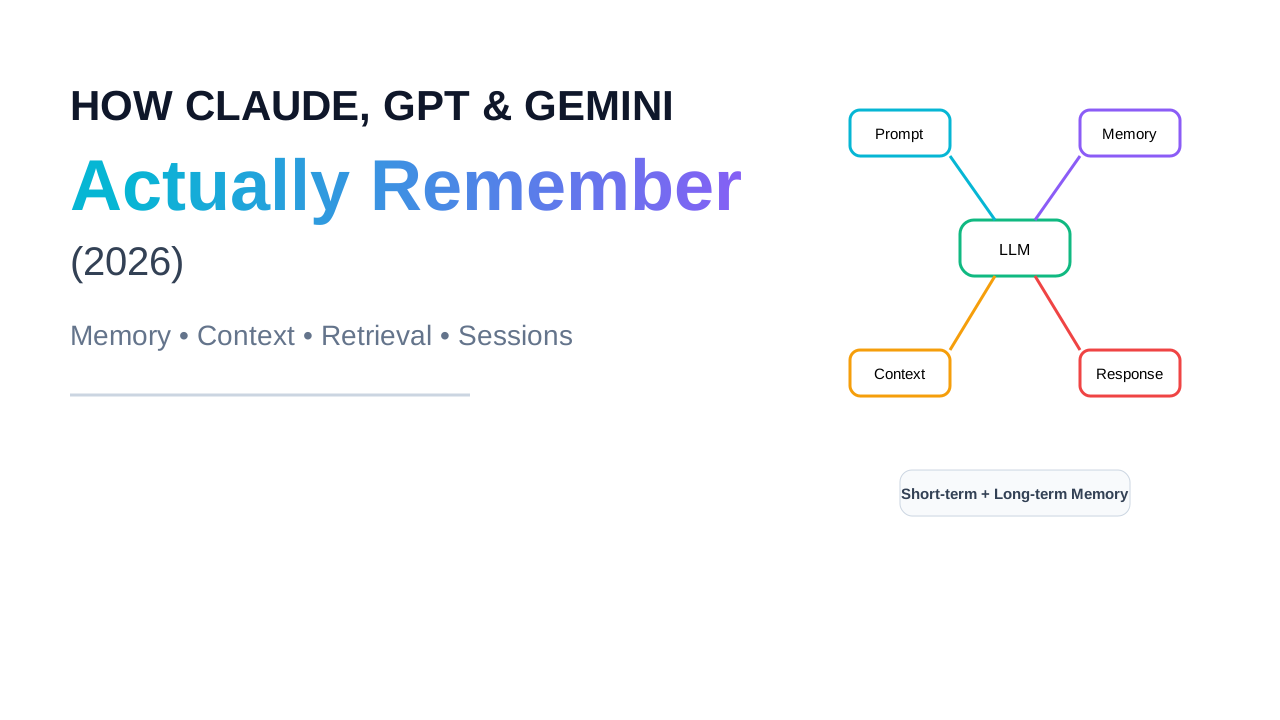
The most useful mental model for AI memory architecture is a four-layer stack, with each layer trading off speed, persistence, and engineering complexity differently:
┌────────────────────────────────────────────────────────┐
│  LAYER 1: Working Memory (Context Window)              │
│  Speed: Instant     Persistence: Current call only     │
│  Capacity: 8K–1M tokens depending on model             │
│  Engineering cost: Zero — built in                     │
└──────────────────────────┬─────────────────────────────┘
                           │ retrieved / injected
┌──────────────────────────▼─────────────────────────────┐
│  LAYER 2: Session Memory (Short-Term External)         │
│  Speed: <10ms       Persistence: Hours to days         │
│  Storage: Redis, SQLite, PostgreSQL                    │
│  Addresses: Session gap                                │
└──────────────────────────┬─────────────────────────────┘
                           │ semantically retrieved
┌──────────────────────────▼─────────────────────────────┐
│  LAYER 3: Long-Term Memory (Episodic + Preference)     │
│  Speed: 50–150ms    Persistence: Months to indefinite  │
│  Storage: Vector database (pgvector, Pinecone, Qdrant) │
│  Addresses: Personalization gap, session gap           │
└──────────────────────────┬─────────────────────────────┘
                           │ updated only via training
┌──────────────────────────▼─────────────────────────────┐
│  LAYER 4: Parametric Memory (Model Weights)            │
│  Speed: N/A (always present)   Persistence: Fixed      │
│  Updated: Retraining or fine-tuning only              │
│  Addresses: General world knowledge                    │
└────────────────────────────────────────────────────────┘
Every decision in memory system design is a question of: which layer should this information live in, and how should it move between layers as interactions evolve? A user preference stated in a conversation should move from working memory (where it was first mentioned) to long-term memory (where it persists for future sessions). A retrieved document that answers a specific question lives in the context window for this turn and nowhere else. The movement of information between layers is where most of the engineering work happens.
Phase 3: Internal Working Deep Dive — How Memory Is Actually Built
The KV Cache: The Performance Memory Engineers Forget
Before discussing external memory systems, there’s a memory layer that operates entirely inside the model’s inference engine that most application engineers never think about explicitly: the key-value (KV) cache.
When a Transformer model processes a sequence of tokens, it computes key and value matrices at every attention layer for every token. These computations are expensive. On the second turn of a conversation — which re-sends the same system prompt, the same previous messages, and adds only the new user turn — recomputing those matrices for every unchanged token is pure redundant work.
The KV cache stores computed key and value tensors for tokens that haven’t changed since the last request, so only the new tokens need fresh computation. For a long session with a fixed system prompt, this can eliminate 40-60% of the total compute cost per request, directly reducing both latency and cost.
Anthropic exposes this as “prompt caching” — you can mark stable parts of your context (a long system prompt, persistent document context) for explicit caching, with cached tokens billed at roughly 10% of the standard rate. OpenAI offers similar caching behavior automatically for prompts above a certain length threshold. Google’s Gemini API offers explicit context caching with configurable TTLs.
The engineering implication is concrete: structure your prompts so that stable content (system prompt, persistent documents, user preferences) comes first and changes as little as possible between requests. Volatile content (the current turn, newly retrieved search results) goes at the end where it doesn’t break the cached prefix. The cache saves money on every turn of a long conversation, and the savings compound as session length grows.
Context Window Management: The Underrated Engineering Problem
The context window is the most powerful memory tool and the most commonly mismanaged one. The failure mode is simple: accumulate everything, run out of space, truncate arbitrarily from one end, and lose critical information.
A production context window strategy treats the window as a budget with deliberate allocation. A reasonable starting structure for a conversational agent:
- System prompt and user preferences: 10-15% of budget (stable, cached)
- Retrieved long-term memories relevant to current query: 15-20%
- Retrieved knowledge base content: 20-30%
- Recent conversation history: 20-30%
- Current user turn and tool results: remaining budget
The percentages shift based on the application. A research agent might allocate heavily to knowledge retrieval. A personal assistant prioritizes memory. A coding agent allocates generously to retrieved code context. The point is that allocation is deliberate, not accidental.
When conversation history approaches its budget, the right response is not arbitrary truncation but structured summarization: compress the oldest turns into a compact summary that preserves the essential thread — decisions made, constraints established, conclusions reached — at a fraction of the token cost. This summary becomes part of the “stable” context, cached and present on every subsequent turn, while the verbatim recent history uses the remaining budget for turns where precise wording matters.
Session Memory: Persistence Without Complexity
Session memory addresses the session gap with minimum engineering complexity. The pattern is simple: maintain a thread identifier for each conversation, serialize the conversation history as JSON, and persist it to a fast key-value store. On each new request within a thread, load the history and include it in the context. On each new request starting a new thread, begin fresh.
Redis works well for active sessions because reads and writes are under a millisecond and it handles high concurrency naturally. SQLite works well for single-server deployments or local applications. PostgreSQL with a conversations table works well when you already have a Postgres instance and want to avoid adding infrastructure.
The engineering decisions that matter: expiry policy (how long do sessions stay hot in Redis before archival?), session boundaries (does a new conversation mean a new thread, or does the user control when a thread ends?), and cross-device continuity (can a user start a conversation on mobile and continue on desktop?). These are product decisions with engineering implications, but they all resolve to the same underlying pattern of a thread ID that loads its history on demand.
Long-Term Memory: The Hard Part
Long-term memory is where AI memory engineering gets genuinely difficult. Storing memories is trivially cheap. The hard part is retrieval — given a new session with a new query, finding the specific past interactions, preferences, and facts that are actually relevant right now, from potentially hundreds of past sessions and thousands of stored facts, fast enough that users don’t perceive the latency.
The standard retrieval architecture has three stages.
Stage 1: Encode and index. Past interaction summaries, preference statements, and learned facts are encoded as high-dimensional vectors by an embedding model and stored in a vector index. The embedding model converts text into geometry — semantically similar content becomes geometrically close vectors. “User prefers TypeScript” and “User said avoid JavaScript when possible” will have close vectors even with no shared keywords, because a well-trained embedding model captures semantic equivalence rather than lexical overlap.
Stage 2: Query-time retrieval. When a new session starts, the current query is embedded by the same model, and approximate nearest-neighbor search finds the top-k stored memories with highest semantic similarity to the current context. In production at moderate scale, this takes 50-150ms with a well-tuned vector store — fast enough to run on every turn without perceptible impact on response latency.
Stage 3: Re-ranking and selection. The top-k semantically similar memories are re-ranked by a cross-encoder — a model that sees the query and each candidate together and produces a precise relevance score, rather than the independent embeddings of the bi-encoder retrieval step. Re-ranking catches cases where semantic similarity led to a plausible but not actually relevant memory, and it dramatically improves the precision of what gets injected into the context. The computational cost of re-ranking is manageable because it only operates on the small candidate set from Stage 2, not the full memory store.
Memory Extraction: How New Memories Get Created
A memory system that requires manual input (“remember this”) will be used sporadically and miss most of what’s worth remembering. A production system extracts memories automatically at the end of sessions (or at configurable turn intervals), using a lightweight LLM call to identify what’s worth storing:
The extraction model receives the conversation and a structured prompt asking it to identify explicit preferences (“I prefer X”), important facts about the user’s context (job, project, constraints), and significant decisions or conclusions reached. It returns structured output — a JSON array of memory objects with a type field (preference, episode, fact) and a concise content string. These are embedded and stored in the vector index.
Using a smaller, cheaper model for extraction is deliberate. Memory extraction is a classification and summarization task that doesn’t require deep reasoning. Running the most capable and expensive model on every session’s history at closing time would be costly and provide no quality benefit over a well-prompted smaller model. This is model tiering applied to memory operations: use the minimum capability required for each task.
The Consolidation Problem: Why Memory Systems Degrade Over Time
Here is the engineering challenge that teams hit six to twelve months after deploying a long-term memory system: the store grows, and retrieval quality degrades.
After a hundred sessions, a user might have fifteen stored preference memories, some of which contradict each other because preferences changed over time. The vector store dutifully retrieves the top-k semantically similar memories on each query, but with fifteen overlapping preferences in the store, several of those slots are wasted on near-duplicates while genuinely relevant but more distant memories are crowded out.
Human long-term memory doesn’t have this problem because it actively consolidates — similar memories merge into generalized schemas, weakly-accessed memories fade, and the system naturally promotes recency and importance. AI memory systems need to replicate this deliberately.
The standard implementation is a periodic consolidation pass, running nightly or triggered by store size thresholds:
- Cluster stored memories by topic using the vector store’s own geometry
- Within each cluster, identify memories that conflict or overlap
- Run a summarization pass that produces one consolidated memory per cluster, preserving the most recent and most frequently accessed information
- Write the consolidated memory and archive the source memories
This keeps the store lean, reduces retrieval noise, and naturally promotes recent preferences over stale ones. The access count and last-accessed timestamp stored alongside each memory are exactly the signals this consolidation algorithm needs to decide what to preserve, merge, or archive.
Phase 4: Engineering Implementation — Building a Production Memory System
The Complete Memory Manager
Here is a production-shaped memory system that implements all three external memory layers: session persistence, long-term episodic storage, and automatic memory extraction.
import json
import sqlite3
import uuid
from datetime import datetime
from typing import Optional

import numpy as np


class MemoryManager:
    """
    Production memory manager for an AI agent.
    Implements session memory (Layer 2) and long-term memory (Layer 3).
    """

    def __init__(self, db_path: str = "agent_memory.db"):
        self.conn = sqlite3.connect(db_path, check_same_thread=False)
        self._init_schema()

    def _init_schema(self):
        self.conn.executescript("""
            CREATE TABLE IF NOT EXISTS sessions (
                thread_id   TEXT PRIMARY KEY,
                history     TEXT NOT NULL,
                updated_at  TIMESTAMP DEFAULT CURRENT_TIMESTAMP
            );

            CREATE TABLE IF NOT EXISTS memories (
                id              TEXT PRIMARY KEY,
                user_id         TEXT NOT NULL,
                memory_type     TEXT NOT NULL,   -- 'preference', 'episode', 'fact'
                content         TEXT NOT NULL,
                embedding       BLOB NOT NULL,    -- float32 numpy bytes
                created_at      TIMESTAMP DEFAULT CURRENT_TIMESTAMP,
                last_accessed   TIMESTAMP,
                access_count    INTEGER DEFAULT 0
            );

            CREATE INDEX IF NOT EXISTS idx_memories_user
                ON memories(user_id);
        """)

    # ── Session Layer (Layer 2) ────────────────────────────────────────────────

    def load_session(self, thread_id: str) -> list:
        """Load conversation history for a thread. Returns [] if new thread."""
        row = self.conn.execute(
            "SELECT history FROM sessions WHERE thread_id = ?",
            (thread_id,),
        ).fetchone()
        return json.loads(row[0]) if row else []

    def save_session(self, thread_id: str, history: list) -> None:
        """Persist session state after every iteration — not just at session end."""
        self.conn.execute(
            """INSERT OR REPLACE INTO sessions (thread_id, history, updated_at)
               VALUES (?, ?, CURRENT_TIMESTAMP)""",
            (thread_id, json.dumps(history)),
        )
        self.conn.commit()

    # ── Long-Term Memory Layer (Layer 3) ──────────────────────────────────────

    def store_memory(
        self,
        user_id: str,
        content: str,
        memory_type: str,
        embedding: np.ndarray,
    ) -> str:
        """Store a new memory with its embedding vector."""
        mem_id = str(uuid.uuid4())
        self.conn.execute(
            """INSERT INTO memories
               (id, user_id, memory_type, content, embedding)
               VALUES (?, ?, ?, ?, ?)""",
            (
                mem_id, user_id, memory_type, content,
                embedding.astype(np.float32).tobytes(),
            ),
        )
        self.conn.commit()
        return mem_id

    def retrieve_relevant(
        self,
        user_id: str,
        query_embedding: np.ndarray,
        top_k: int = 5,
        min_score: float = 0.72,
    ) -> list[dict]:
        """
        Cosine similarity retrieval over stored memories.
        In production with >100K memories, replace with pgvector or Pinecone.
        The interface is identical — only the underlying call changes.
        """
        rows = self.conn.execute(
            "SELECT id, memory_type, content, embedding FROM memories WHERE user_id = ?",
            (user_id,),
        ).fetchall()

        if not rows:
            return []

        q_norm = query_embedding / (np.linalg.norm(query_embedding) + 1e-8)
        results = []

        for mem_id, mem_type, content, emb_bytes in rows:
            stored = np.frombuffer(emb_bytes, dtype=np.float32)
            stored_norm = stored / (np.linalg.norm(stored) + 1e-8)
            score = float(np.dot(q_norm, stored_norm))

            if score >= min_score:
                results.append({
                    "id": mem_id,
                    "type": mem_type,
                    "content": content,
                    "score": score,
                })

        results.sort(key=lambda x: x["score"], reverse=True)
        top = results[:top_k]

        # Update access metadata — used by the consolidation algorithm later
        if top:
            ids = [m["id"] for m in top]
            placeholders = ",".join("?" * len(ids))
            self.conn.execute(
                f"""UPDATE memories
                   SET last_accessed = CURRENT_TIMESTAMP,
                       access_count  = access_count + 1
                   WHERE id IN ({placeholders})""",
                ids,
            )
            self.conn.commit()

        return top
Why save_session saves after every turn, not just at session end. If the process crashes during turn seven of a ten-turn conversation, saving only at the end means losing everything. Saving after every turn means a crash loses at most the current turn — which is recoverable. This is the same durability principle behind database WALs and Redis AOF persistence, applied to conversation state.
Why the similarity threshold min_score=0.72 is not arbitrary. Without a minimum threshold, the retrieval returns the top-k most similar memories even if none of them are actually relevant — because “most similar” is relative. A query about database optimization that retrieves the five least-irrelevant memories from a store full of preferences about writing style is actively harmful: those memories consume context budget and introduce noise. The threshold filters out the long tail of weakly similar memories, ensuring only genuinely relevant ones reach the context window.
Context Assembly: Putting Memory Into the Prompt
def assemble_context(
    user_id: str,
    thread_id: str,
    current_query: str,
    system_prompt: str,
    memory_manager: MemoryManager,
    embed_fn,
) -> tuple[str, list]:
    """
    Builds the full context for an API call by assembling all memory layers.
    Returns (full_system_prompt, messages_array).
    """
    # Retrieve relevant long-term memories
    query_embedding = embed_fn(current_query)
    memories = memory_manager.retrieve_relevant(user_id, query_embedding, top_k=5)

    # Inject memories at the TOP of the system prompt — not appended at the end.
    # Beginning-of-context placement receives more reliable model attention
    # and signals these are authoritative background facts, not conversation.
    memory_block = ""
    if memories:
        lines = [f"- [{m['type'].upper()}] {m['content']}" for m in memories]
        memory_block = (
            "\n\nKnown context from previous sessions:\n"
            + "\n".join(lines)
            + "\n"
        )

    full_system_prompt = system_prompt + memory_block

    # Load session history and prune to budget
    history = memory_manager.load_session(thread_id)
    history = _prune_history(history, token_budget=6000)

    messages = history + [{"role": "user", "content": current_query}]
    return full_system_prompt, messages


def _prune_history(history: list, token_budget: int) -> list:
    """
    Keeps the most recent turns that fit within the token budget.
    Older turns that exceeded the budget should be summarized and stored
    as session-level episodic memories — not silently dropped.
    """
    kept = []
    running = 0
    for turn in reversed(history):
        # Rough token estimate: characters / 4
        turn_tokens = len(str(turn.get("content", ""))) // 4
        if running + turn_tokens > token_budget:
            break
        kept.insert(0, turn)
        running += turn_tokens
    return kept
Why memories go into the system prompt rather than as separate user/assistant messages. Injecting memories as system prompt content signals to the model that this is authoritative background context it should reason from, not conversational content it should respond to. A memory injected as a user message (“By the way, you mentioned you prefer TypeScript”) could be interpreted as the user making a new request. In the system prompt it’s unambiguously pre-established context.
Automatic Memory Extraction
EXTRACTION_PROMPT = """Review this conversation and extract anything worth \
remembering for future sessions.

Return ONLY a JSON array. Each item must have:
- "type": "preference" | "episode" | "fact"
- "content": one sentence under 120 characters

Focus on:
- Explicit preferences ("I prefer...", "always use...", "never...")
- Important facts about the user's context (role, project, constraints)
- Significant decisions or conclusions reached in this conversation

If nothing worth storing, return: []"""


def extract_and_store_memories(
    conversation: list,
    user_id: str,
    memory_manager: MemoryManager,
    llm_client,
    embed_fn,
) -> int:
    """
    Runs at session end. Extracts memorable facts and stores them.
    Uses a small, cheap model — extraction doesn't require deep reasoning.
    Returns the number of memories stored.
    """
    history_text = "\n".join(
        f"{m['role'].upper()}: {m['content']}"
        for m in conversation
        if isinstance(m.get("content"), str)
    )

    response = llm_client.messages.create(
        model="claude-haiku-4-5-20251001",  # Cheap and fast — right for this task
        max_tokens=512,
        messages=[{
            "role": "user",
            "content": EXTRACTION_PROMPT + f"\n\nConversation:\n{history_text}",
        }],
    )

    try:
        raw = response.content[0].text.strip()
        memories = json.loads(raw)
    except (json.JSONDecodeError, IndexError):
        # A missed memory is acceptable. A crash at session end is not.
        return 0

    count = 0
    for mem in memories:
        if not isinstance(mem, dict):
            continue
        content = mem.get("content", "")
        mem_type = mem.get("type", "fact")
        if content and len(content) <= 200:
            embedding = embed_fn(content)
            memory_manager.store_memory(user_id, content, mem_type, embedding)
            count += 1

    return count
Why the extraction silently returns zero on JSON decode failure rather than raising. Memory extraction is infrastructure that serves the main conversation experience. If extraction fails at session end, the user’s experience was still complete — they just won’t have this session’s facts available next time. A crash at session end that propagates into a 500 error to the user is categorically worse than a silently missed memory. Infrastructure failures must be isolated from the user-facing path.
Common Implementation Mistakes
Saving session state only at session end. Makes the system fragile to crashes mid-conversation. Save after every turn.
No minimum similarity threshold on memory retrieval. Causes the most similar but still irrelevant memories to flood the context. Always threshold.
Storing memories in the middle of the context window. The lost-in-the-middle effect will cause the model to inconsistently apply stored preferences. Always inject at the beginning of the system prompt.
Using the same expensive model for memory extraction as for the main conversation. Extraction is a simple classification task. Using a large model for it adds cost and latency with no quality benefit.
Letting the memory store grow indefinitely without consolidation. Retrieval precision degrades as the store grows. Build consolidation into the system from the start, not as an afterthought.
Storing raw conversation turns verbatim as memories. Raw turns are noisy and token-expensive. Run them through extraction first to produce concise, structured memory objects.
Phase 5: How Claude, GPT, and Gemini Actually Implement Memory
Claude’s Memory: Transparent, Editable, User-Controlled
Anthropic’s approach to memory in Claude.ai is architecturally interesting because it prioritizes user transparency over seamless automation. When memory is enabled, Claude generates structured memory objects from conversations — user-stated preferences, important context facts, notable decisions — and stores them attached to the user’s account. On subsequent conversations, relevant memories are retrieved and included in the context.
What makes Claude’s implementation distinctive is the transparency layer: users can view every stored memory, edit any of them, and delete individual entries or clear the store entirely. This design reflects a deliberate product philosophy — users who can see and control what the system knows about them tend to trust it more than users who receive personalization from an invisible mechanism they can’t inspect or correct.
The practical engineering implication of transparency is that memory objects must be human-readable and semantically compact. A raw conversation segment is useless as a visible memory artifact. A concise structured statement like “User is a backend engineer who prefers Go for system services and Python for data work” is useful both for retrieval and for user comprehension.
Claude’s memory also consolidates. Rather than accumulating indefinitely, similar memories merge over time, keeping the store lean and ensuring older, outdated preferences don’t compete with current ones for retrieval slots.
GPT’s Memory: Similar Architecture, Different Product Presentation
OpenAI’s memory in ChatGPT follows structurally similar principles — semantic extraction, vector-indexed storage, retrieval into context — with a slightly different user experience surface. Memory management is exposed as a relatively prominent feature, with users able to view and delete stored facts from within the ChatGPT interface.
One notable property of GPT’s memory system is that it stores memories at a fairly coarse granularity — general preferences and high-level facts rather than granular session-specific details. This appears to be a deliberate decision to keep memory objects broadly applicable across future conversations rather than context-specific to particular past sessions. The trade-off is that highly specific episodic memories (“in our conversation about the React project last Tuesday”) are less well-captured than general behavioral patterns (“user prefers to see code examples before explanations”).
OpenAI also exposes explicit memory management through the Assistants API for developers, allowing programmatic control over what facts are stored for a given user and how they’re retrieved — a more flexible interface than the consumer product’s automatic extraction.
Gemini’s Memory: Ecosystem Integration at Scale
Google’s approach to memory in Gemini differs from the others in its depth of ecosystem integration. Gemini can access persistent context through a user’s Google account — past conversations, documents in Google Drive, emails (with appropriate permissions), Calendar events, and other signals from across the Google product surface. This is not a standalone memory module; it’s a permissioned access layer into an already-existing model of the user’s digital life.
The engineering advantage is that Google has already built a sophisticated, comprehensive model of user preferences and context through Search, Gmail, Drive, Maps, and YouTube interaction history. Gemini inherits this context rather than building it from scratch through conversation. The user doesn’t need to re-establish their professional context, communication style preferences, or organizational patterns by telling Gemini — these signals are already present in the broader Google account context.
The trade-off is privacy surface and permission complexity. Users granting Gemini access to Gmail and Drive for context are making a substantially larger data disclosure than users sharing conversation history with a standalone memory module. The richness of context and the breadth of permission required scale together.
The Long-Context Debate: Does a Million Tokens Replace Memory Architecture?
Gemini’s 1M+ token context window raises a legitimate question: if you can fit an entire year’s worth of conversations into a single context window, do you still need a memory architecture?
The answer is yes, for several reasons that don’t dissolve with longer windows.
Cost scales linearly with context length. Processing a million-token context on every turn of every conversation is expensive at any scale. Selective retrieval — finding the few thousand tokens actually relevant to the current query — is orders of magnitude cheaper than reprocessing the entire history on every turn.
The lost-in-the-middle effect persists even in long-context models. Empirical results consistently show that models attend less reliably to information in the center of very long contexts, regardless of context window size. A user preference mentioned 800,000 tokens ago in a million-token window is not as reliably attended to as one retrieved and placed at the beginning of the context for the current turn.
Session persistence and cross-device continuity require external storage regardless of context window size. A million-token context window doesn’t survive a device restart, a different browser session, or a user returning to the product two weeks later. External memory does.
The honest framing is that long context windows and memory architecture are complementary, not competing. Long context handles the within-session depth problem. Memory architecture handles the cross-session continuity and personalization problems. The combination produces better results than either alone.
Production Systems: Coding Assistants, Support AI, and Agent Frameworks
Coding assistants like Cursor and GitHub Copilot implement a specialized form of memory scoped to the project: a continuously maintained vector index of the codebase that makes the entire project’s structure and content retrievable as working context. This is semantic memory over a specific knowledge domain, updated as files change, and retrieved based on the current file and task. It’s architecturally a RAG system where the “documents” are source files and the “query” is the current coding context.
Customer support AI at companies like Klarna, Intercom’s AI Copilot, and Salesforce Einstein combines two retrieval systems: exact lookup against structured databases (order history, account status, support ticket history — data where precise values matter and approximate retrieval would be dangerous) and semantic search over unstructured interaction history (past chat transcripts, support notes). The hybrid is necessary because “what is this user’s current order status” requires exact retrieval while “has this user mentioned this problem before” requires semantic matching.
Agent frameworks — particularly LangGraph, which uses PostgreSQL-backed checkpointing for durable session state — implement the session memory layer as a first-class architectural concern rather than an afterthought. Every step of an agent loop is checkpointed, enabling recovery from crashes without restarting tasks from the beginning. This is the same principle as the save_session after every turn pattern above, applied at the agent execution level.
Phase 6: AI Era Relevance — Memory and the Agentic Future
Why Memory Is the Missing Piece for Long-Running Agents
The agent systems generating serious business value in 2026 — coding agents, research assistants, customer success agents, operational automation — all share a defining characteristic: they operate over time, not in isolated single-session interactions. A coding agent working on a large feature over two weeks needs to carry forward what it built yesterday, what decisions it made, what approaches it abandoned. A research agent exploring a complex topic needs to remember what it already investigated so it doesn’t circle back to the same dead ends.
Without memory architecture, these agents are fundamentally limited to single-session work. They can be capable within a session but start from zero every time, relearning context that should have been preserved, repeating investigations that should have built on prior results. This limitation is not a model capability problem — it’s a memory architecture problem, and it’s fully solvable with the tools covered in this article.
The combination of LangGraph’s checkpointed session state (which handles continuity through a single long-running task) and the long-term memory architecture above (which handles continuity across separate sessions) is what enables genuine multi-day, multi-session agent workflows that feel coherent and progressive rather than repeatedly starting over.
Memory in Multi-Agent Systems
When multiple agents collaborate on a task — a planner, several researchers, a writer, an editor — memory architecture gains a new dimension: the distinction between shared team memory and agent-private memory.
Shared team memory is what the whole agent team collectively knows and is working on. One researcher’s findings should be available to the writer. The planner’s task decomposition should be visible to every executing agent. This shared memory lives in an external store accessible to all agents, with careful write coordination to prevent race conditions when multiple agents update it concurrently.
Agent-private memory is the individual agent’s working history — intermediate reasoning steps, tool results it accumulated, dead ends it explored — that doesn’t need to be shared with teammates and may actively create noise if it does. Keeping this in the individual agent’s session layer, not the shared store, preserves the signal-to-noise ratio in the shared memory that all agents depend on.
Getting this distinction wrong — either isolating all memory per agent (so researchers can’t share findings) or sharing all memory (so every agent’s reasoning artifacts flood the shared context) — are both common failure modes in first-attempt multi-agent memory designs.
The Personalization Flywheel
Here is the strategic business argument for memory architecture that goes beyond the technical: a well-implemented memory system creates a compounding advantage. Each session adds memories that make the next session more valuable. The system becomes more useful to a specific user over time, creating an experience that a memoryless model genuinely cannot match regardless of its raw capability.
This flywheel is the mechanism behind what users describe as an AI that “finally gets me.” It’s not a more capable model — it’s the same model with accumulated context that makes its responses more relevant, more personalized, and more efficient than starting from scratch. The value of the memory store compounds with each session, and that compounding creates genuine retention and loyalty that pure model quality does not.
The engineering implication is that investing in memory architecture early — before it’s strictly required by the current product stage — pays compounding returns as the user base grows and the memory stores accumulate. Teams that defer memory architecture until it becomes painful typically find that retrofitting it into an existing product is significantly harder than building it in from the start.
Phase 7: Advantages, Limitations, and Trade-offs
What Memory Systems Do Well
Session continuity that users actually notice. The most visible win of a well-implemented memory system is that users stop re-explaining themselves. For any product where users return repeatedly — a coding assistant, a writing helper, a research tool — this creates a qualitatively different experience that users actively prefer and will choose over a memoryless competitor.
Personalization without fine-tuning. Adapting a model to a specific user’s style, terminology, and preferences through memory retrieval is dramatically cheaper and more flexible than fine-tuning. Preferences can be updated by storing a new memory. Fine-tuned models require new training runs.
Organizational knowledge accumulation. For enterprise applications where an agent serves an organization rather than an individual, memory systems enable the agent to accumulate organizational knowledge — processes, terminology, decision history — that makes it more valuable as an institutional asset over time.
Where Memory Systems Consistently Struggle
Retrieval misses are silent failures. When the database returns the wrong result, you get an error. When memory retrieval fails to surface a relevant preference, the model simply proceeds without it — producing a response that contradicts a preference the user thought was established. These failures are hard to detect (the user may not even notice immediately) and hard to debug (the system logs show a successful retrieval with high-scoring memories, not the relevant but missed memory that was just outside the top-k).
Stale memories actively degrade quality. A memory store that never expires or consolidates will eventually contain outdated preferences, superseded decisions, and context from projects long completed. These outdated memories compete for retrieval slots with current, relevant memories and occasionally win, causing the model to act on information that is no longer true. Consolidation and recency weighting are engineering requirements, not optional optimizations.
Privacy and regulatory complexity scales with memory richness. The more detailed the memory store, the more sensitive the data it contains, and the more complex the compliance requirements around storage, access, retention, and deletion. GDPR’s right to erasure means deleting a user must delete their memories — including consolidated memories that may contain extracted facts from their interactions. Building this deletion cascade into the system is much easier when designed in from the start than when retrofitted later.
Phase 8: Career Impact & Future
The Skills This Domain Requires
AI memory systems engineering sits at the intersection of three disciplines: vector database infrastructure (indexing, retrieval quality, scaling), applied LLM engineering (context assembly, prompt design for extraction and retrieval), and distributed systems (session storage, consistency, fault tolerance). Engineers who develop genuine depth across all three are in a category that is meaningfully underrepresented relative to the demand for it.
The specific competencies in highest interview demand for roles involving memory systems: vector index design and query optimization, embedding model selection for specific domains, hybrid retrieval (dense + sparse) architecture, memory consolidation algorithm design, and privacy-compliant memory infrastructure. These are not skills acquired from documentation reading — they require building and operating real memory systems at scale to develop the intuition the interviews test for.
What to Build Next
If this article has given you the conceptual foundation: build the memory manager from Phase 4, run a realistic multi-session test scenario, deliberately introduce a stale memory (store a preference, update it, then observe whether retrieval surfaces the old or new one), and break the consolidation problem by hand — let the store grow to hundreds of memories and measure retrieval precision before and after a consolidation pass. Experiencing these failure modes in a controlled environment is the fastest path to the engineering judgment that production memory systems require.
From there, the natural next steps are the LangGraph article on this site for the agent checkpointing model that handles session durability at the infrastructure level, and the RAG article for the knowledge retrieval layer that provides the semantic memory component for knowledge-intensive agents.
Conclusion: The Intelligence Is in the Weights. The Memory Is in the Infrastructure.
Here is the most clarifying sentence in this entire article: a language model’s “memory” is not a model property — it’s an infrastructure property.
The model has no memory of its own beyond parametric knowledge baked in at training. Everything that makes an AI assistant feel like it “knows you,” “remembers your preferences,” or “builds on previous conversations” is the result of deliberate engineering outside the model: retrieval systems that find relevant history, storage systems that persist it across sessions, extraction systems that identify what’s worth keeping, and context assembly systems that present the right information at the right moment.
This reframing is practically important because it clarifies where the leverage is. If your AI application feels impersonal, repetitive, or frustratingly forgetful, the answer is almost never a better model — it’s better memory architecture. The model is already capable of using context well if you give it the right context. Giving it the right context, consistently, at scale, is the engineering work that separates AI products that users abandon after three sessions from the ones that become indispensable over months.
That engineering work is not glamorous. It’s vector index tuning, consolidation algorithm design, session state persistence, and retrieval threshold calibration. It doesn’t get announced at developer conferences. But it’s the difference between an AI assistant that seems smart on a demo and one that actually earns its place in someone’s daily workflow. Building that kind of product is the work, and it starts here.