The Question That Started It All
In late 2019, a small team of researchers at Facebook AI Research was staring at a frustrating problem. Large language models were getting impressively fluent. They could write coherent paragraphs, answer trivia questions, and even hold a passable conversation. But ask one a question slightly outside its training data, or about something that happened last week, and it would do one of two things: confidently make something up, or shrug and say it didn’t know.
Neither option is acceptable in a production system. A customer support bot that invents a refund policy is a liability. A medical assistant who hallucinates a drug interaction is dangerous. A coding assistant that references a library function that doesn’t exist wastes a developer’s afternoon.
The researchers asked a deceptively simple question: What if, instead of forcing the model to memorize the entire world inside its weights, we gave it a library card?
That idea, published in 2020 as a paper titled “Retrieval-Augmented Generation for Knowledge-Intensive NLP Tasks,” became one of the most consequential architectural patterns in modern AI. Today, almost every serious AI product you interact with — search engines with AI summaries, coding assistants, enterprise chatbots, customer support systems — relies on some version of this idea. It’s called Retrieval-Augmented Generation, or RAG.
This article will not give you a two-sentence definition and move on. We are going to build RAG from the ground up: why it had to exist, how it actually works under the hood, how to implement a working version yourself, how the biggest AI companies in the world deploy it at scale, and why it sits at the center of the agentic AI era we’re now living in.
By the end, you should be able to explain RAG to a colleague, debug a broken retrieval pipeline, and make informed architectural decisions about when to use it — and when not to.
Phase 1: The Problem — Why RAG Had to Be Invented
The Illusion of a Knowledgeable Model
To understand why RAG exists, you first need to understand what a large language model actually is — not in marketing terms, but mechanically.
An LLM is a function that has been trained to predict the next token in a sequence, given billions of examples of text. During training, it doesn’t store facts the way a database stores rows. It compresses statistical patterns about language — including a huge amount of factual co-occurrence — into the weights of a neural network. Ask GPT-style models “What is the capital of France?” and they answer correctly not because there’s a row somewhere that says France -> Paris, but because the token sequence “capital of France is Paris” appeared so often, in so many contexts, during training that the pattern became deeply baked into the weights.
This is called parametric knowledge — knowledge encoded implicitly in the model’s parameters. It’s remarkably powerful for general reasoning, language understanding, and broadly known facts. But it has three structural weaknesses that no amount of scaling alone can fix.
Weakness One: The Knowledge Cutoff
Every model is trained on a snapshot of data up to some date. After that, the model is frozen. It has no idea a company changed its pricing yesterday, that a new version of a library shipped last month, or that an election happened six weeks ago. You can’t “update” a trained model’s knowledge without retraining or fine-tuning it — an expensive, slow, and operationally heavy process that companies cannot realistically do every time a fact in the world changes.
Think about what that means for a real business. A telecom company’s support bot needs to know about a promotion that launched this morning. An internal engineering assistant needs to know about a service that was deprecated last week. Retraining a multi-billion parameter model for that would be like demolishing and rebuilding a library every time one book gets updated.
Weakness Two: Hallucination Under Pressure
When a language model doesn’t actually know something, it doesn’t fail gracefully by default — it generates the most statistically plausible-sounding answer, whether or not that answer is true. This is often called hallucination, though “confident improvisation” might be more accurate. The model isn’t lying; it’s doing exactly what it was trained to do — produce fluent, plausible continuations — in a situation where fluency and truth have come apart.
This becomes especially dangerous in knowledge-intensive tasks: legal research, medical question answering, financial analysis, internal company documentation. These are exactly the domains where being confidently wrong is worse than saying “I don’t know.”
Weakness Three: The Private Knowledge Problem
No matter how large a model’s training corpus is, it will never contain your company’s internal wiki, your private codebase, your customer support tickets, or your proprietary research data. These are not public internet text — they were never part of any pretraining run, and for good reason: they’re confidential.
This creates a fundamental ceiling. A general-purpose LLM, no matter how capable, simply cannot answer questions about information it has never seen. And the most valuable, high-stakes questions in any real business are almost always about that company’s own data — not general world knowledge.
The Pre-RAG Attempts (And Why They Fell Short)
Before RAG became the dominant pattern, engineers tried two main workarounds, and it’s worth understanding why each one struggled, because the failures directly motivate RAG’s design.
Attempt 1: Fine-tuning on private data. Take a pretrained model and continue training it on your company’s documents. This bakes new information into the weights. The problem: fine-tuning is expensive, slow to iterate on, prone to “catastrophic forgetting” (where new training degrades unrelated capabilities), and — critically — it doesn’t actually teach the model facts reliably. Fine-tuning is excellent for teaching a model a style, format, or behavior. It is a poor mechanism for injecting precise, updatable factual knowledge, because the model still has to compress that information statistically rather than store it verbatim.
Attempt 2: Prompt stuffing. Just paste the entire relevant document into the prompt before asking the question. This works for small amounts of data — a single PDF, a short policy document. But real systems have millions of documents, and even models with very large context windows have two problems: cost (processing huge contexts on every single query is expensive and slow) and the well-documented “lost in the middle” effect, where models pay less attention to information buried in the middle of a long context, even when that information is technically present. You can’t just dump your entire company wiki into every prompt and expect reliable, attentive reasoning over all of it.
The Insight That Solved It
The breakthrough insight behind RAG is almost embarrassingly simple once you see it: separate the act of knowing facts from the act of reasoning over them.
Instead of asking the model to memorize everything, build a system that:
- Stores knowledge externally, in a searchable form.
- At query time, retrieves only the small handful of pieces of information that are actually relevant to the question being asked.
- Hands that retrieved information to the language model as context, and asks it to reason and write an answer grounded in that material.
The language model stops being an encyclopedia and starts being something closer to a brilliant analyst who is handed exactly the right case files right before they need them. It doesn’t need to know everything — it needs to know how to read, reason, and synthesize whatever it’s given, and the retrieval system’s job is to make sure what it’s given is correct, current, and relevant.
This division of labor is the entire conceptual core of RAG. Everything else in this article is an elaboration of how to make that retrieval step accurate and that generation step grounded.
Phase 2: Building the Mental Model
Before we touch architecture diagrams or code, you need an intuition you can carry around in your head — one that won’t break the moment you encounter an unfamiliar implementation detail.
The Open-Book Exam Analogy
Imagine two students taking the same difficult exam.
Student A spent months memorizing a textbook. During the exam, they write answers purely from memory. If a question touches something they studied closely, they nail it. If a question touches something obscure, half-remembered, or that wasn’t in their edition of the textbook, they guess — and they guess confidently, because admitting uncertainty isn’t something they’ve been trained to do.
Student B is allowed to bring the textbook into the exam room, along with a fast index and the ability to flip to exactly the right page in seconds. They don’t have the book memorized, but they’re excellent at finding the right passage and explaining it clearly in their own words. When a question comes up, they locate the relevant section, read it, and synthesize an answer grounded in the actual source material.
Student B is RAG. The “fast index” is the retrieval system. The “ability to flip to exactly the right page” is semantic search over embeddings. The “explaining it clearly” is the language model’s generation capability. Student B isn’t smarter than Student A in raw reasoning ability — they might even be the same underlying model — but Student B is dramatically more reliable on questions about specific, factual, citable content, because they’re reasoning over verified material rather than reconstructing it from fuzzy memory.
Parametric vs. Non-Parametric Knowledge
This is the single most important conceptual distinction in RAG, and it’s worth internalizing precisely:
Parametric knowledge lives inside the model’s weights. It was absorbed during pretraining. It’s static after training ends, it’s compressed and lossy (the model doesn’t store exact text, it stores statistical patterns), and it cannot be selectively updated or removed without retraining.
Non-parametric knowledge lives outside the model, in an external store — a database, a document collection, a vector index. It can be updated instantly by adding, editing, or deleting records. It’s exact and verifiable (you can trace an answer back to the precise source document). It does not require touching the model’s weights at all.
RAG systems combine both: parametric knowledge gives the model its general reasoning, language fluency, and broad world understanding, while non-parametric knowledge supplies precise, current, and private facts at the moment they’re needed. Neither one replaces the other — they’re complementary.
The Librarian Analogy for Retrieval
Here’s a second mental model, specifically for understanding how retrieval works.
Imagine a library with no card catalog, where books are simply organized by the meaning of their content rather than alphabetically by title. You don’t walk up and ask for “Book #4471.” You describe what you’re looking for — “something about how compound interest affects long-term savings” — and an expert librarian, who has read and deeply understood every book in the building, walks directly to the shelf containing the two or three books most relevant to that description, even if none of them contain your exact words.
That’s what an embedding-based retrieval system does. It doesn’t match keywords; it matches meaning. This is the critical leap RAG makes beyond older “search and stuff into prompt” approaches — it uses semantic similarity, not just literal string matching, to find relevant material.
The Core Mental Loop
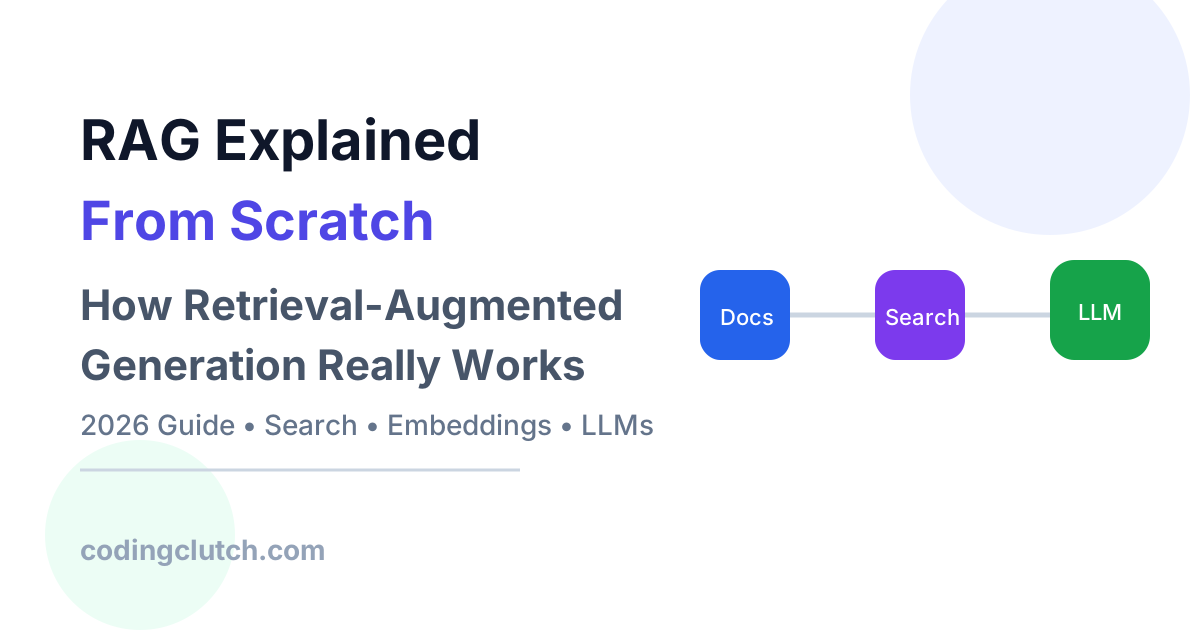
Strip away every implementation detail and RAG reduces to this loop, which you should be able to draw on a whiteboard from memory:
User Question
     │
     ▼
[1] Convert question into a vector (embedding)
     │
     ▼
[2] Search a knowledge store for the most similar vectors
     │
     ▼
[3] Retrieve the actual text behind those vectors
     │
     ▼
[4] Insert that text into a prompt alongside the original question
     │
     ▼
[5] Ask the LLM to answer using only/primarily that retrieved text
     │
     ▼
Grounded Answer (ideally with citations)
Every production RAG system — no matter how sophisticated, with rerankers, hybrid search, multi-hop retrieval, or agentic loops layered on top — is an elaboration of this five-step loop. Once this is wired into your intuition, the “deep dive” section that follows will feel like zooming into detail rather than learning something new.
Phase 3: Internal Working Deep Dive — What Actually Happens Behind the Scenes
This is the heart of the article. We’re going to walk through a RAG system’s full lifecycle in two distinct phases that engineers must always keep separate in their mental model: the ingestion (indexing) phase, which happens before any user ever asks a question, and the query (inference) phase, which happens live, every time a user sends a message.
Phase 3A: Ingestion — Building the Knowledge Store
Step 1: Document Collection and Loading
Everything starts with raw source material: PDFs, Word documents, HTML pages, Markdown files, Confluence pages, Slack threads, support tickets, codebases, database rows — anything you want the system to be able to answer questions about. The ingestion pipeline’s first job is simply to extract clean, structured text from these heterogeneous formats. This sounds trivial; in production, it’s often the messiest part of the entire system. A PDF with multi-column layouts, embedded tables, and scanned images requires fundamentally different extraction logic than a clean Markdown file.
Step 2: Chunking — The Most Underrated Decision in RAG
You cannot embed an entire 200-page manual as a single vector and expect useful retrieval — the resulting vector would represent an average of so many different topics that it would be useless for matching specific questions. So documents must be split into smaller pieces, called chunks.
This sounds like a minor preprocessing detail. It is, in practice, one of the single highest-leverage design decisions in a RAG system, and here’s why: chunk boundaries determine what unit of information can ever be retrieved. If you chunk badly, you can have a perfect embedding model, a perfect vector database, and a perfect LLM, and your system will still give wrong or incomplete answers.
Common chunking strategies, in increasing order of sophistication:
- Fixed-size chunking: split text every N tokens (e.g., 500 tokens), often with some overlap (e.g., 50 tokens) between consecutive chunks so that information sitting on a boundary isn’t lost. Simple, fast, but blind to actual document structure — it can split a sentence, or even a critical clause, right down the middle.
- Recursive/structure-aware chunking: split along natural boundaries first (paragraphs, then sentences, then words) only falling back to harder splits when a section is still too large. This respects the author’s own organization of ideas.
- Semantic chunking: use embeddings themselves to detect where the topic shifts within a document, and split there, so each chunk is maximally coherent around a single idea.
- Document-aware chunking: respect structural elements explicitly — keep a table intact, keep a code function intact, keep a markdown section under its heading. This is essential for technical documentation and codebases, where splitting a function body mid-way destroys its meaning entirely.
The trade-off engineers wrestle with constantly: smaller chunks give more precise retrieval (less irrelevant text gets pulled in) but lose surrounding context (a chunk might reference “it” or “this process” without the antecedent). Larger chunks preserve context but dilute the embedding’s specificity and waste space in the LLM’s context window with irrelevant filler. Most production systems converge somewhere in the 200–800 token range per chunk, with metadata attached to help re-establish context (document title, section heading, source URL).
Step 3: Embedding — Turning Text into Geometry
Each chunk is passed through an embedding model — a neural network trained specifically to convert text into a fixed-length vector of numbers (commonly somewhere between 384 and 3072 dimensions) such that semantically similar pieces of text end up as vectors that are close together in that high-dimensional space, while unrelated text ends up far apart.
This is the mathematical machinery underneath the “librarian who understands meaning” analogy from Phase 2. The embedding model has been trained (usually via contrastive learning, where it sees pairs of similar and dissimilar text and learns to pull similar pairs together and push dissimilar pairs apart in vector space) to encode meaning into geometry. “The cat sat on the mat” and “A feline rested on the rug” will produce vectors that are close together, even though they share almost no words, because an embedding model trained well captures semantic similarity rather than lexical overlap.
Crucially, the embedding model used at ingestion time must be the exact same model used at query time — you can’t embed your documents with one model and your questions with another and expect the geometry to line up, because each model defines its own private vector space with its own geometry. This is a common production bug: someone swaps embedding models for a cost or quality upgrade and forgets to re-embed the entire existing document store, leaving the system silently degraded.
Step 4: Indexing — Making Billions of Vectors Searchable Fast
Once you have millions of chunk-vectors, you face a hard computational problem: given a new query vector, how do you find the closest vectors among millions or billions of candidates, in milliseconds?
The naive approach — compute the distance from the query to every single stored vector — is called brute-force / exact nearest neighbor search, and it’s perfectly accurate but doesn’t scale; it’s an O(n) operation per query, and at large n, that’s far too slow for real-time use.
Production vector databases instead use Approximate Nearest Neighbor (ANN) algorithms, which trade a tiny amount of accuracy for an enormous amount of speed. The two most important ANN families to understand:
- HNSW (Hierarchical Navigable Small World graphs): builds a multi-layered graph structure where each vector is a node connected to its approximate neighbors. Search starts at a sparse top layer and “zooms in” through progressively denser layers, like using a low-resolution map to get to the right city before switching to a street-level map to find the exact address. HNSW offers excellent query speed and high recall, and is the default choice in most modern vector databases (Pinecone, Weaviate, Qdrant, Milvus, and pgvector’s HNSW index all use variants of this).
- IVF (Inverted File Index): clusters the vector space into a fixed number of partitions (using something like k-means) ahead of time. At query time, the system identifies which few partitions the query vector likely falls near, and only searches within those partitions rather than the entire dataset — dramatically reducing the search space.
These index structures are why RAG systems can search across millions of documents and return relevant results in well under 100 milliseconds — a speed that would be impossible with naive brute-force comparison at scale.
Phase 3B: Query Time — What Happens the Instant a User Hits Enter
Now the live, latency-sensitive part of the system kicks in.
Step 1: Query Embedding
The user’s question is passed through the same embedding model used during ingestion, producing a query vector in the identical vector space as the document chunks.
Step 2: Similarity Search
The query vector is compared against the index using a distance metric — most commonly cosine similarity (which measures the angle between two vectors, ignoring their magnitude — useful because it cares about direction, i.e., meaning, rather than raw vector length) or dot product / Euclidean distance, depending on how the embedding model was trained. The ANN index returns the top-k most similar chunks — typically somewhere between 3 and 20, depending on the system.
Step 3: (Often) Hybrid Search
Pure semantic search has a known weakness: it can struggle with exact-match needs, like specific product codes, error messages, acronyms, or proper nouns that the embedding model hasn’t learned to weight heavily. To compensate, many production systems run a hybrid search, combining dense vector search (semantic) with a traditional sparse keyword search algorithm like BM25 (a statistical ranking function descended from classic information retrieval, which scores documents based on term frequency and rarity). The results from both methods are merged, typically using a fusion technique like Reciprocal Rank Fusion (RRF), which combines rankings from multiple retrieval methods without needing to normalize their differing score scales.
Step 4: Reranking
The top-k results from initial retrieval are good, but not perfect — ANN search optimizes for speed, and the bi-encoder embedding models used for the first pass (which embed the query and documents independently, then compare vectors) are computationally cheap but slightly less precise than they could be. A common refinement step is reranking: take the (say) top 20 candidates returned by the fast vector search, and run them through a slower but more accurate cross-encoder model, which looks at the query and each candidate document together (rather than independently) and produces a precise relevance score. This two-stage “retrieve cheap, rerank precise” pattern — sometimes called a retrieval funnel — is standard in serious production RAG systems, because it captures most of the speed benefit of ANN search while recovering most of the accuracy lost to approximation.
Step 5: Context Assembly
The final, reranked set of chunks — now reduced to perhaps the 3–8 most relevant pieces of text — is assembled into a prompt. This is not a trivial concatenation. Engineers typically structure this assembly carefully: each chunk is labeled with its source (document name, section, URL) so the model can cite it; chunks are ordered (sometimes by relevance, sometimes to mitigate the “lost in the middle” effect by placing the most important chunk near the beginning or end of the context, where models attend most reliably); and a system prompt instructs the model on how to use the material — typically something like “Answer using only the information in the provided context. If the answer isn’t present, say you don’t know.”
Step 6: Generation
The assembled prompt — system instructions, retrieved context, conversation history, and the user’s question — is sent to the LLM, which generates a response. Because the model now has the actual relevant facts sitting directly in its context window, it doesn’t need to rely on shaky parametric memory; it can read, synthesize, and answer the way Student B did in our exam analogy — citing the specific passage rather than guessing from memory.
Step 7: (Often) Post-Processing and Citation
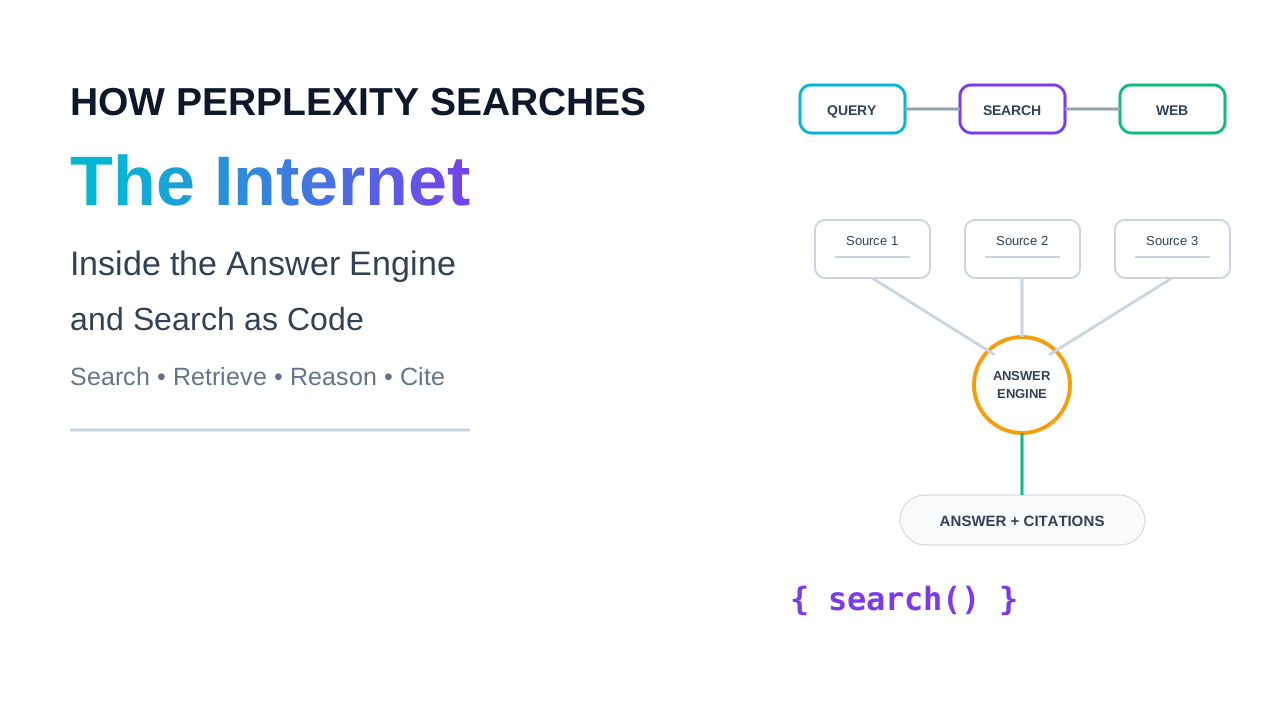
Many production systems add a final step that maps statements in the generated answer back to the specific source chunks that supported them, allowing the UI to show inline citations — the small numbered footnotes you see in tools like Perplexity, or the linked sources you see under an AI Overview in modern search engines.
This entire seven-step query-time loop typically completes in well under two seconds end-to-end in a well-engineered system, even though it involves an embedding call, a vector search, often a reranking call, and a full LLM generation call.
Phase 4: Engineering Implementation — Building RAG From Scratch
Theory is only half the job. Let’s build a minimal but realistic RAG pipeline using plain Python, so you can see every moving part with nothing hidden behind a framework abstraction. We’ll use the Anthropic API for embeddings-adjacent reasoning and generation, NumPy for the vector math, and no heavyweight orchestration library — because understanding what a framework like LangChain or LlamaIndex is doing for you is far more valuable than memorizing its API surface.
Step 1: Chunking the Source Documents
def chunk_text(text: str, chunk_size: int = 500, overlap: int = 75) -> list[str]:
    """
    Splits text into overlapping chunks, breaking on paragraph
    boundaries where possible to avoid cutting ideas in half.
    """
    paragraphs = [p.strip() for p in text.split("\n\n") if p.strip()]
    chunks, current = [], ""

    for para in paragraphs:
        if len(current) + len(para) <= chunk_size:
            current += (para + "\n\n")
        else:
            if current:
                chunks.append(current.strip())
            # carry the tail of the previous chunk forward for context continuity
            current = current[-overlap:] + para + "\n\n"

    if current:
        chunks.append(current.strip())

    return chunks
Why it exists: This avoids the naive “split every N characters” approach, which routinely cuts sentences (and meaning) in half. Splitting on paragraph boundaries first respects the author’s own structure. The overlap parameter ensures a sentence that references something in the previous chunk still has a thread of context.
Production trade-off: A fixed chunk_size is a simplification. A real system would also track token count (not character count, since LLMs bill and reason in tokens) and ideally use a structure-aware splitter for headings, tables, and code blocks separately.
Step 2: Embedding and Storing Chunks
import numpy as np
import requests

def embed_texts(texts: list[str]) -> np.ndarray:
    """
    Calls an embedding API and returns a (n_texts, dim) matrix.
    In production, swap this for your provider's embedding endpoint.
    """
    response = requests.post(
        "https://api.your-embedding-provider.com/v1/embeddings",
        json={"input": texts, "model": "embedding-model-v1"},
    )
    vectors = [item["embedding"] for item in response.json()["data"]]
    return np.array(vectors, dtype=np.float32)


class SimpleVectorStore:
    """
    A minimal in-memory vector store. Real systems use Pinecone,
    Weaviate, Qdrant, or pgvector — this exists purely to make the
    underlying math transparent.
    """
    def __init__(self):
        self.vectors: np.ndarray | None = None
        self.chunks: list[str] = []
        self.metadata: list[dict] = []

    def add(self, texts: list[str], metadata: list[dict]):
        new_vectors = embed_texts(texts)
        # normalize so dot product == cosine similarity
        new_vectors = new_vectors / np.linalg.norm(new_vectors, axis=1, keepdims=True)

        self.vectors = (
            new_vectors if self.vectors is None
            else np.vstack([self.vectors, new_vectors])
        )
        self.chunks.extend(texts)
        self.metadata.extend(metadata)

    def search(self, query: str, top_k: int = 5) -> list[dict]:
        query_vector = embed_texts([query])[0]
        query_vector = query_vector / np.linalg.norm(query_vector)

        scores = self.vectors @ query_vector  # cosine similarity via dot product
        top_indices = np.argsort(scores)[::-1][:top_k]

        return [
            {
                "text": self.chunks[i],
                "score": float(scores[i]),
                "metadata": self.metadata[i],
            }
            for i in top_indices
        ]
Why normalize the vectors? Cosine similarity measures the angle between two vectors, not their length. By normalizing every vector to unit length before storing them, a simple dot product becomes mathematically equivalent to cosine similarity — letting us use fast matrix multiplication (self.vectors @ query_vector) instead of computing cosine similarity term by term. This is a standard production optimization, not a shortcut.
Why this won’t scale as-is: self.vectors @ query_vector is brute-force exact search — fine for a few thousand chunks, but it’s an O(n) scan that becomes too slow once you have millions of vectors. This is exactly the gap that ANN indexes like HNSW (discussed in Phase 3) are built to close. In production, you would swap this SimpleVectorStore for a real vector database that maintains an HNSW or IVF index internally.
Step 3: Retrieval + Prompt Assembly + Generation
def build_rag_prompt(question: str, retrieved_chunks: list[dict]) -> str:
    context_blocks = []
    for i, chunk in enumerate(retrieved_chunks, start=1):
        source = chunk["metadata"].get("source", "unknown")
        context_blocks.append(f"[{i}] Source: {source}\n{chunk['text']}")

    context = "\n\n".join(context_blocks)

    return f"""You are a precise assistant. Answer the question using ONLY
the context below. If the answer is not contained in the context,
say "I don't have enough information to answer that." Cite sources
using the bracketed numbers, e.g. [1].

Context:
{context}

Question: {question}

Answer:"""


def answer_question(store: SimpleVectorStore, question: str) -> str:
    retrieved = store.search(question, top_k=5)
    prompt = build_rag_prompt(question, retrieved)

    response = requests.post(
        "https://api.anthropic.com/v1/messages",
        headers={"content-type": "application/json"},
        json={
            "model": "claude-sonnet-4-6",
            "max_tokens": 1000,
            "messages": [{"role": "user", "content": prompt}],
        },
    )
    return response.json()["content"][0]["text"]
Why the explicit instruction to say “I don’t have enough information”? This single line is doing a huge amount of work. Without it, the model will often fall back on its parametric knowledge when retrieval comes up empty or weak — silently reintroducing the exact hallucination risk RAG was built to eliminate. Forcing an explicit refusal path when context is insufficient is one of the highest-leverage prompt-engineering decisions in any RAG system.
Why numbered citations? Mapping each context block to a bracketed number gives the model an easy, low-effort way to cite its sources, and gives your application UI a clean way to turn [1] into a clickable link back to the source document — exactly what you see in tools like Perplexity or modern AI search overviews.
Common Implementation Mistakes
A few mistakes show up so often in real RAG deployments that they deserve explicit naming:
- Chunking without testing retrieval quality. Teams pick a chunk size once, ship it, and never revisit it — even though chunk size has an outsized effect on answer quality. A proper RAG system needs a retrieval evaluation set (sample questions with known correct source chunks) to actually measure whether changes help or hurt.
- Ignoring metadata filtering. Pure vector search has no concept of permissions, dates, or document type. A production system needs to filter candidates by access control (so a user never retrieves a document they’re not authorized to see) and often by recency (so an outdated policy document doesn’t outrank its replacement).
- Retrieving too few or too many chunks. Too few, and the model lacks the full picture. Too many, and you reintroduce the “lost in the middle” problem and pay for unnecessary tokens.
- Skipping reranking to save latency. This is a legitimate trade-off at extreme scale, but for most applications the accuracy gain from a reranking pass is well worth the 50–150ms it typically adds.
- Forgetting to re-embed after a model upgrade. As mentioned earlier, mixing vectors from two different embedding models silently corrupts the entire vector space’s geometry.
Phase 5: Real-World Systems — How Major Companies Deploy RAG at Scale
Search Engines: Google and Microsoft
Modern AI-powered search summaries — Google’s AI Overviews and Microsoft’s Copilot-powered Bing results — are, at their core, massive RAG systems. The “retrieval” step isn’t a small vector database; it’s the company’s entire existing web search index, refined through ranking signals built over decades. The retrieved web pages are passed to a language model that synthesizes a direct answer with citations back to source pages. The engineering challenge at this scale isn’t building the retrieval-generation loop conceptually — it’s doing it at the latency and throughput of billions of daily queries, while filtering for source quality and avoiding the amplification of misinformation.
Enterprise Knowledge: Amazon and Microsoft
Amazon’s enterprise AI assistant products and Microsoft’s Copilot for Microsoft 365 both apply RAG against private organizational data — internal documents, emails, Teams or Slack conversations, SharePoint files. The hard engineering problem here isn’t the retrieval math; it’s permissions-aware retrieval at scale. A vector search must never surface a document the requesting user isn’t authorized to see, which means access control has to be enforced as a filter during retrieval, not as an afterthought applied to the final answer. Getting this wrong is a serious security failure, not just a quality bug.
Developer Tools: GitHub Copilot and Coding Assistants
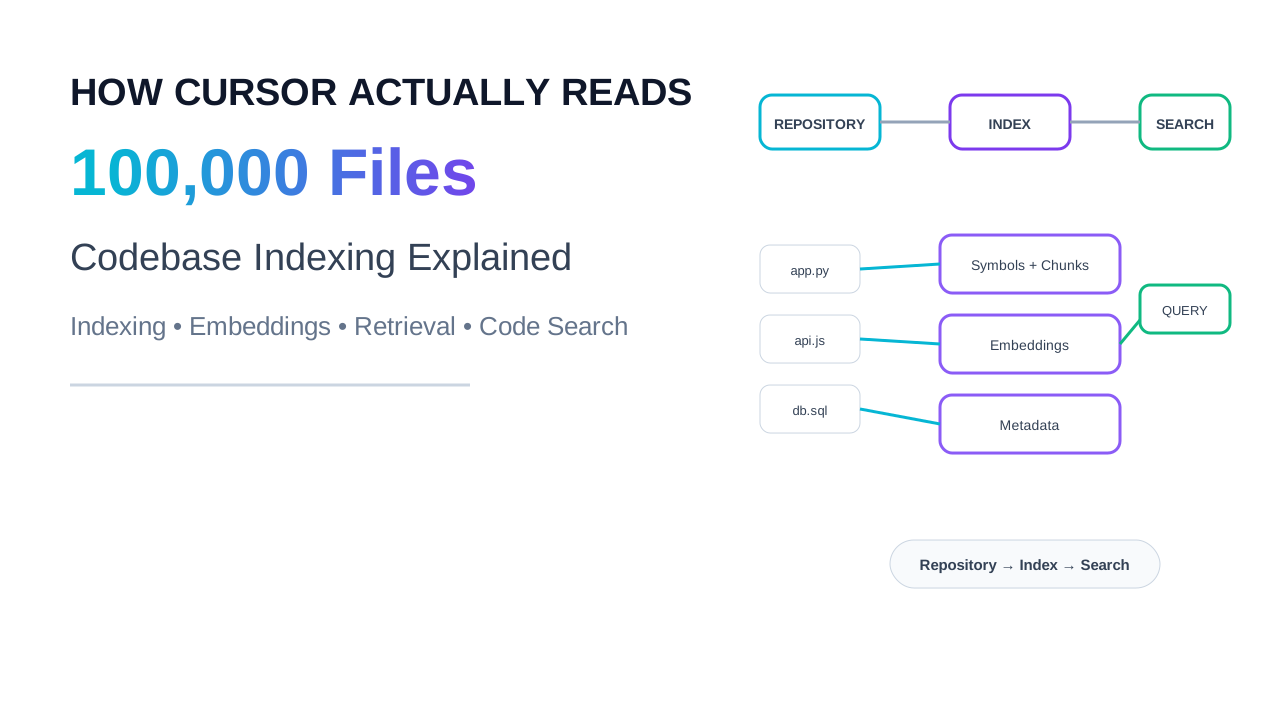
Coding assistants use a specialized form of RAG where the “documents” are source files in your own codebase. Instead of generic text chunking, these systems use code-aware retrieval — often combining the embedding-based semantic search described earlier with structural signals like the abstract syntax tree, function call graphs, and recently edited files, so that an assistant answering “how does our authentication middleware work” retrieves the actual relevant functions rather than unrelated boilerplate.
Answer Engines: Perplexity
Perplexity built its entire product identity around transparent, well-cited RAG: every claim in an answer is traceable to a retrieved web source, displayed inline. This is a useful case study because it shows RAG not just as a backend trick for accuracy, but as a user-facing trust mechanism — the citations themselves are a product feature that builds user confidence, independent of whether the underlying answer is technically correct.
Lessons Across All of These
A few patterns repeat across every large-scale RAG deployment regardless of company: retrieval quality dominates generation quality (a perfect LLM fed irrelevant context still produces a bad answer); latency budgets force hard trade-offs between retrieval depth and response speed; and permissions and freshness are first-class engineering concerns, not edge cases, the moment a system touches private or rapidly changing data.
Phase 6: AI Era Relevance — Why RAG Sits at the Center of Agentic AI
From Static QA to Agentic Retrieval
Early RAG systems were single-shot: one question in, one retrieval pass, one answer out. The agentic era we’re now in treats retrieval as a tool an AI agent can choose to invoke, multiple times, as part of a larger reasoning loop. An agent working on a complex task — say, debugging a production incident — might retrieve relevant logs, realize it needs more context, retrieve related code, realize it needs historical incident reports, retrieve those too, and only then synthesize a diagnosis. This pattern, sometimes called agentic RAG or multi-hop retrieval, treats the retrieval step not as a fixed pipeline stage but as an action the model decides to take, potentially multiple times, based on what it learns from earlier retrievals.
This is a meaningful architectural shift: retrieval is no longer something that happens to the model before it starts reasoning — it’s something the model actively directs as part of its reasoning.
RAG as Agent Memory
Multi-agent systems and long-running AI agents face a problem analogous to the one that motivated RAG in the first place: an agent’s context window is finite, but a long-running task can generate far more relevant history (prior actions, observations, learned facts) than fits in that window. Many modern agent architectures solve this by treating an agent’s own memory as a RAG target — storing past observations, decisions, and outcomes in a vector store, and retrieving the most relevant fragments of that history when needed, rather than keeping the entire transcript in context at all times. This is effectively RAG turned inward: instead of retrieving from a document corpus, the agent retrieves from its own experience.
RAG vs. Long Context: A Live Debate
As LLM context windows have grown into the hundreds of thousands and even millions of tokens, a reasonable question has emerged: does RAG still matter if you can just stuff everything into context?
The honest answer is: yes, for several durable reasons. First, cost — processing a million-token context on every single query, even when most of it is irrelevant, is expensive at scale in a way that targeted retrieval of a few thousand relevant tokens is not. Second, the lost-in-the-middle effect persists even in long-context models to varying degrees; precision retrieval still tends to outperform “throw everything in and hope the model finds it.” Third, and most importantly, freshness and access control don’t disappear just because context windows got bigger — you still need a mechanism to update knowledge without retraining, and to ensure a user only sees authorized content, and that mechanism is retrieval, regardless of context length. In practice, the strongest modern systems combine both: a long context window and a retrieval step that selects the highest-value material to put into that window, rather than treating them as competing approaches.
GraphRAG and Structured Retrieval
A notable evolution beyond plain vector similarity is GraphRAG, where, instead of (or in addition to) a vector index, the knowledge store is organized as a knowledge graph — entities connected by explicit relationships. This matters for questions that require connecting multiple pieces of information across a corpus rather than retrieving a single relevant passage — for example, “how are these two product incidents related,” which requires traversing relationships rather than finding one chunk of similar text. Vector similarity alone struggles with this kind of multi-hop, relational reasoning; graph-structured retrieval is purpose-built for it.
Why AI Engineers Specifically Need to Understand This
If you’re entering AI engineering today, RAG is not an optional specialty topic — it is foundational infrastructure, in the same category as understanding databases is foundational to backend engineering. Nearly every serious LLM-powered product that needs to be accurate, current, or grounded in private data is going to involve some form of retrieval. Understanding chunking strategy, embedding model selection, vector index trade-offs, reranking, and the RAG-vs-fine-tuning decision is now table-stakes knowledge for building production AI systems — not an advanced elective.
Phase 7: Advantages, Limitations, and Trade-offs
Advantages — And When They Actually Matter
Up-to-date answers without retraining. This matters enormously the moment your data changes faster than your retraining cadence — which, for almost any real business, is true. Update the document store, and the next query reflects the change immediately. No GPU cluster, no fine-tuning job, no model redeployment.
Grounded, citable answers. This matters most in high-stakes or compliance-sensitive domains — legal, medical, financial, regulatory — where an unverifiable claim is functionally useless even if it happens to be correct, because no one downstream can trust it without a source to check.
Access to private data without exposing it to model training. This matters for any organization with confidential information, because it means you never have to send sensitive data into a model training pipeline (with all the data governance complexity that implies) just to make an assistant aware of it.
Lower cost than fine-tuning for knowledge updates. This matters at the team-resourcing level — maintaining a document pipeline and vector index is a fraction of the engineering and compute cost of a fine-tuning operation, and it can be done by engineers without specialized ML training expertise.
Limitations — And Why They’re Not Just Footnotes
Retrieval quality is a hard ceiling on answer quality. If the right document was never indexed, was chunked badly, or doesn’t surface in the top-k results, the LLM cannot answer correctly — no matter how capable the model is. This matters because it shifts where engineering effort needs to go: a RAG system’s biggest lever for improvement is very often not the LLM at all, but the retrieval pipeline.
It does not eliminate hallucination entirely. Even with perfect retrieval, a model can still misread, misquote, or over-generalize from the retrieved context, or blend retrieved facts with parametric knowledge in subtle, hard-to-detect ways. This matters because teams sometimes treat RAG as a hallucination “fix” rather than a hallucination mitigation, and skip the evaluation work needed to catch the cases where it still goes wrong.
Latency overhead. Embedding, search, and often reranking all add time before generation even begins. This matters in latency-sensitive applications — voice assistants, real-time chat — where every added pipeline stage is a user-perceived delay that has to be budgeted carefully.
Operational complexity. A RAG system is not “an LLM plus a database” — it’s an ongoing pipeline: documents change, need re-chunking and re-embedding; embedding models get upgraded, requiring full re-indexing; retrieval quality needs continuous evaluation. This matters because it’s a maintained system, not a one-time integration, and teams that underestimate this ongoing operational burden are routinely surprised by it six months after launch.
Garbage in, garbage out applies to the document store itself. If your source documents are outdated, contradictory, or poorly written, RAG will faithfully retrieve and surface that bad information with the same confidence as good information. This matters because RAG is not a substitute for basic information hygiene — it amplifies the quality (or lack thereof) of whatever you feed it.
Phase 8: Career Impact & Future
Why This Skill Is in High Demand
As of 2026, “RAG engineer” or “AI infrastructure engineer” roles — even when not labeled that explicitly — sit at the intersection of three traditionally separate disciplines: backend/data engineering (building and maintaining the ingestion and indexing pipeline), information retrieval (chunking strategy, embedding model selection, ranking and reranking), and applied LLM engineering (prompt design, context assembly, evaluation). Engineers who can speak fluently across all three are unusually valuable, because most teams have either backend engineers who don’t understand retrieval quality trade-offs, or ML researchers who don’t think operationally about pipeline maintenance and latency budgets.
Relevant Roles
This knowledge is directly applicable to roles titled (or functioning as) AI Engineer, Machine Learning Engineer, Applied AI Engineer, AI Platform/Infrastructure Engineer, Search/Information Retrieval Engineer, and increasingly, general Backend or Full-Stack Engineer roles at companies shipping AI features, where RAG has become as fundamental a building block as authentication or caching.
Interview Relevance
RAG shows up constantly in technical interviews for AI-adjacent roles, in a few recurring forms: system design questions (“design a customer support chatbot grounded in our documentation”), debugging scenarios (“retrieval is returning irrelevant chunks — what would you check?”), and trade-off discussions (“when would you choose fine-tuning over RAG, or vice versa?”). Candidates who can walk through the full ingestion-to-generation pipeline with concrete trade-offs at each stage — not just “it retrieves stuff and the LLM uses it” — stand out clearly from those who only know the term.
What to Learn Next
If this article gave you the foundation, the natural next steps are: build a small RAG project end-to-end yourself (even the minimal version from Phase 4 is a strong learning exercise); study vector database internals more deeply (HNSW papers, IVF, product quantization); learn evaluation frameworks for retrieval and generation quality (precision/recall at k, faithfulness and groundedness metrics); and explore agentic RAG patterns, where retrieval becomes a tool invoked dynamically within a larger agent loop rather than a fixed upfront step.
The Real Lesson Behind RAG
Strip away the vector databases, the embedding models, and the reranking algorithms, and RAG is teaching us something more fundamental about how to build trustworthy AI systems: don’t ask a model to be a perfect oracle of all knowledge — ask it to be an excellent reasoner over verified, current, relevant information, and build the infrastructure that gets it that information at the right moment.
This is a lesson that extends well beyond chatbots answering questions about PDFs. It’s the same principle underlying agentic memory systems, the same principle underlying how modern search engines ground their AI summaries, and the same principle that will keep mattering as models get larger and context windows get longer — because no matter how capable a model becomes, it will never have direct access to what changed in your company an hour ago, unless something is built to give it that access deliberately.
The engineers who designed RAG in 2020 weren’t trying to make models smarter. They were trying to make them honest — to give a fluent, confident system a mechanism for saying “here’s what I actually found” instead of “here’s my best guess.” That shift, from confident guessing to grounded reasoning, is arguably the most important architectural idea separating impressive AI demos from AI systems people can actually depend on.
If you remember nothing else from this article, remember this: retrieval is what turns a language model from a brilliant improviser into a reliable reasoner. Everything else — the chunking strategy, the embedding model, the index structure, the reranker — exists in service of that one transformation.