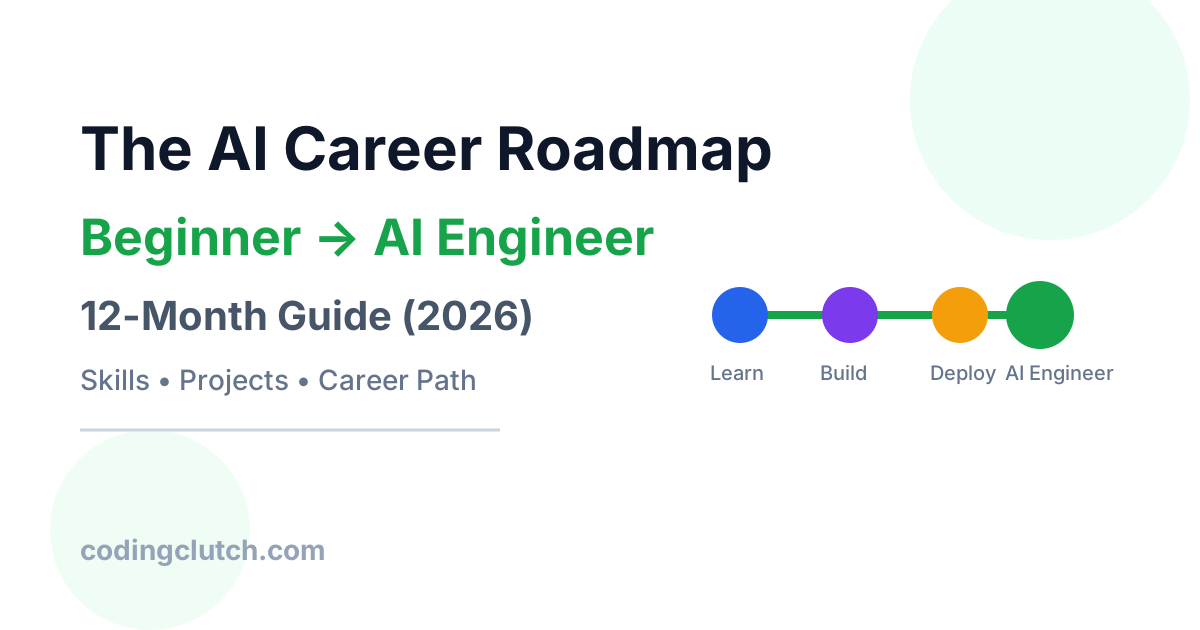
The New Gold Rush Isn’t AI—It’s AI Talent
Every major technological revolution creates two categories of people. The first group uses the technology. The second group builds the technology. History consistently rewards the second group.
During the early internet era, millions learned how to browse websites. A much smaller group learned how the web actually worked—HTTP, databases, servers, networking, and software engineering. Those builders created companies worth billions of dollars.
The same pattern repeated during the mobile revolution.
Millions downloaded applications. A smaller group learned Android development, iOS development, backend engineering, cloud infrastructure, and distributed systems. They became the architects of the mobile economy.
Today, artificial intelligence is creating the next wave. Millions of people are learning how to use ChatGPT. A much smaller group is learning how to build AI systems. Those individuals are becoming AI Engineers.
And that distinction is becoming one of the most valuable career differentiators in technology.
Why AI Engineering Exists
Many beginners assume AI Engineering is simply a modern name for Machine Learning Engineering.
This is only partially true.
To understand why AI Engineering emerged as a separate discipline, we must examine the problems modern companies are facing.
Ten years ago, AI projects primarily involved prediction.
Organizations wanted answers to questions such as:
- Will this customer churn?
- Is this transaction fraudulent?
- What movie should be recommended?
- What product might be purchased next?
Traditional machine learning systems handled these tasks effectively. Engineers collected data. Data scientists trained models. The model generated predictions. The application consumed those predictions.
The workflow was relatively straightforward.
Then large language models changed everything.
Suddenly AI systems could:
- Generate code
- Write documents
- Analyze contracts
- Answer questions
- Summarize research
- Perform reasoning tasks
- Use tools
- Execute workflows
The challenge shifted dramatically. Companies no longer need prediction systems. They needed intelligent systems. This introduced entirely new engineering problems. How do you connect an LLM to company data?
How do you prevent hallucinations?
How do you build memory?
How do you manage context windows?
How do you orchestrate multiple AI models?
How do you create AI agents capable of executing tasks autonomously?
These questions gave birth to a new role:
AI Engineer.
AI Engineer vs Machine Learning Engineer
One of the biggest sources of confusion for newcomers is understanding the difference between modern AI Engineering and traditional Machine Learning Engineering.
A Machine Learning Engineer primarily focuses on creating models.
Their responsibilities often include:
- Data pipelines
- Feature engineering
- Model training
- Evaluation metrics
- Deployment
- Monitoring
An AI Engineer focuses on building intelligent products using AI models.
Their responsibilities include:
- LLM integration
- Retrieval systems
- Prompt engineering
- Agent architecture
- Tool calling
- AI workflows
- Vector databases
- Model orchestration
Think of it this way.
A Machine Learning Engineer builds the engine.
An AI Engineer builds the car.
Both are valuable.
Both require technical expertise.
But the skill sets are increasingly diverging.
Understanding the Modern AI Ecosystem
Before creating a roadmap, we need a mental model.
Many beginners see AI as a single field.
In reality, modern AI resembles an entire technology stack.
Imagine a skyscraper.
At the bottom lies the foundation.
Above it are multiple layers.
Every layer depends on the layers beneath it.
AI works similarly.
Layer 1: Computer Science Fundamentals
Everything starts here.
Without programming, algorithms, data structures, operating systems, networking, and databases, advanced AI concepts become difficult to understand.
Many aspiring AI engineers skip this layer.
This is one of the biggest career mistakes.
The strongest AI engineers are almost always strong software engineers first.
Layer 2: Mathematics
AI is fundamentally mathematical.
Linear algebra explains how neural networks represent information.
Probability explains uncertainty.
Statistics explain learning.
Calculus explains optimization.
You do not need a PhD in mathematics.
But you need enough mathematical intuition to understand what models are actually doing.
Layer 3: Machine Learning
Machine learning teaches systems how to learn patterns from data.
This layer introduces concepts such as:
- Regression
- Classification
- Clustering
- Evaluation metrics
- Model training
- Generalization
Without understanding machine learning, large language models often appear magical.
With machine learning knowledge, they become understandable engineering systems.
Layer 4: Deep Learning
Deep learning transformed AI.
Instead of manually designing features, engineers created neural networks capable of learning representations automatically.
This led to breakthroughs in:
- Computer Vision
- Speech Recognition
- Natural Language Processing
- Recommendation Systems
Most modern AI products are built on deep learning foundations.
Layer 5: Large Language Models
Transformers introduced a fundamentally different way of processing information.
Modern systems such as GPT models, Claude, Gemini, and open-source alternatives emerged from this breakthrough.
Understanding LLMs is no longer optional for AI engineers.
It is becoming foundational knowledge.
Layer 6: AI Engineering
This is where modern AI products are built.
The focus shifts from model creation to system creation.
Topics include:
- RAG
- Agents
- Vector Databases
- Prompt Architecture
- Tool Use
- AI Workflows
- LLMOps
This is the layer creating many of today’s highest-demand AI jobs.
The 12-Month Roadmap Begins: Months 1–3
Most people fail before they start because they chase advanced topics immediately.
They install LangChain.
They watch videos about AI Agents.
They build a chatbot.
Then they realize they don’t understand APIs, Python, networking, databases, or software architecture.
The result is frustration.
The correct roadmap is different.
The first three months should focus almost entirely on software engineering fundamentals.
Learning Python the Right Way
Python has become the dominant language of AI.
However, most beginners learn Python incorrectly.
They memorize syntax.
They copy tutorials.
They build small scripts.
Then they struggle when projects become larger.
Instead, learn Python as an engineering language.
Master:
- Functions
- Classes
- Object-Oriented Programming
- Exception Handling
- File Systems
- Modules
- Package Management
- Virtual Environments
- APIs
- Concurrency Basics
More importantly, understand why these concepts exist.
Large AI systems are software systems.
Software engineering principles matter.
Data Structures and Algorithms Still Matter
One of the most common questions in 2026 is:
“Does DSA still matter because AI can write code?”
The answer is yes.
Perhaps more than ever.
AI can generate code.
But engineers still need to evaluate whether that code is efficient, scalable, and maintainable.
When building retrieval systems, vector databases, recommendation systems, or AI infrastructure, algorithmic thinking remains essential.
Focus on understanding:
- Arrays
- Linked Lists
- Hash Maps
- Trees
- Graphs
- Heaps
- Sorting
- Searching
- Recursion
Don’t study them only for interviews.
Study them because they shape how engineers think.
Understanding Databases
Modern AI systems depend heavily on data.
Every AI application eventually interacts with storage.
Learn:
- SQL
- Database Design
- Indexing
- Query Optimization
- Transactions
Then understand NoSQL systems.
Many AI workloads involve:
- Large-scale document storage
- Embeddings
- Vector search
- Knowledge bases
Database knowledge becomes increasingly valuable as AI systems grow.
APIs: The Language of Modern Software
Every AI application communicates through APIs.
When ChatGPT retrieves information from external tools, APIs are involved.
When an AI Agent interacts with a weather service, APIs are involved.
When an LLM accesses company data, APIs are involved.
Understanding:
- HTTP
- REST
- JSON
- Authentication
- Rate Limiting
is absolutely essential.
Many aspiring AI engineers underestimate this skill.
Experienced engineers know it is foundational.
Months 3–4: Mathematics That Actually Matters
Mathematics scares many aspiring AI professionals.
The good news is that practical AI engineering requires understanding rather than mathematical perfection.
The goal is intuition.
Not memorization.
Linear Algebra: The Language of Neural Networks
Every embedding, transformer, and neural network ultimately manipulates vectors and matrices.
When an LLM converts text into embeddings, it transforms language into mathematical representations.
Those representations exist in high-dimensional vector spaces.
Without linear algebra, embeddings appear mysterious.
With linear algebra, they become logical.
Focus on:
- Vectors
- Matrices
- Dot Products
- Eigenvectors
- Transformations
These concepts appear repeatedly throughout modern AI.
Probability and Statistics
AI systems make decisions under uncertainty.
Probability provides the mathematical framework for uncertainty.
Statistics provides the framework for learning from data.
Topics worth mastering include:
- Probability distributions
- Conditional probability
- Bayes’ theorem
- Hypothesis testing
- Confidence intervals
These ideas appear everywhere from model evaluation to LLM token prediction.
Calculus and Optimization
Training a neural network is fundamentally an optimization problem.
The model begins with poor parameters.
Training gradually improves them.
Calculus explains how this improvement occurs.
Focus on intuition:
- Derivatives
- Gradients
- Optimization
- Gradient Descent
You do not need advanced theoretical mastery initially.
You need conceptual understanding.
Building Your First AI Engineer Mindset
At this stage, many learners ask:
“When do I start building AI applications?”
The answer is sooner than you think.
But not by skipping fundamentals.
Instead, start thinking like an engineer.
Whenever you encounter a new AI tool, ask:
- What problem does it solve?
- What happens internally?
- How does data flow?
- What are the trade-offs?
- How does it scale?
These questions separate builders from users.
And AI Engineering is fundamentally about becoming a builder.
The Foundation Determines Everything
The biggest misconception about becoming an AI Engineer is that success depends on learning the newest framework.
It doesn’t.
Frameworks change every year.
Fundamentals survive for decades.
The engineers thriving in the AI era are rarely the people who memorized the most prompts.
They are the people who understand software systems, mathematics, data, and engineering principles deeply enough to adapt as technology evolves.
The first four months of your journey may not feel glamorous.
You won’t be building autonomous agents immediately.
You won’t be training billion-parameter models.
But you will be building something far more valuable: the foundation that makes everything else possible.
Now we move into the layer where artificial intelligence actually begins.
This is the stage where computers transition from being explicitly programmed to being trained.
This distinction may sound subtle, but it represents one of the most important ideas in computer science.
For decades, software engineering operated under a simple paradigm:
Humans wrote rules. Computers followed them.
Machine learning changed that paradigm.
Instead of writing every rule manually, engineers began building systems capable of learning those rules from data.
Everything that followed—from recommendation systems to ChatGPT—emerged from that fundamental shift.
This section is where your journey transitions from software engineering fundamentals to modern AI engineering.
Months 5–6: Understanding Machine Learning from First Principles
Most people encounter machine learning through libraries.
They learn:
from sklearn.linear_model import LinearRegression
Train a model.
Generate predictions.
Move on.
The problem is that this approach teaches usage, not understanding.
To become an AI engineer, you must understand why machine learning exists in the first place.
The Problem Traditional Programming Could Not Solve
Imagine you need to build a spam filter.
Traditional software engineering suggests writing rules.
For example:
IF email contains "WIN MONEY"
THEN mark as spam
Simple enough.
Then spammers adapt.
They write:
W1N M0NEY
You add more rules.
They adapt again.
Soon, your application contains thousands of fragile conditions.
The system becomes difficult to maintain.
Engineers faced this exact challenge repeatedly.
Not just with spam.
But with:
- Fraud detection
- Recommendation systems
- Search ranking
- Medical diagnosis
- Speech recognition
- Language understanding
The common pattern was obvious:
The rules were too complex to write manually.
So engineers asked a different question:
“What if the computer could learn the rules itself?”
Machine learning was the answer.
The Core Idea Behind Machine Learning
At its heart, machine learning is surprisingly simple.
Instead of programming rules:
Rules → Output
We provide examples:
Examples → Learning → Rules
The machine discovers patterns hidden within data.
This sounds straightforward.
The challenge lies in how the learning actually occurs.
Thinking Like a Model
Imagine showing a child thousands of pictures.
Some contain cats.
Some contain dogs.
You never explain what whiskers are.
You never explain ear shapes.
You simply provide examples.
Over time, the child begins recognizing patterns.
Machine learning works similarly.
The model gradually adjusts internal parameters until it can accurately identify those patterns.
Learning is essentially an optimization process.
The system repeatedly asks:
“How wrong am I?”
Then modifies itself to become slightly less wrong.
Millions or billions of these adjustments eventually create intelligence.
The Architecture of a Machine Learning Pipeline
Most beginners focus entirely on models.
In production systems, models are often the smallest component.
A real ML system resembles an assembly line.
Raw Data
    ↓
Data Cleaning
    ↓
Feature Engineering
    ↓
Training
    ↓
Evaluation
    ↓
Deployment
    ↓
Monitoring
Every stage introduces engineering challenges.
Data Collection
Machine learning systems are fundamentally data systems.
Many projects fail before training even begins because the data is poor.
Engineers quickly learn an important lesson:
Better data often beats better algorithms.
A mediocre model trained on excellent data frequently outperforms a sophisticated model trained on bad data.
This reality explains why large technology companies invest heavily in data infrastructure.
Data is often the true competitive advantage.
Feature Engineering
Before deep learning became dominant, feature engineering was one of the most valuable skills in AI.
Engineers manually transformed raw data into useful representations.
For example:
Raw:
Date of Birth
Feature:
Age
Raw:
Purchase History
Feature:
Average Monthly Spend
The model learns from features rather than raw information.
Although deep learning automates much of this process today, understanding feature engineering remains valuable because it teaches how models interpret information.
Supervised Learning: The Foundation of Modern AI
Most machine learning systems begin with supervised learning.
The concept is simple.
Provide:
Input + Correct Answer
The model learns the relationship.
Examples:
House Features → House Price

Customer Behavior → Churn Prediction

Medical Symptoms → Diagnosis

Transaction Data → Fraud Detection
This learning paradigm powered much of the AI industry before large language models emerged.
Even today, supervised learning remains critical.
Why Neural Networks Changed Everything
Traditional machine learning achieved impressive results.
But it struggled with highly unstructured data.
For example:
- Images
- Audio
- Video
- Human language
These domains contain enormous complexity.
Manually designing features became increasingly difficult.
Engineers needed a different approach.
That solution became neural networks.
Months 6–7: Deep Learning and Representation Learning
Deep learning is often presented as a collection of mathematical equations.
But the real breakthrough was conceptual.
Neural networks solved a problem that traditional machine learning struggled with:
automatic representation learning.
Instead of engineers manually creating features, neural networks learn features automatically.
This single innovation transformed AI.
Understanding Representation Learning
Consider facial recognition.
Traditional ML might require manually specifying:
- Eye distance
- Nose width
- Face symmetry
- Jaw shape
Deep learning learns these representations automatically.
The system discovers useful patterns without explicit instructions.
This ability is what makes modern AI possible.
The Anatomy of a Neural Network
A neural network can be viewed as a layered transformation system.
Input:
Image
Layer 1:
Detect edges
Layer 2:
Detect shapes
Layer 3:
Detect facial components
Layer 4:
Recognize identity
Each layer learns increasingly abstract representations.
This hierarchical learning capability allows neural networks to solve problems that previously seemed impossible.
The Hidden Revolution: GPUs
A major reason deep learning exploded after 2012 wasn’t theoretical innovation alone.
It was computational power.
Training modern neural networks requires enormous parallel processing capabilities.
This is where GPUs became transformative.
Unlike CPUs, which excel at sequential operations, GPUs excel at performing thousands of calculations simultaneously.
This makes them ideal for matrix operations.
The rise of modern AI is deeply connected to the rise of GPU computing.
Without accelerated hardware, today’s AI revolution would not exist.
The Transformer Revolution
For years, researchers improved neural networks incrementally.
Then in 2017, a research paper changed everything.
The paper introduced the Transformer architecture.
Its title was:
Attention Is All You Need
Few papers in computer science have had a larger impact.
Virtually every major language model today traces its lineage to this breakthrough.
Why Previous Architectures Struggled
Earlier language models processed text sequentially.
Word by word.
This created limitations.
Consider:
The animal didn't cross the road because it was too tired.
What does “it” refer to?
The model must understand relationships between distant words.
Older architectures struggled with long-range dependencies.
Transformers solved this elegantly.
The Mental Model of Attention
Attention is one of the most important concepts in modern AI.
Imagine reading a research paper.
You don’t assign equal importance to every word.
Your brain focuses on relevant sections.
Transformers do something similar.
They dynamically determine which parts of information deserve attention.
This mechanism allows models to understand context far more effectively than previous architectures.
How Large Language Models Actually Work
One of the biggest misconceptions in AI is that LLMs understand language the way humans do.
They don’t.
They are prediction engines.
Extremely sophisticated prediction engines.
Their core task is:
Predict the next token.
Given:
The capital of France is
The model predicts:
Paris
The astonishing result is that solving this simple prediction problem at enormous scale appears to create surprisingly intelligent behavior.
Inside the LLM Training Pipeline
Modern LLM development occurs in multiple stages.
Stage 1: Pretraining
The model consumes massive datasets.
Potentially trillions of tokens.
Books.
Articles.
Research papers.
Code.
Documentation.
Forums.
Web pages.
The objective remains simple:
Predict missing tokens
Repeated billions of times.
Stage 2: Instruction Tuning
Pretraining creates knowledge.
Instruction tuning creates usefulness.
Engineers teach the model to follow human instructions.
Examples:
Summarize this document

Write Python code

Explain recursion
The model learns desired behaviors.
Stage 3: Alignment
Raw intelligence is not enough.
Models must behave safely and predictably.
Alignment processes help optimize responses according to human preferences.
This stage significantly influences user experience.
Retrieval-Augmented Generation (RAG)
One of the biggest limitations of LLMs is that their knowledge becomes frozen after training.
Companies quickly discovered a problem.
Business information changes constantly.
Models cannot be retrained every day.
Engineers needed a solution.
RAG emerged as one of the most important architectural patterns in AI.
Why RAG Exists
Imagine asking:
What was our company's revenue last quarter?
The answer exists in internal documents.
Not inside the model itself.
Instead of retraining:
Question
    ↓
Retrieve Documents
    ↓
Inject Context
    ↓
Generate Answer
This dramatically improves accuracy.
Understanding Embeddings
Embeddings are the backbone of modern retrieval systems.
Think of embeddings as numerical representations of meaning.
For example:
Dog
and
Puppy
produce vectors located near each other in vector space.
Meanwhile:
Dog
and
Quantum Mechanics
appear much farther apart.
This spatial representation enables semantic search.
Instead of matching keywords, systems retrieve meaning.
This distinction powers modern RAG systems.
Vector Databases: The Infrastructure Behind AI Search
Traditional databases answer questions like:
SELECT * FROM users
Vector databases answer a different question:
What information is semantically similar?
Examples include:
- Pinecone
- Weaviate
- Milvus
- Qdrant
These systems became foundational infrastructure for modern AI products.
Without vector search, scalable RAG systems would be far less effective.
Engineering Your First Production AI Application
At this point in the roadmap, you should stop building tutorial projects.
Start building systems.
Examples:
AI Documentation Assistant
Features:
- Document ingestion
- Embedding generation
- Vector storage
- Retrieval
- Response generation
Research Assistant
Features:
- Multi-document search
- Citation generation
- Summarization
- Context management
Code Knowledge Agent
Features:
- Repository indexing
- Semantic code search
- Documentation retrieval
- Architecture explanation
These projects mirror real industry requirements far more closely than basic chatbots.
What Companies Actually Want in 2026
A common mistake is assuming companies primarily hire people who can train large models.
Most organizations do not train frontier models.
Instead they build products using them.
This means employers increasingly value:
- Software Engineering
- API Integration
- LLM Systems
- RAG Architecture
- Cloud Infrastructure
- Data Engineering
- AI Product Development
The ability to create useful AI systems often matters more than the ability to train models from scratch.
Conclusion: From Models to Systems
The most important lesson of this stage is that modern AI is no longer just about models.
The industry has shifted.
In the early years, competitive advantage came from creating better algorithms.
Today, competitive advantage increasingly comes from building better systems around powerful models.
The AI engineer of 2026 is not merely a machine learning practitioner.
They are a systems engineer, software engineer, infrastructure engineer, and AI practitioner combined into a single role.
Machine learning teaches machines to learn.
Deep learning teaches machines to represent information.
Transformers teach machines to understand context.
Large language models teach machines to generate knowledge.
But AI engineering teaches something even more valuable:
How to transform those capabilities into products people actually use.
At this point, you possess enough knowledge to understand how today’s AI applications work.
But understanding existing AI systems is no longer enough.
The next phase of the AI revolution is not about models.
It is about autonomous systems built on top of models.
This is where AI Agents enter the picture.
And this is why the final stage of the roadmap is arguably the most exciting.
Because this is where an aspiring AI learner transitions into a modern AI Engineer capable of building production-grade intelligent systems.
Months 8–10: Understanding AI Agents Beyond the Hype
Few terms have generated more excitement—and confusion—than “AI Agent.”
The internet often describes agents as magical systems capable of replacing humans.
In reality, AI agents are engineering systems.
Sophisticated engineering systems.
But engineering systems nonetheless.
To understand why agents matter, we must first understand the limitations of traditional LLM applications.
Why Chatbots Are Not Enough
A standard LLM application follows a simple workflow:
User Question
      ↓
LLM
      ↓
Response
This architecture works well for:
- Question answering
- Summarization
- Content generation
- Coding assistance
However, many real-world tasks require much more.
Imagine asking:
“Analyze our last three months of sales data, identify the top-performing products, create a report, generate charts, and email the results to management.”
A traditional chatbot cannot complete this workflow.
The task requires:
- Data retrieval
- Analysis
- Visualization
- Document generation
- Email delivery
Multiple actions.
Multiple tools.
Multiple decisions.
This is where agents become necessary.
The Core Mental Model of an AI Agent
Many beginners imagine agents as intelligent beings.
A better mental model is:
An AI Agent is an LLM connected to tools, memory, and decision-making loops.
Think about a human employee.
An employee does not merely answer questions.
They:
- Gather information
- Use software tools
- Make decisions
- Execute tasks
- Monitor progress
- Adapt to changing conditions
AI agents attempt to replicate portions of this workflow.
The critical shift is moving from:
Generate Response
to
Achieve Objective
This distinction defines modern agent systems.
The Anatomy of an AI Agent
Behind every sophisticated AI agent lies a surprisingly structured architecture.
A production-grade agent typically contains five major components.
1. The Reasoning Engine
The reasoning engine is usually an LLM.
Its responsibility is deciding:
- What information is needed?
- Which tool should be used?
- What action should happen next?
- Has the objective been completed?
The LLM becomes the brain of the system.
2. Memory
Humans remember previous interactions.
Agents require memory as well.
Memory generally exists at multiple levels.
Short-Term Memory
Current conversation context.
Examples:
- User requests
- Recent tool outputs
- Temporary reasoning
Long-Term Memory
Persistent information.
Examples:
- User preferences
- Historical interactions
- Organizational knowledge
Without memory, agents repeatedly solve the same problems.
With memory, they improve over time.
3. Tools
Tools are what make agents useful.
Examples include:
- Search engines
- Databases
- APIs
- Email services
- Calendar systems
- Internal company applications
A modern agent is often less about the LLM itself and more about the ecosystem of tools surrounding it.
4. Planning System
Simple tasks require no planning.
Complex objectives require decomposition.
For example:
Launch Marketing Campaign
might become:
Research Competitors
      ↓
Analyze Audience
      ↓
Generate Content
      ↓
Create Campaign Assets
      ↓
Schedule Publication
The ability to break large objectives into smaller tasks is a defining characteristic of advanced agent systems.
5. Execution Layer
Plans have little value unless executed.
The execution layer:
- Invokes APIs
- Runs code
- Accesses databases
- Generates outputs
This is where decisions become actions.
Single-Agent vs Multi-Agent Systems
As organizations began deploying AI agents, a problem emerged.
One agent attempting to do everything often became inefficient.
The solution resembled human organizations.
Specialization.
Single-Agent Architecture
User
   ↓
Agent
   ↓
Tools
Advantages:
- Simpler implementation
- Lower cost
- Easier debugging
Limitations:
- Limited scalability
- Context overload
- Reduced specialization
Multi-Agent Architecture
Coordinator Agent
        ↓
 ┌──────┼──────┐
 ↓      ↓      ↓
Research Coding Analysis
 Agent   Agent   Agent
Each agent specializes in a specific domain.
This architecture increasingly appears in enterprise AI systems.
How Modern AI Companies Build Agent Systems
Many people assume advanced AI products are powered by a single model.
Reality is far more complex.
Production systems typically involve:
Frontend
      ↓
Gateway
      ↓
Orchestrator
      ↓
Agent Layer
      ↓
Tool Layer
      ↓
Knowledge Layer
      ↓
Data Infrastructure
The model is merely one component.
The surrounding infrastructure often determines success.
The Rise of Agentic Workflows
One of the biggest trends of 2026 is the transition from AI applications to agentic workflows.
Traditional software:
Workflow → AI
Agentic systems:
Goal → Agent → Workflow
The difference is profound.
Instead of engineers manually specifying every step, agents dynamically determine the workflow.
This dramatically increases flexibility.
However, it also introduces complexity.
Why Agent Engineering Is Becoming a Career
Five years ago, companies hired:
- Backend Engineers
- Frontend Engineers
- Data Engineers
- ML Engineers
Today a new specialization is emerging:
AI Agent Engineer
These professionals focus on:
- Agent architecture
- Tool integration
- Workflow orchestration
- LLM reasoning systems
- Agent evaluation
- Agent reliability
This specialization is growing rapidly across the industry.
Months 10–11: AI Infrastructure, LLMOps, and Production Systems
Many aspiring AI engineers stop after building demos.
Companies hire engineers who can build production systems.
The difference is enormous.
A chatbot running locally is not a production AI platform.
The Hidden Engineering Behind AI Products
Consider what happens when millions of users access an AI application simultaneously.
The system must handle:
- Authentication
- Load balancing
- Rate limiting
- Observability
- Monitoring
- Scaling
- Security
- Reliability
These concerns become increasingly important as AI adoption grows.
Understanding LLMOps
Machine Learning introduced MLOps.
Large Language Models introduced LLMOps.
LLMOps focuses on managing AI systems throughout their lifecycle.
Typical responsibilities include:
- Prompt management
- Model versioning
- Evaluation pipelines
- Monitoring
- Cost optimization
- Safety controls
This discipline is becoming essential for enterprise AI deployments.
The New AI Stack
A modern AI system might contain:
Frontend
     ↓
API Layer
     ↓
Agent Framework
     ↓
LLM Gateway
     ↓
Model Providers
     ↓
Vector Database
     ↓
Data Layer
     ↓
Cloud Infrastructure
Understanding this stack significantly improves your value as an engineer.
Most companies care less about isolated AI knowledge and more about end-to-end system understanding.
Cloud Skills Every AI Engineer Should Learn
AI systems rarely operate on personal laptops.
Production deployment typically involves cloud platforms.
Important areas include:
- Docker
- Kubernetes
- AWS
- Azure
- Google Cloud
- CI/CD
- Infrastructure as Code
Cloud skills often differentiate hobbyists from professionals.
AI System Evaluation: The Hard Problem Nobody Talks About
Traditional software evaluation is straightforward.
A function either works or fails.
AI systems are different.
An answer may be:
- Correct
- Partially correct
- Misleading
- Hallucinated
This creates unique challenges.
Modern organizations increasingly invest in:
- Benchmarking
- Agent evaluation
- Human feedback systems
- Automated testing pipelines
Evaluation is rapidly becoming one of the most valuable AI engineering skills.
Months 11–12: Building a Portfolio That Gets Interviews
Many learners spend months studying.
Very few spend enough time demonstrating their skills.
Recruiters cannot evaluate knowledge they cannot see.
Your portfolio becomes evidence.
The Three-Project Strategy
Instead of building twenty small projects, build three exceptional ones.
Project 1: Production RAG Platform
Features:
- Document ingestion
- Embeddings
- Vector search
- Authentication
- Monitoring
- Evaluation dashboard
Demonstrates:
- LLM integration
- Retrieval systems
- Backend engineering
Project 2: Autonomous AI Agent
Features:
- Planning
- Tool usage
- Memory
- Multi-step execution
Demonstrates:
- Agent engineering
- Workflow orchestration
- System design
Project 3: AI SaaS Product
Examples:
- Research assistant
- Legal assistant
- Customer support platform
- Developer productivity tool
Demonstrates:
- Product thinking
- Full-stack development
- Real-world deployment
Open Source Contributions
One of the fastest ways to accelerate growth is contributing to open source.
Potential ecosystems include:
- LangGraph
- LlamaIndex
- Haystack
- Qdrant
- vLLM
- Ollama
Contributions provide something tutorials cannot:
Exposure to real engineering challenges.
Preparing for AI Engineer Interviews
The interview landscape is evolving rapidly.
Modern AI Engineer interviews often evaluate four dimensions.
Software Engineering
Expect questions involving:
- APIs
- Databases
- System design
- Python
Strong engineering fundamentals remain essential.
Machine Learning
Topics include:
- Supervised learning
- Model evaluation
- Overfitting
- Feature engineering
LLM Systems
Topics include:
- RAG
- Embeddings
- Vector databases
- Prompt engineering
Agent Systems
Topics include:
- Agent architecture
- Tool calling
- Workflow orchestration
- Evaluation strategies
This combination increasingly defines modern AI engineering interviews.
Career Paths in the AI Era
The AI industry is diversifying rapidly.
Common roles include:
AI Engineer
Build AI-powered applications.
LLM Engineer
Specialize in LLM systems.
Agent Engineer
Build autonomous workflows.
Machine Learning Engineer
Develop predictive systems.
AI Infrastructure Engineer
Manage large-scale AI platforms.
Applied AI Engineer
Transform research into products.
AI Product Engineer
Combine engineering with product development.
Demand continues expanding across all categories.
The Biggest Mistake Aspiring AI Engineers Make
Many learners chase tools.
Today’s framework becomes tomorrow’s legacy system.
The engineers who thrive focus on principles.
Understand:
- Software systems
- Data flow
- Machine learning
- Distributed architecture
- AI fundamentals
Tools change.
Principles compound.
This distinction often determines long-term success.
The Future of AI Careers Through 2030
The next five years will likely reshape software engineering more dramatically than the previous twenty.
Several trends are already emerging.
AI-Native Development
Developers increasingly collaborate with AI systems rather than coding alone.
Engineering productivity is changing fundamentally.
Agent-Based Enterprises
Organizations are beginning to deploy networks of specialized agents.
This will create demand for agent architects and agent engineers.
AI Infrastructure Expansion
As adoption grows, infrastructure requirements will expand dramatically.
The demand for engineers capable of scaling AI systems will continue rising.
Human-AI Collaboration
The most valuable professionals will not compete against AI.
They will learn to orchestrate it.
This may become one of the defining skills of the next decade.
Your 12-Month AI Engineer Roadmap at a Glance
Months 1–3
- Python
- DSA
- Databases
- APIs
- Software Engineering Fundamentals
Months 3–4
- Linear Algebra
- Probability
- Statistics
- Calculus Fundamentals
Months 5–6
- Machine Learning
- Data Pipelines
- Model Evaluation
Months 6–7
- Deep Learning
- Neural Networks
- Transformers
Months 7–8
- LLMs
- Embeddings
- Vector Databases
- RAG
Months 8–10
- AI Agents
- Multi-Agent Systems
- Agentic Workflows
Months 10–11
- Cloud
- LLMOps
- AI Infrastructure
- Production Systems
Months 11–12
- Portfolio
- Open Source
- Interview Preparation
- Job Applications
Conclusion: AI Engineering Is Not About Models—It’s About Building Intelligence Into Software
The biggest lesson from this roadmap is that becoming an AI Engineer is not a journey of learning a single technology.
It is the convergence of multiple disciplines.
Computer science teaches you how systems work.
Software engineering teaches you how to build reliable products.
Machine learning teaches machines to learn.
Deep learning teaches machines to represent information.
Large language models teach machines to reason over language.
Agents teach machines to act.
The future belongs to engineers who can combine all of these capabilities into real-world systems.
The most successful AI engineers of 2030 will not necessarily be the people who trained the largest models.
They will be the people who learned how to transform intelligence into products, workflows, infrastructure, and businesses.
That is why the roadmap begins with fundamentals and ends with systems.
Because in the AI era, the highest leverage skill is no longer writing code alone.
It is understanding how intelligence, software, data, and infrastructure come together to create something useful.
And that is precisely what an AI Engineer does.